

- Introduction
- History
- Chaigeley School
- Thelwall Railway Station
- The Pickering Arms
- The Pickering Family
- All Saints Church
- School Life
- Thelwall Old Hall
- Thelwall War Memorial
- Post Office and Telephone Box
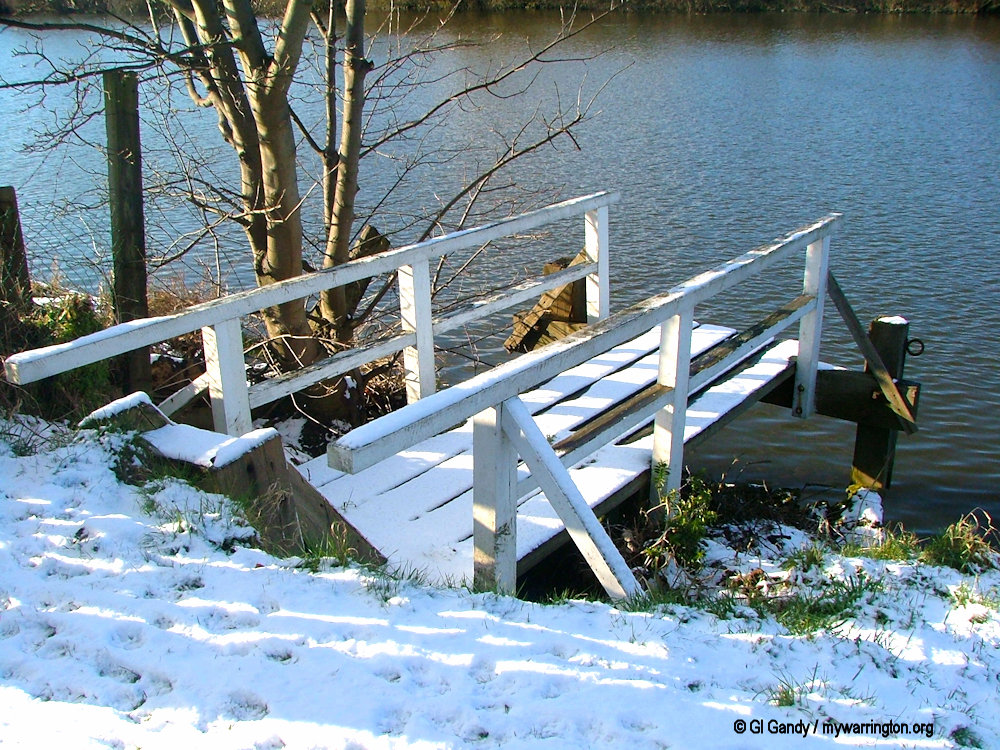
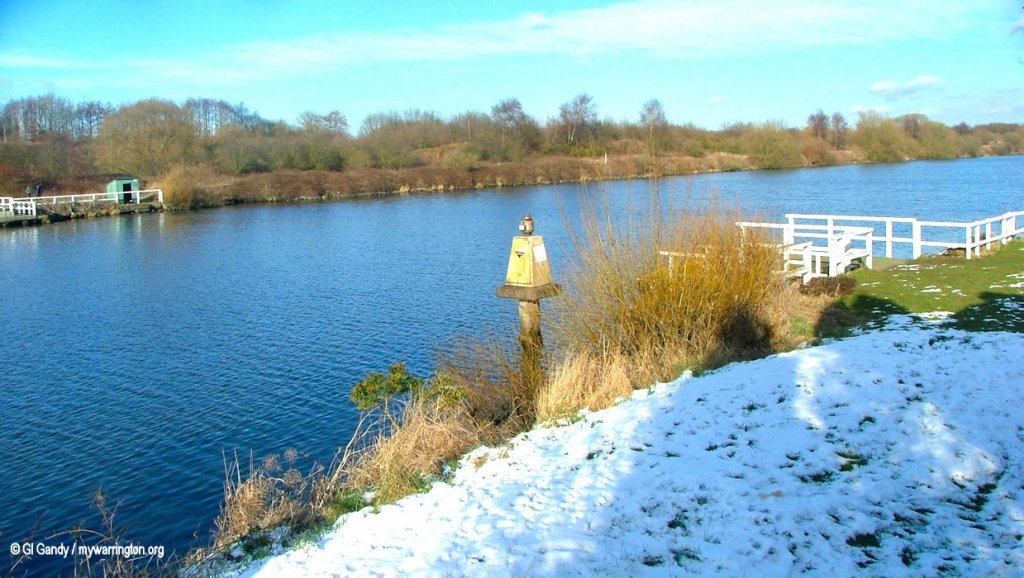
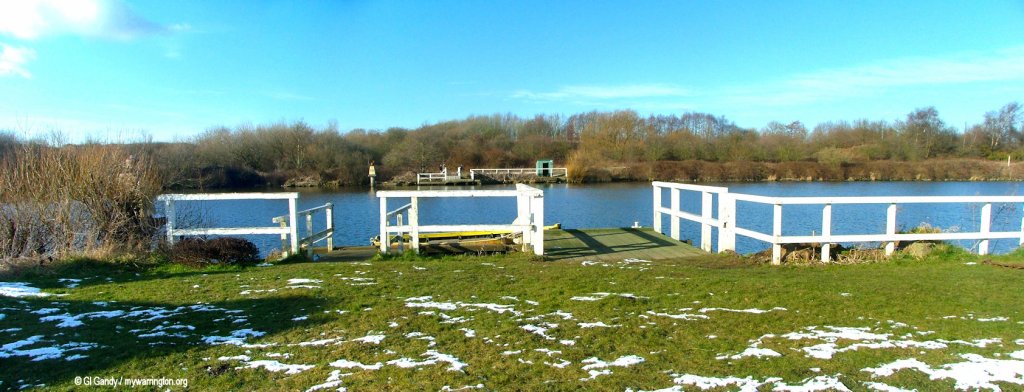
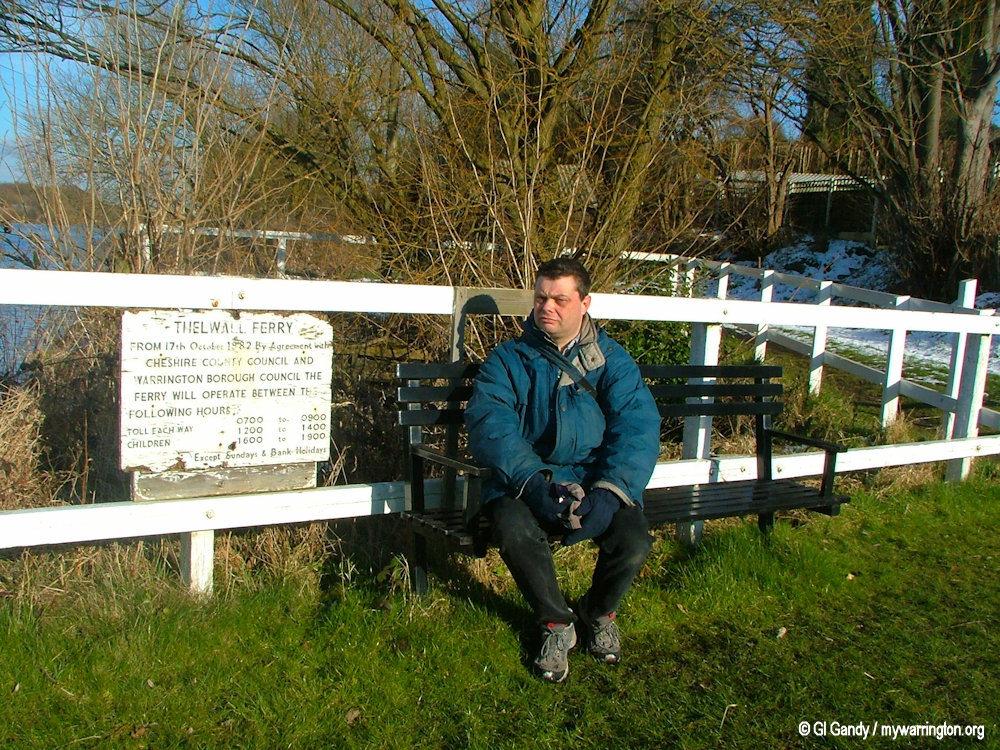
- Thelwall Ferry
- Thelwall Viaduct
- Thelwall Morris Men
- The Bridgewater Players
- Thelwall Rose Queen
- A Final Walkabout
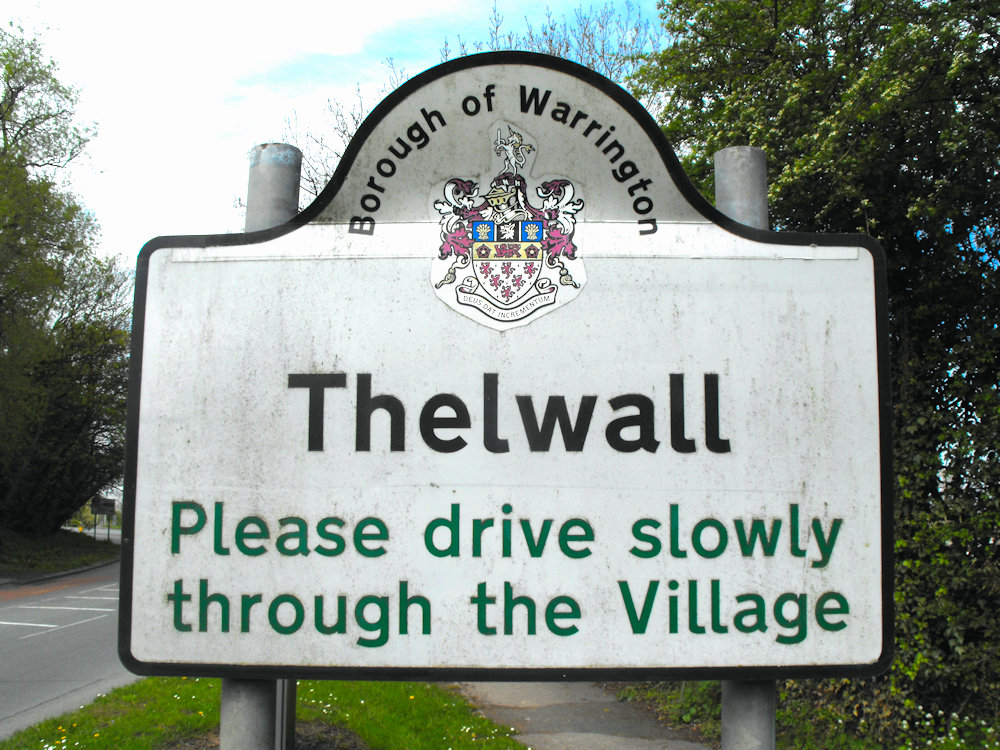
Introduction
In 1870-72, John Marius Wilson’s Imperial Gazetteer of England and Wales described Thelwall like this:
THELWALL, a township-chapelry, with a village, in Runcorn parish, Cheshire; on the river Mersey, the Bridgewater canal, and the Manchester, Lymm, and Warrington railway, 3 miles E by S of Warrington. It has a post-office under Warrington, and a r. station. Acres, 1,417. Real property, £3,766. …
Pop. in 1851, 347; in 1861, 468 Houses, 81. The manor belongs to the Marquis of Cholmondeley. T. Hall is the seat of J. Nicholson, Esq. The living is a p. curacy in the diocese of Chester. Value, £150.* Patron, J. Nicholson, Esq. The church was built in 1842, and is in the early English style. There is a national school.
GB Historical GIS / University of Portsmouth, History of Thelwall, in Warrington and Cheshire | Map and description, A Vision of Britain through Time.
URL: http://www.visionofbritain.org.uk/place/5920
Date accessed: 14th September 2025
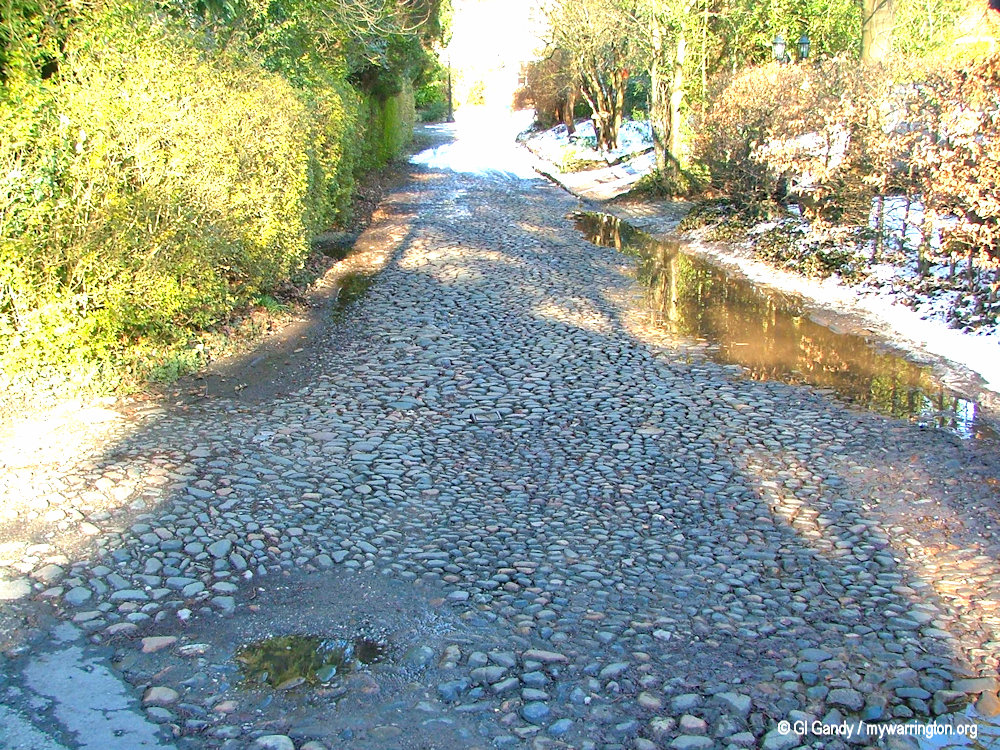
Ferry Lane leads to the Penny Ferry (4 Mar 2006)
History
I am grateful to Cheshire County Council for permission to use extracts from their joint report with English Heritage, CHESHIRE HISTORIC TOWNS SURVEY – Thelwall – Archaeological Assessment, (CHTS-T) which has been incorporated into my other research.
Thelwall is a small suburban village in south Warrington, between Lymm and Grappenhall. It is also one of the two principal settlements of Grappenhall and Thelwall civil parish.
Roger de Poictu, or Poitou, (son of Roger de Montgomery, the first earl of Shrewsbury), was lord of all the land between the rivers Ribble and Mersey, and he gave half of the fishing at Thelwall, on the north side of the Mersey, to the Abbot of Shrewsbury under Henry I.
Thelwall is first recorded in the Anglo Saxon Chronicle of AD 919 as Thealwaele or Thelwæl, which translates as ‘deep pool at a plank’ or perhaps as ‘pool with a plank bridge’ (Dodgson 1970, 138). (CHTS-T). However, according to Sir Peter Leycester it was “so called from the stakes and stumps, cut from the trees, wherewith it was environed about as a wall”. The general consensus though is that it is more likely that the original meaning of Thelwall was “pool by a plank bridge”.
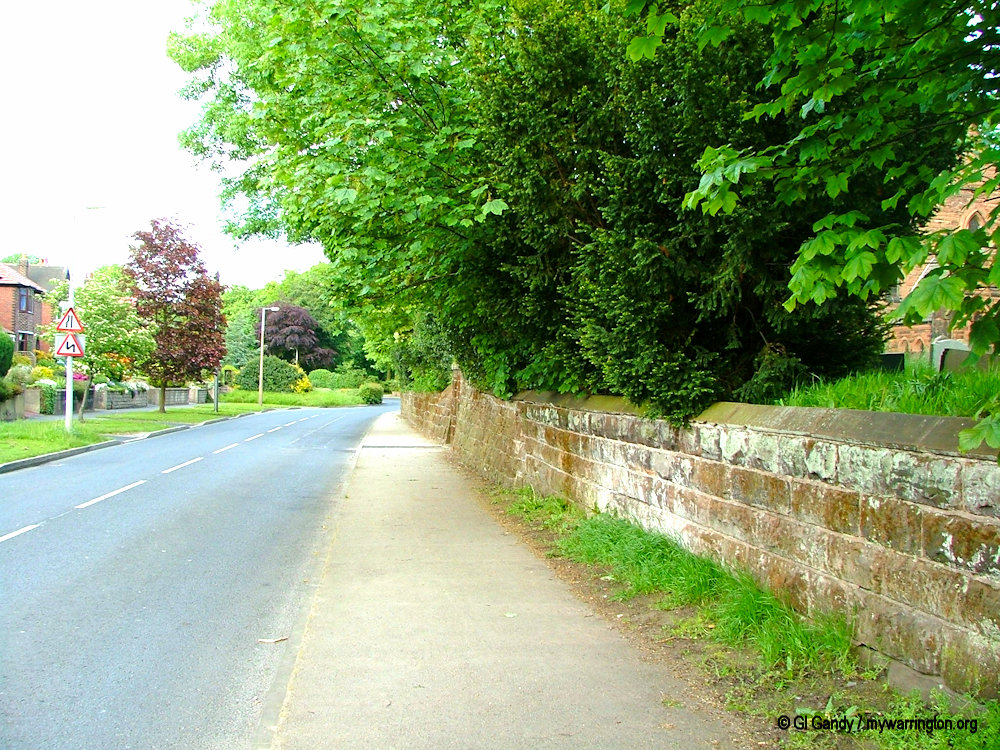
Thelwall New Road (18 May 2004)
Dodgson goes on to suggests that the deep pool referred to may have been located in the River Mersey and that the burh was presumably established here to guard its crossing. Thelwall also occurs in the historical record as Thelwella (1154-60), Thidewell (1240), Thelewell (1241) Thelowell (1304), and Tolwell (1487) (ibid). Thelwall is marked on the early county maps of Saxton (1577) and Speed (1610) as ‘Thelwall Chapelry’. It is also depicted upon Burdett’s map of 1777 (CHTS-T).
In a companion document, CHESHIRE HISTORIC TOWNS SURVEY – Warrington – Archaeological Assessment (CHTS-W), it has been suggested that the Saxon burh founded at Thelwall in AD 919 may have been located at Latchford. The name Latchford means ‘a ford at a boggy place’, which may refer to the ford site in the vicinity of Victoria Park, and Hill has suggested that the burh may have been located here (Hill 1976).
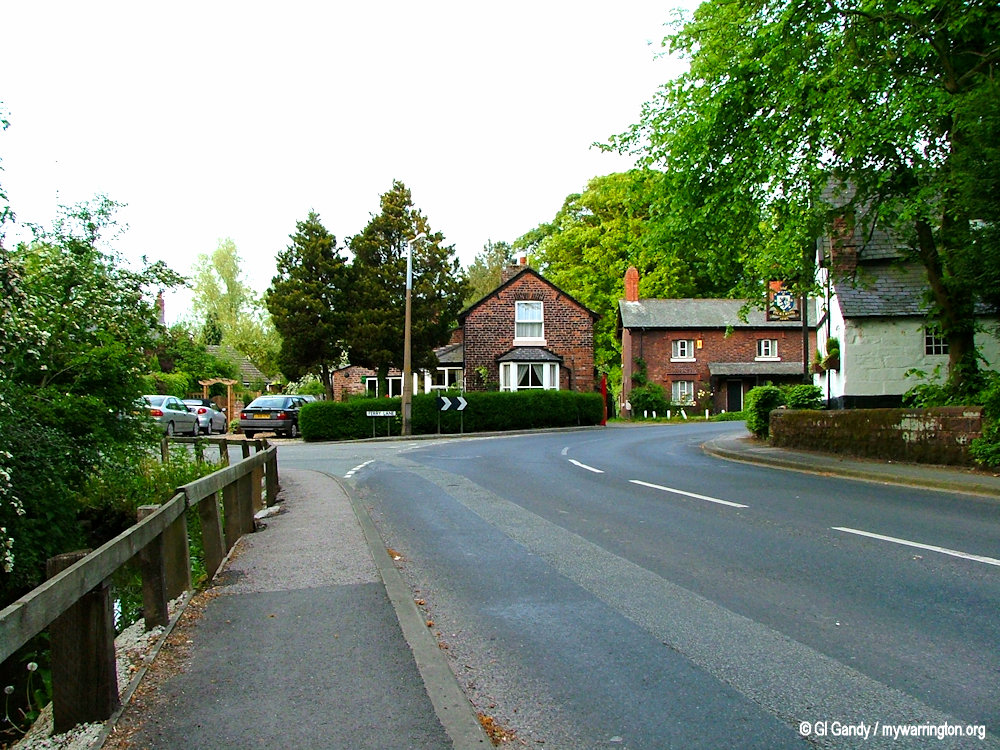
Thelwall New Road (18 May 2004)
However, Higham (1988) has suggested that, until the creation of the Manchester Ship Canal, this area was low-lying and boggy and therefore an unsuitable location for the burh.
However, Old Warps Farm [the location of Victoria Park and Spirit Restaurant in Latchford] formerly lay in this area and the place name ‘warp’ indicates an area of land built up by the deposition of silt, which suggests that this area was not so uninhabitable as Higham suggests.
Very little detail is known about this potential burh, which was no doubt constructed to defend the Mercian boundary from Viking incursion, but its potential location at Latchford is supported by the fact that this area formed a detached part of Thelwall, and Runcorn Parish in the 19th century. (CHTS-W)
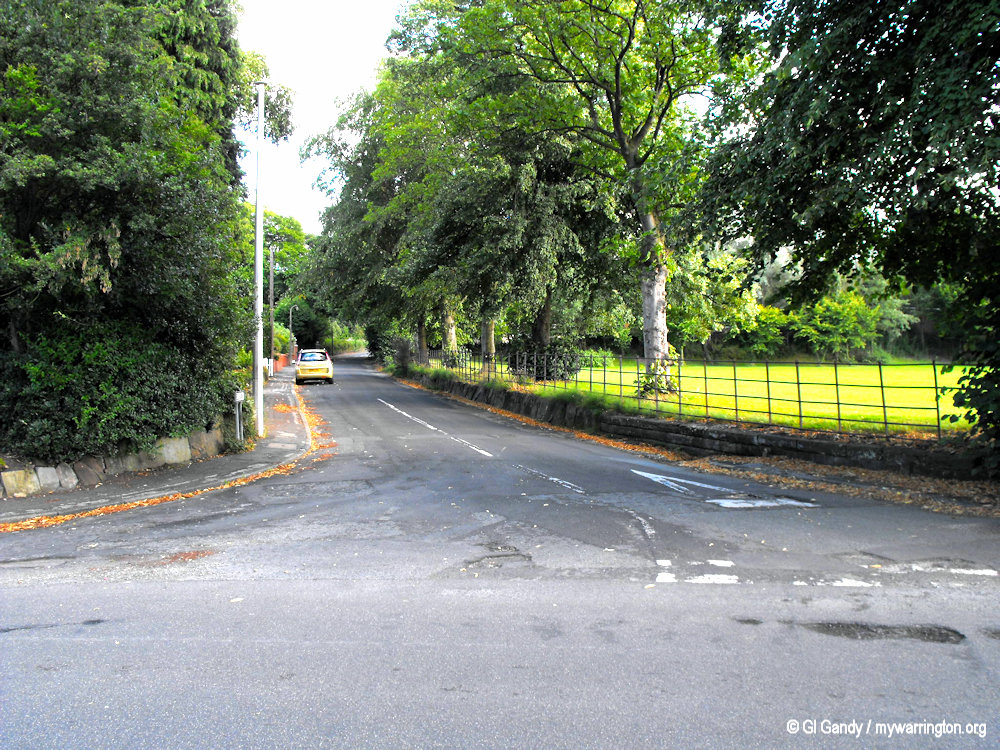
Bell Lane, Thelwall (18 Aug 2010)
Back to the CHTS-T and we see that this is one of three possible locations for the burh, which has not been located.
For the first location, Carter in A History of Latchford From the Bronze Age to the Twentieth Century has suggested that the burh was not located within the area of the village of Thelwall but in what was a detached part of Thelwall, situated in the ‘loops’ or ‘eyes’ of the River Mersey. One such loop, which would have provided an effective defensive site and was also the site of a ford across the Mersey, was Latchford. This area is on the southern edge of Victoria Park and the later Black Bear Park.
A second location to the south of Thelwall village on a ‘small promontory between two valleys lying to the east of the village’ has been suggested by Hill. This site would have the same advantages and disadvantages as the village site
A third possible location for the burh: earthworks have been noted in the grounds of Chaigeley school to the north of Lymm Road (OS Record Card SJ68NE6). These remains are an English Heritage National Monument. The school, an early 19th century mansion, was formerly called Greenfield House, which was described in the 1845 tithe award as having ‘gardens’ and ‘pleasure grounds’ (CHTS-T).
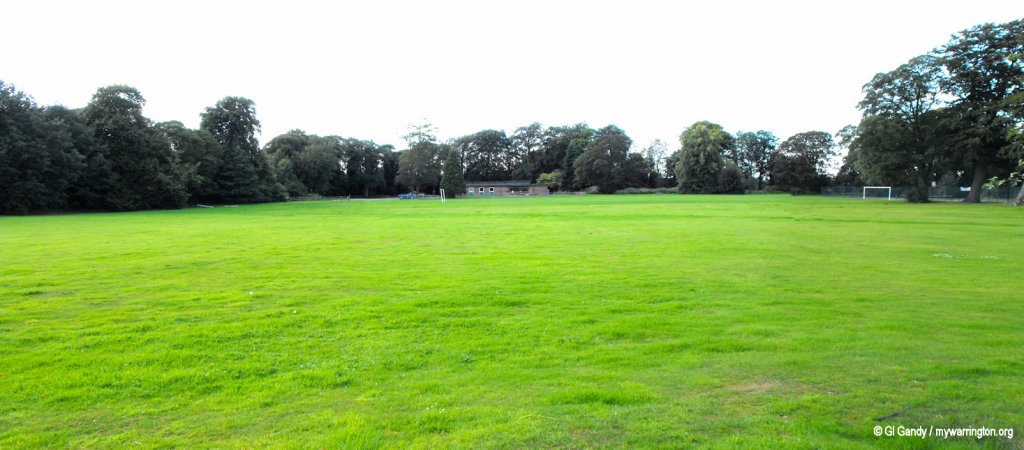
Chaigeley School
Chaigeley School is a Non-maintained Special School, established in 1946, that caters for young people between the ages of 8 and 16 who have social, emotional and mental health difficulties.
When Chaigeley Manor was required by its owner at the close of the war, a new location was found in Thelwall in 1946, where the school resides today (formerly Greenfield’s House) as it was felt that this useful provision for children with emotional and behavioural difficulties should continue, not purely as war relief but on a more permanent basis.
https://chaigeley.org.uk/our-history/ (Photo 18 Aug 2010)
There are two prehistoric findspots at Thelwall, a Neolithic stone axe found near Beech Farm, south of Lymm Road and just to the west of this a Bronze Age metal axe. In the wider area, a concentration of prehistoric sites and finds are located c 1.5km to the south-west in the Chester Road area. These include an early Bronze Age metal axe, a Bronze Age vessel, prehistoric flints and two Bronze Age round barrows.
The area around Thelwall appears to have been of importance since at least Neolithic times and the discovery of stone and metal axes would suggest a nearby trade route, presumably across the Mersey.
The village of Thelwall is a designated Conservation Area and there are twelve listed buildings within Thelwall village, all of which are listed Grade II, including the church of All Saints and Thelwall Old Hall.
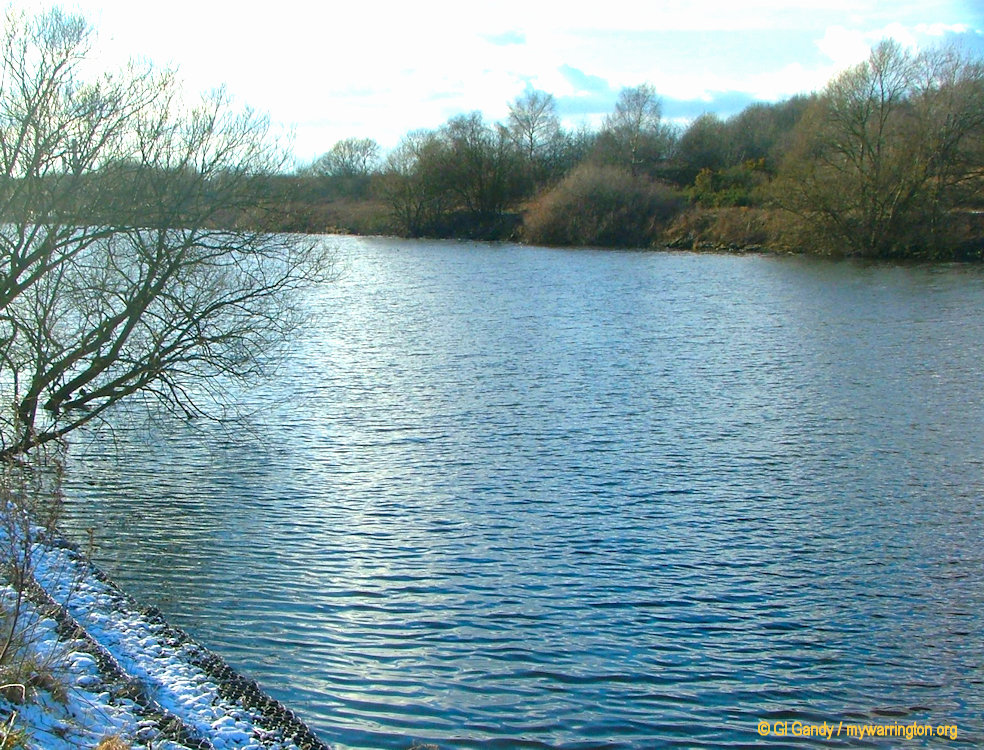
Manchester Ship Canal at Thelwall on 4 March 2006
The political scene is governed by Grappenhall and Thelwall Parish Council (consisting of sixteen elected officials) and Warrington Borough Council (with three representatives of the parish council). The village is part of the Warrington South constituency for parliamentary purposes.
Thelwall Railway Station
At one time Thelwall had its own railway station on the Warrington and Altrincham Junction Railway (W&AJR) that was in operation from 1 November 1853 to 7 July 1985. On 4 August 1853 the W&AJR changed its name to the Warrington and Stockport Railway (W&SR).
It was known locally as the Bank Quay Low Level Line because it ran under the north-south LNWR line at Bank Quay station and had its own platforms.
Read more about the line in Making Tracks. Also in Making Tracks is an extended report on the line by website contributor Bert Harris. Click here for his section.
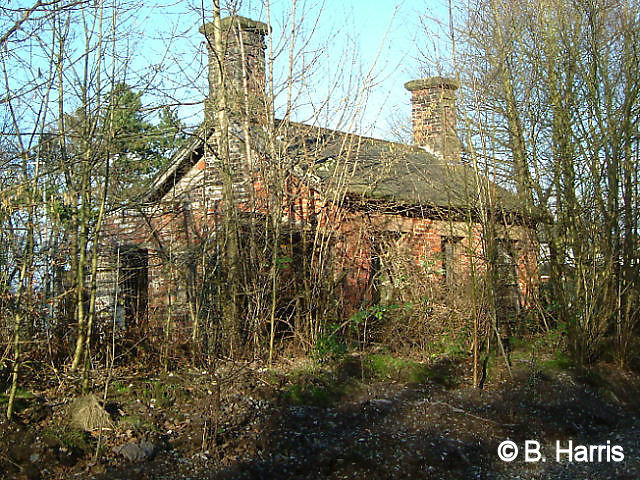
Thelwall Station building in 2001 when it was 135 years old. Photo © Bert Harris.
The Pickering Arms
An inscription on the Pickering Arms recorded that “In the year 920 King Edward the Elder founded a city here and called it Thelwall”. And no, I haven’t made a typo regarding the date of 920. According to Michael Taylor’s book No Mean City – A Local History of Thelwall in Cheshire (published by Marlston Books, Chester in 2010), when planning was underway in 1920 to celebrate Thelwall’s millennium, the date was changed to ‘923’, as can be seen today.
The reason was because it was felt there would not have been enough time after the end of the First World War in 1918 to make preparations. Taylor’s book also includes a photo of the Pickering Arms pub showing the inscription with the date of 920. Taylor also says in his book (p11) ‘It is now reckoned that the year was 919; this fits better with other events in the Chronicle’.
The pub itself is a 17th century Grade II Listed building that is timber-framed with brick infill, and with extensions in brick and sandstone. It has a T-shaped plan and is in two storeys. The windows are casements. It received its listing status on 20 October 1952. Read more at Historic England.
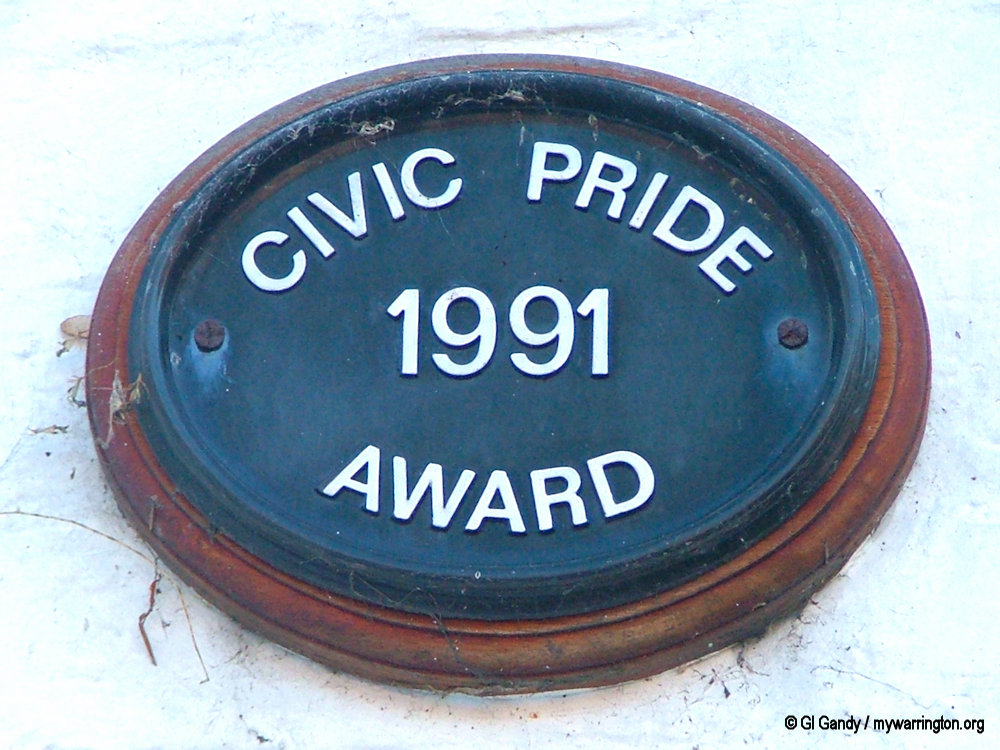
The building won a Civic Pride award in 1991. The pub is named after the Pickering Family. The Pickering’s Arms continues to use the family’s rampant blue lion crest in its branding.
Some information from Wikipedia.
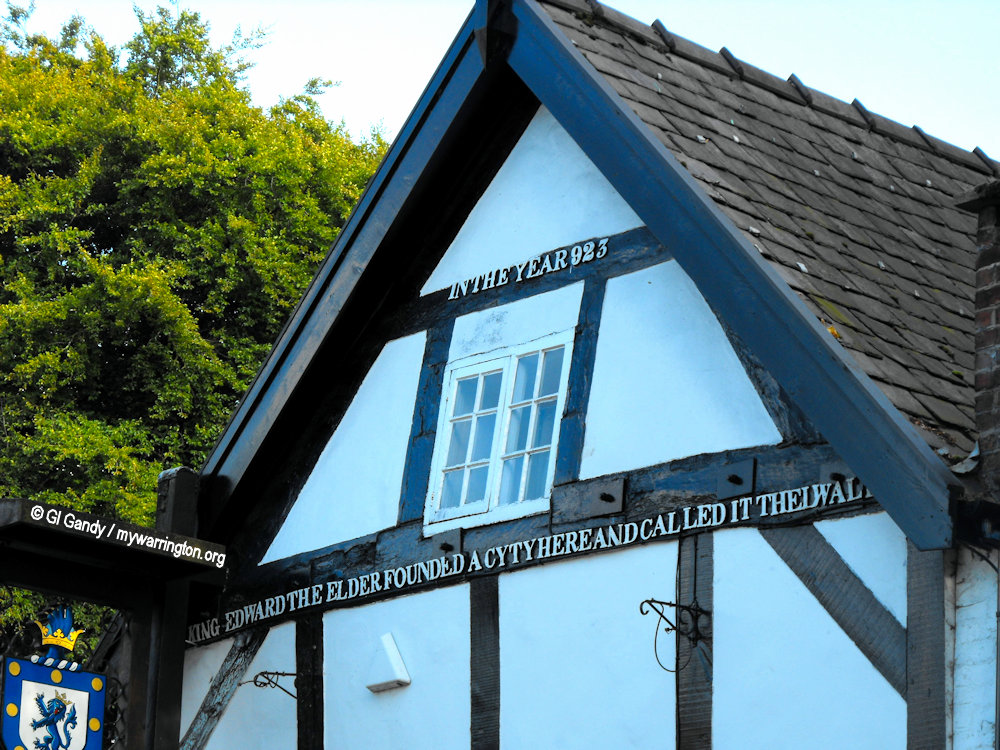
The inscription on the Pickering Arms today. (18 Aug 2010)
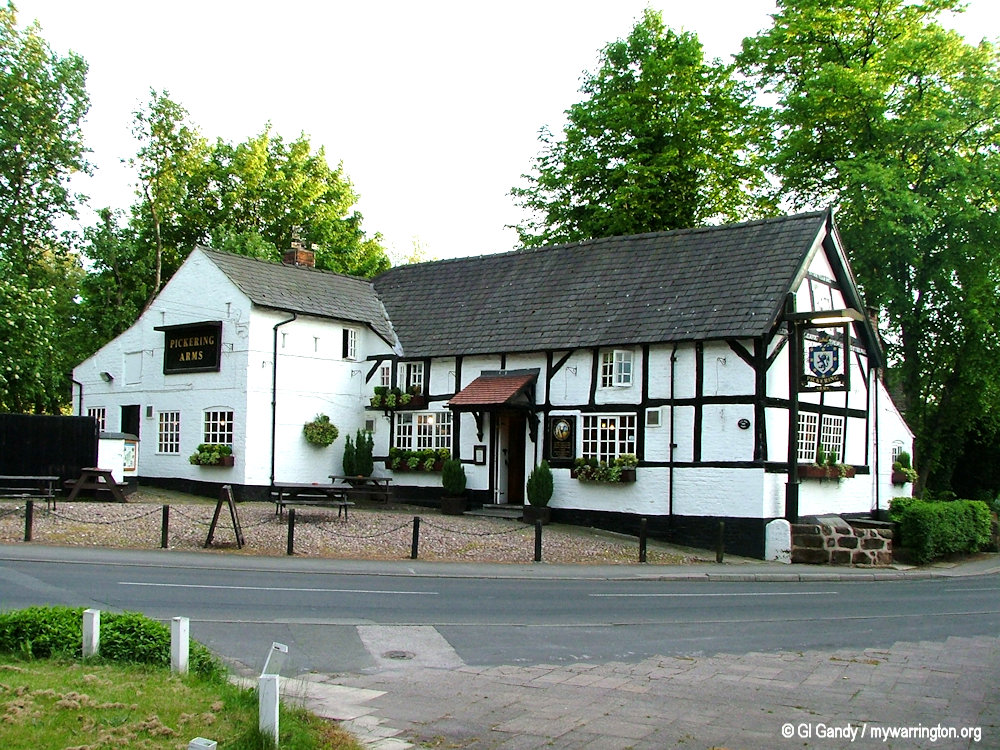
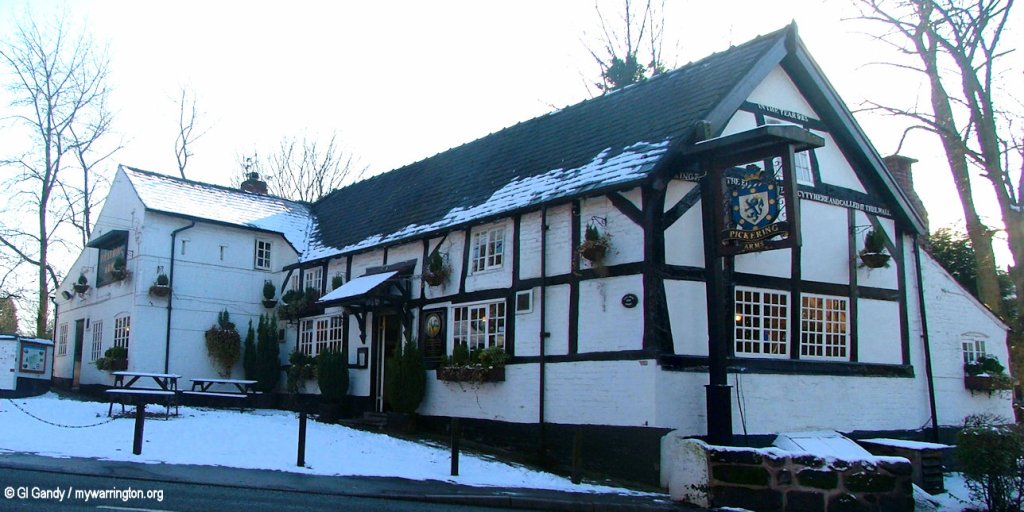
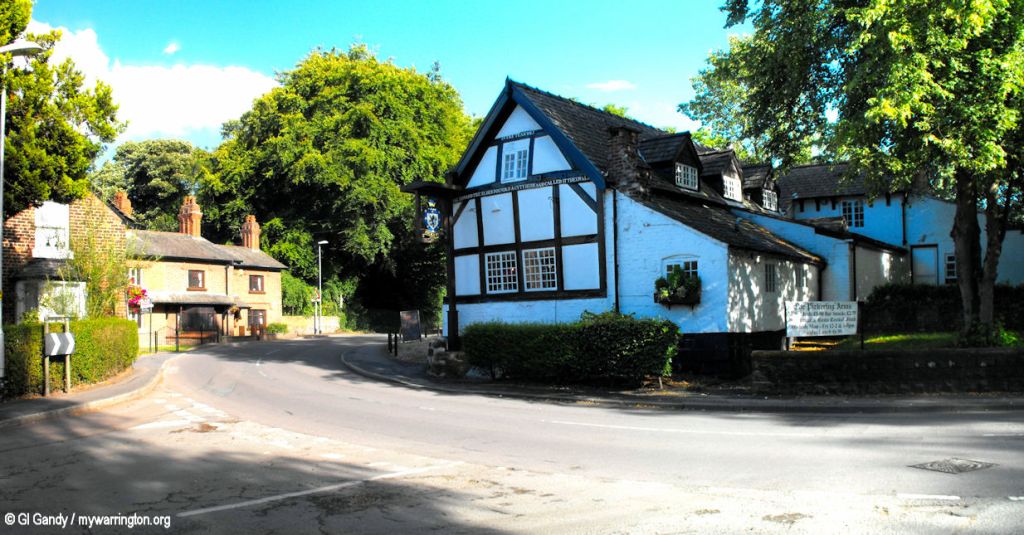
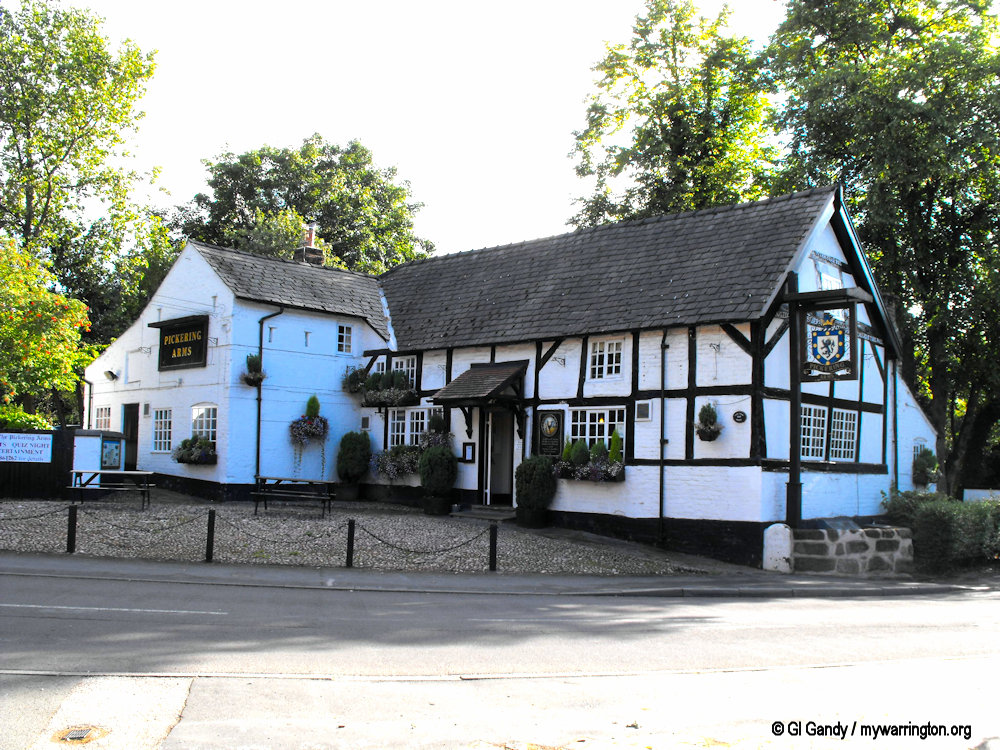
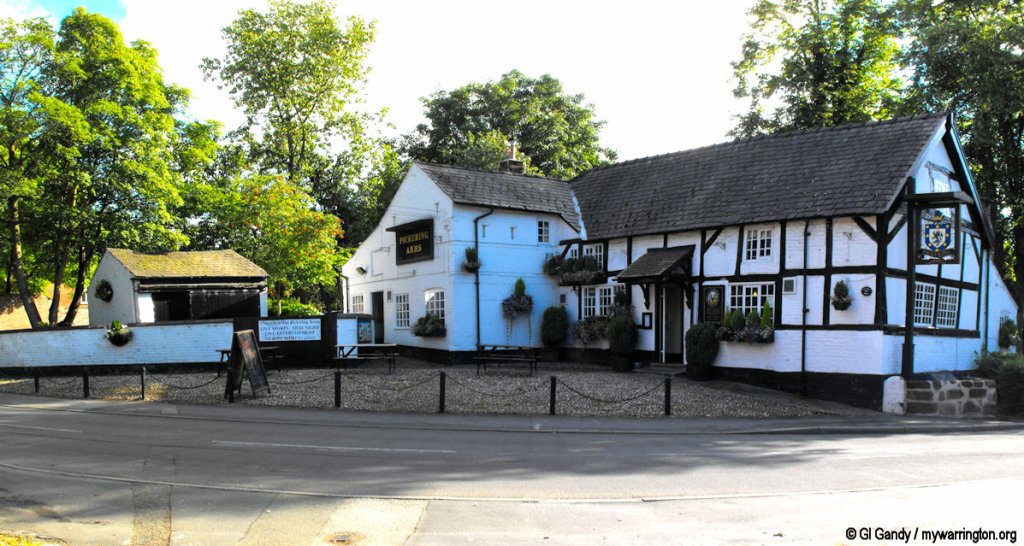
Views of the Pickering Arms
The Pickering Family
The Pickering family were significant landowners and barristers who became lords of the manor of Thelwall in the 17th century when Robert Pickering purchased the estate in 1662.
While Robert’s son John faced imprisonment for debt, his grandson Thomas, a successful industrialist, built the new Georgian Thelwall Hall in the mid-1750s before the family fortune declined, leading to the estate’s sale in the 19th century.
The family’s blue lion crest is still displayed at Thelwall’s Pickering’s Arms pub, which is named after them. Pickering Bridge over the Bridgewater Canal is also named after the family. Read more on the Thelwall Community website. See also the Pickering Family History website.
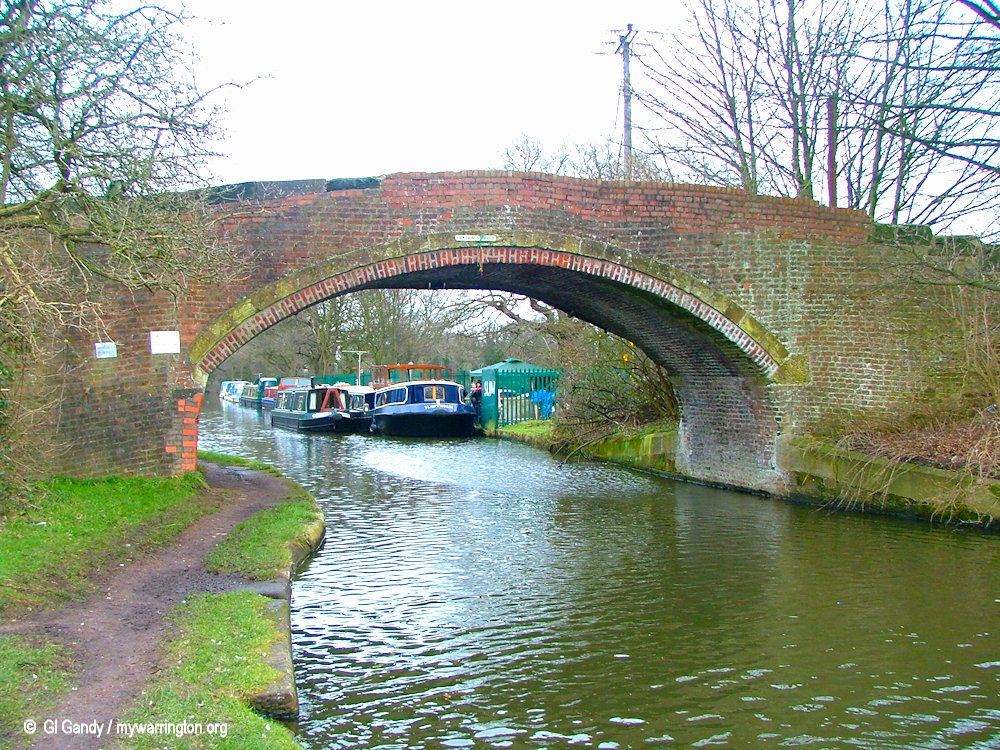
The Pickering’s Bridge over the Bridgewater Canal, named after the Pickering family (photo 27 January 2007).
All Saints Church
All Saints Church is recorded in the National Heritage List for England as a designated Grade II Listed Building. It is an active Anglican parish church in the diocese of Chester, the archdeaconry of Chester and the deanery of Great Budworth.
The origins of a church or chapel at Thelwall are unclear. It has been thought that a chapel was built by Richard Brooke of Norton Priory but a legal suit in 1663 suggests that there was a chapel on the site before this date. At this time Thelwall was in the parish of Runcorn. In 1663 the chapel on the site was restored by Robert Pickering. After this the chapel fell into disrepair. It was restored again and re-opened in 1782.
By the following century the church was too small for its congregation and in 1843 a new church was built and consecrated. This consisted of a nave which was designed by James Mountford Allen.
In 1856 the chancel was built at the expense of James Nicholson and the nave was extended by one bay. In 1890 Henry Stanton commissioned a new north aisle, a new baptistry with a new font, and a new vestry. The aisle and vestry, together with a north porch, were designed by William Owen.
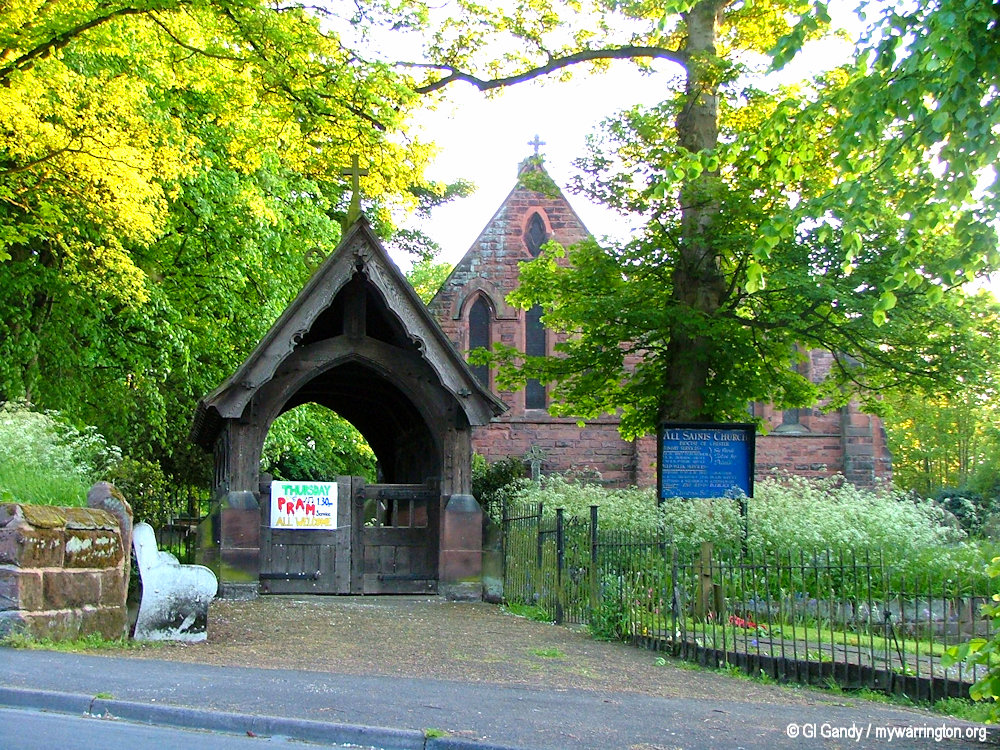
All Saints Church on Thelwall New Road on 18 May 2004.
Architecture
The church is built in sandstone with steeply pitched slate roofs. Its plan consists of a nave of six bays, a chancel of two bays, a north aisle and a west porch. A west bellcote has one bell.
The chancel has a floor of marble and coloured glazed tiles. The reredos has two panels of Biblical scenes in marble which are separated by plaster angels. In the church is a memorial to Edward the Elder who founded Thelwall in 919. This is dated 1907 and is by Eric Gill. The frame of the memorial is by F. C. Eden and Helfar Bros.
From around 1884 the organ used had been built by Gray and Davidson, and in 1964 it was rebuilt by Jardine. By the 21st century the electrical control system had deteriorated and this was replaced in 2005 by a solid-state system made by John Lifton.
The churchyard contains war graves of three soldiers from World War I.
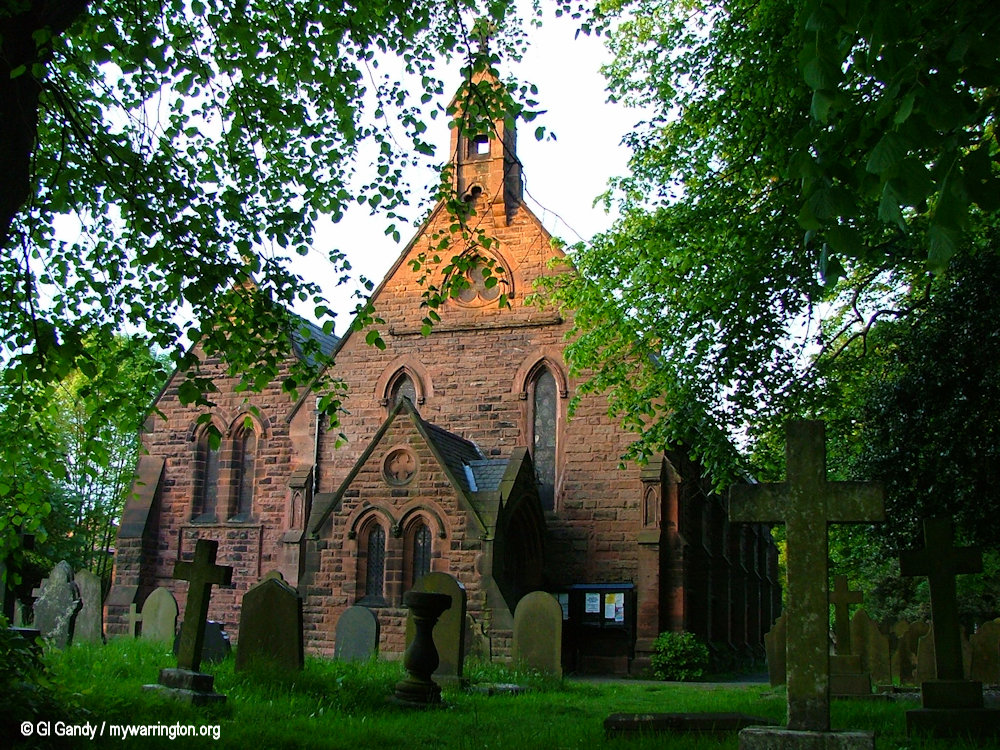
All Saints Church on Thelwall New Road on 18 May 2004.
Information: Wikipedia.
See the church website for more on its history.
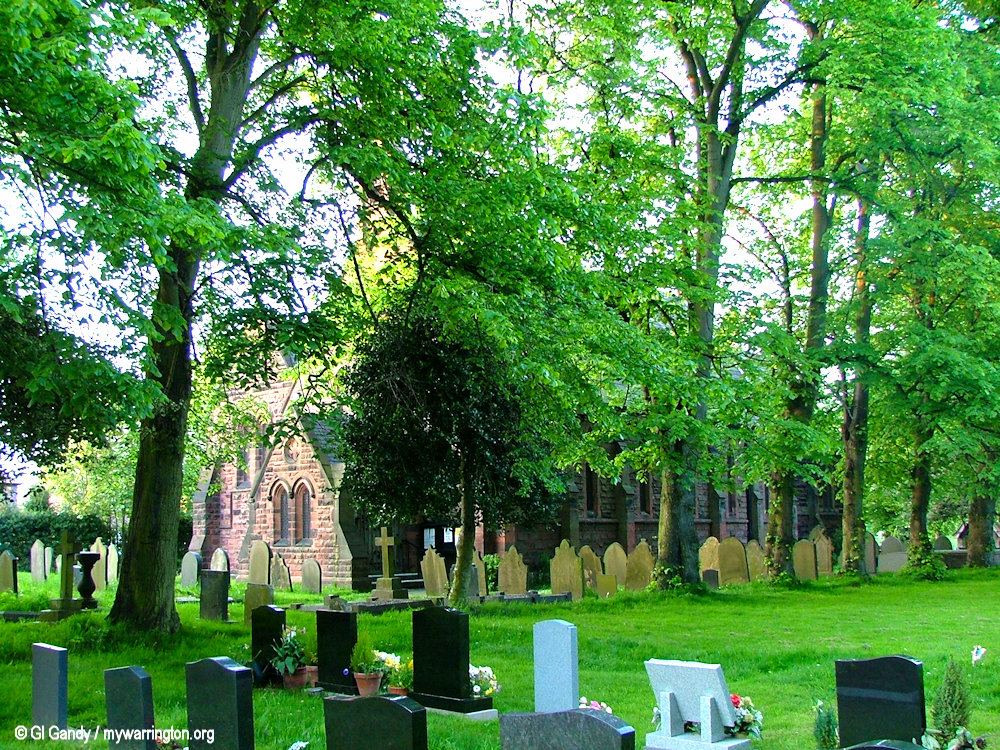
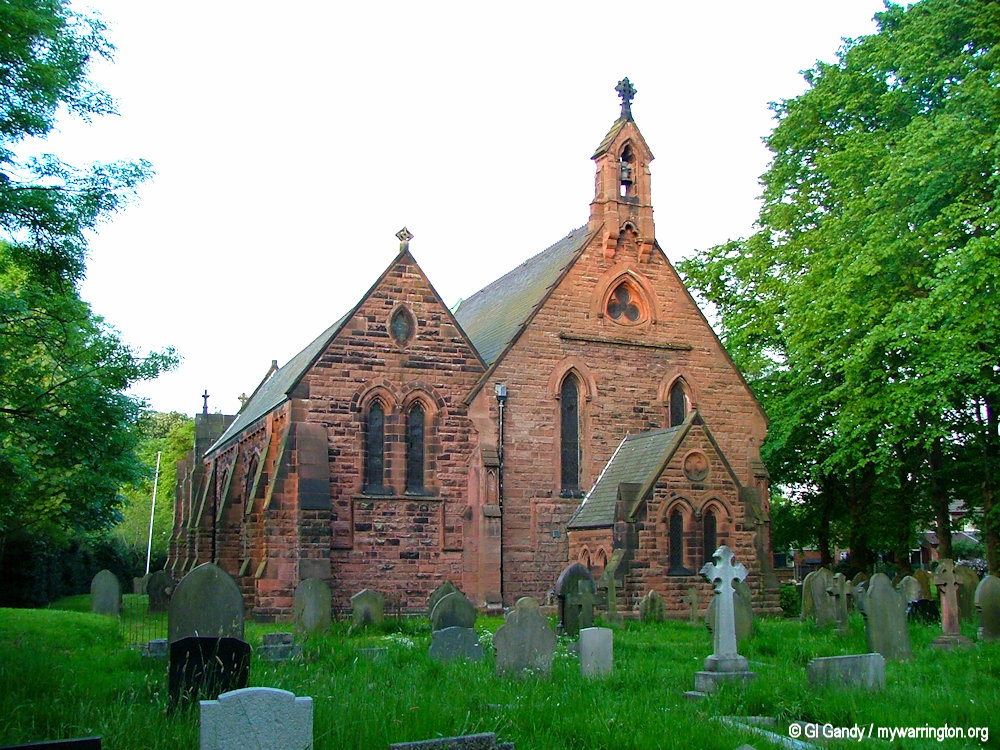
All Saints Church on Thelwall New Road on 18 May 2004.
School Life
The village of Thelwall contains two schools, Thelwall Infant School on Pelham Road and Thelwall Community Junior School on Thelwall Road, and is a satellite school that feeds Lymm High School, a nearby secondary education institute. There is a pre-school at Thelwall Parish Hall, and the Holyrood Nursery on Thelwall New Road.
Thelwall Old Hall
The Grade II Listed Building on Ferry Lane is said to date from the 17th century. It is made of sandstone, pebble-dashed at the front, with a gabled stone-slate roof. It features two storeys and five windows with a central two-storey porch and cross-wing to the right.
There are two mullioned windows to the upper storey left of the porch and over the porch are three windows; only the second from left retains small-pane casements. The lower windows left of the porch and all the windows right of the porch are altered with late 20th century wooden casements.
The door is made of five wedge-shaped oak boards on old wrought-iron hinges. The interior (not inspected) is stated to have some oak beams but no major features. It received its listing status on 8 January 1970. Information: Historic England.
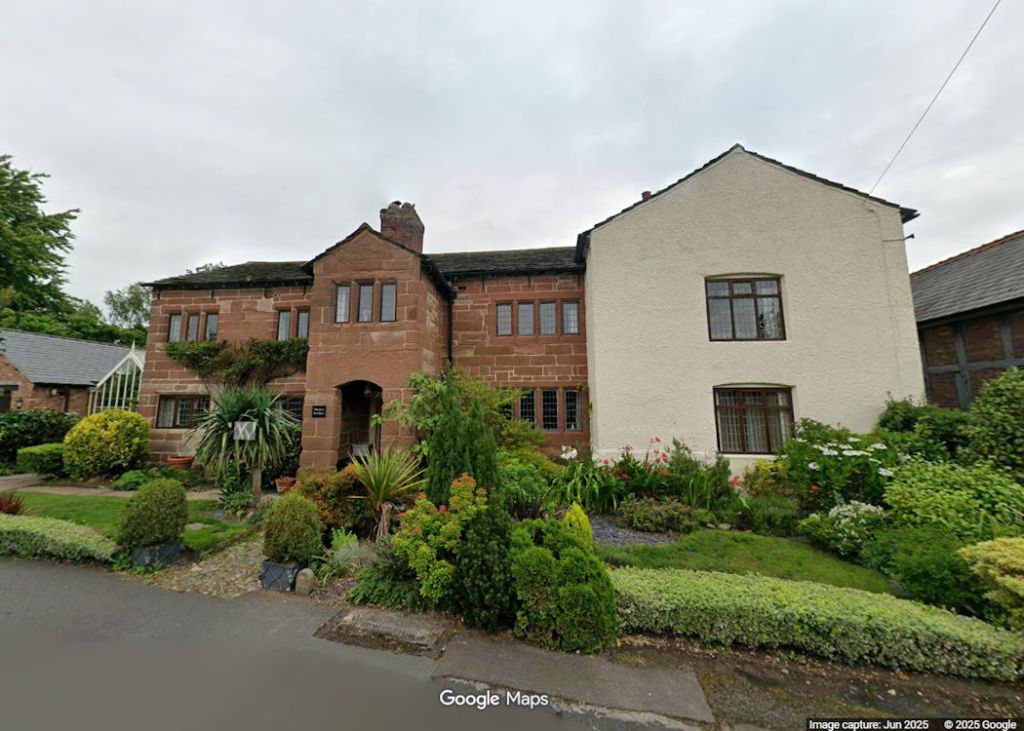
Thelwall Old Hall on Ferry Lane from Google Maps.
Thelwall War Memorial
The memorial on Lymm Road is a granite memorial commemorating the First World War.
It consists of a cross in Anglo-Saxon style set in a small garden.
It is carved with depictions of King Edward the Elder and angels.
It is Grade II Listed.
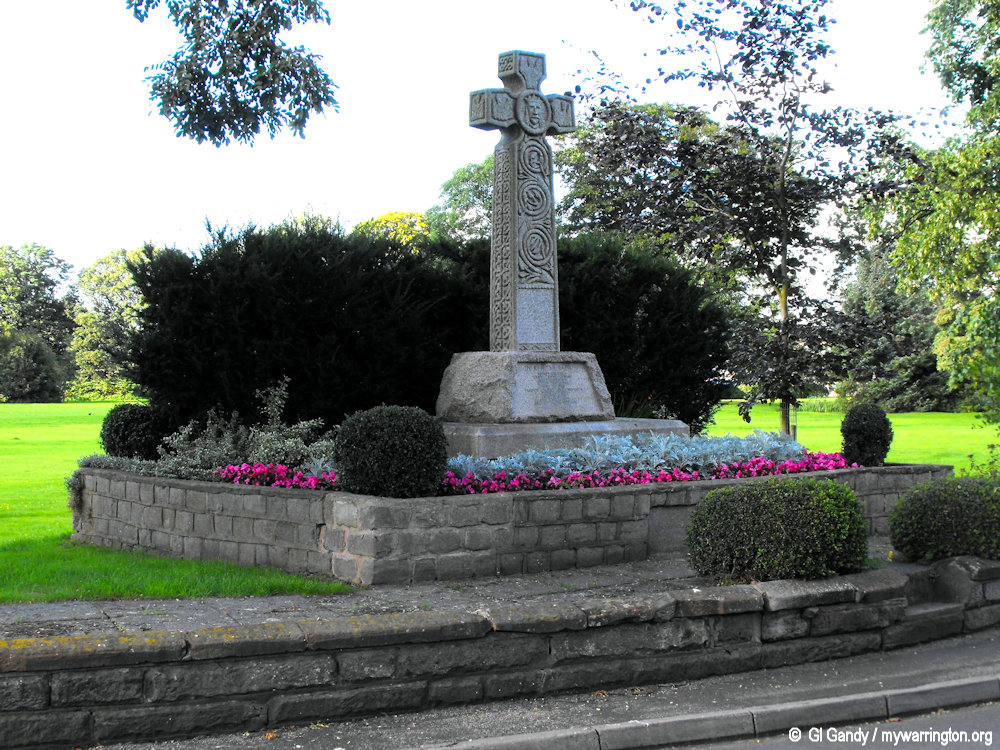
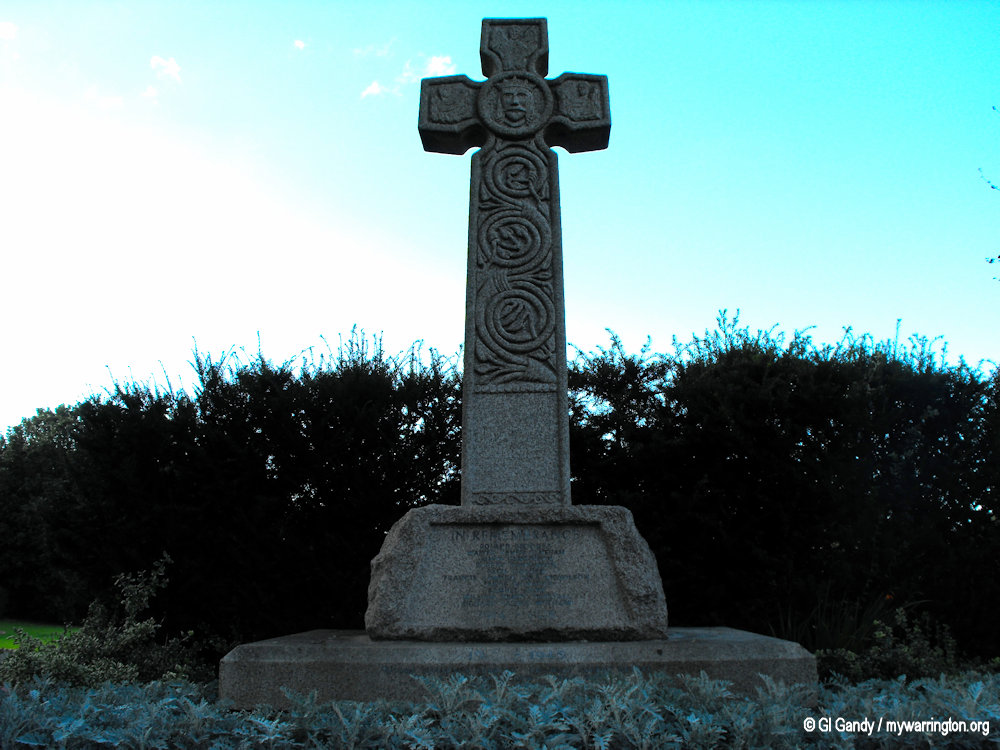
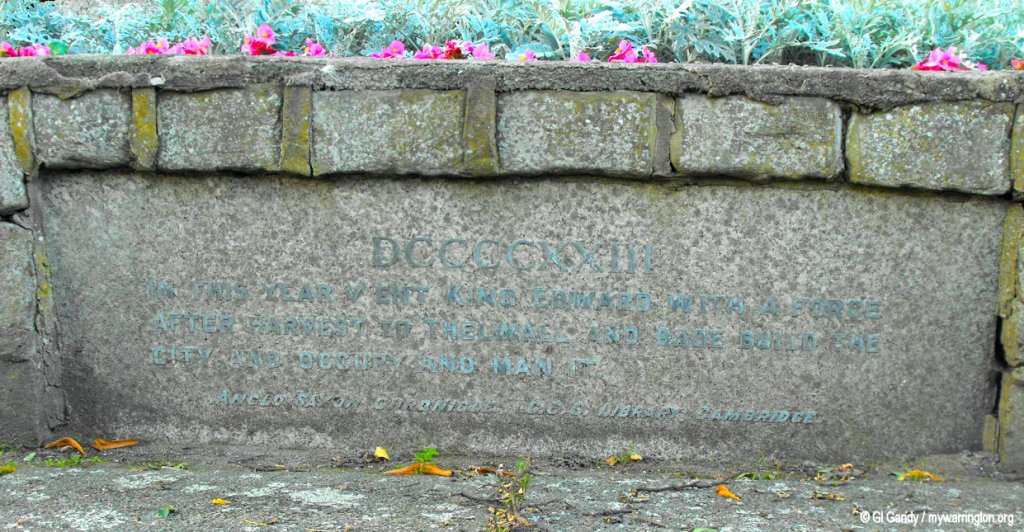
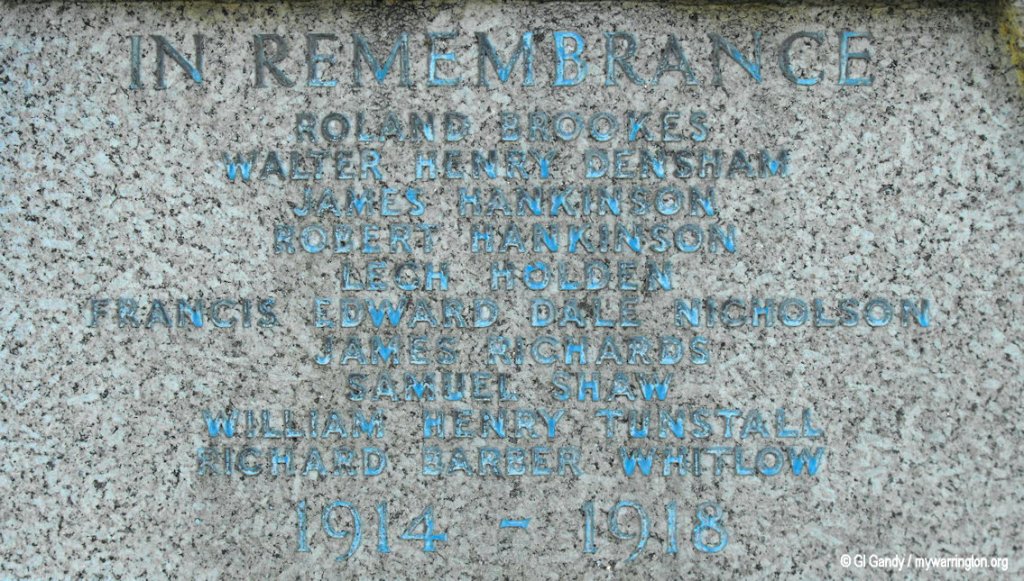
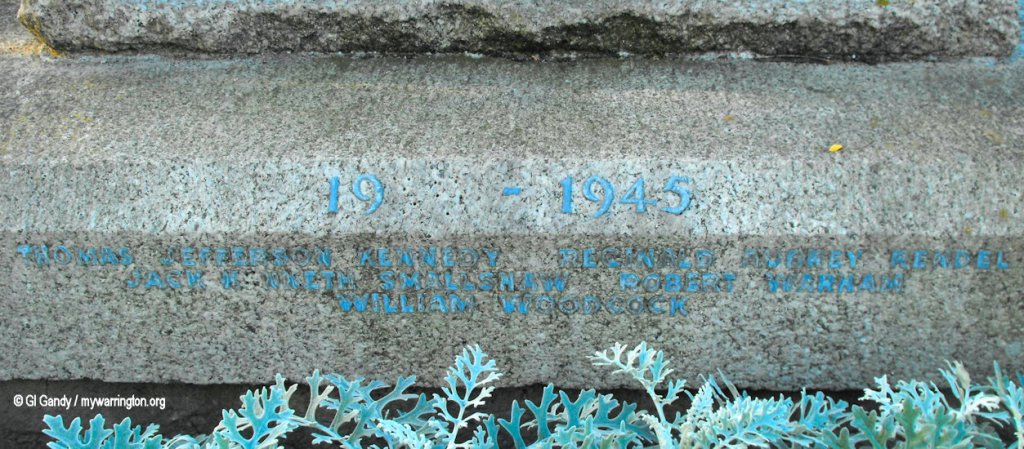
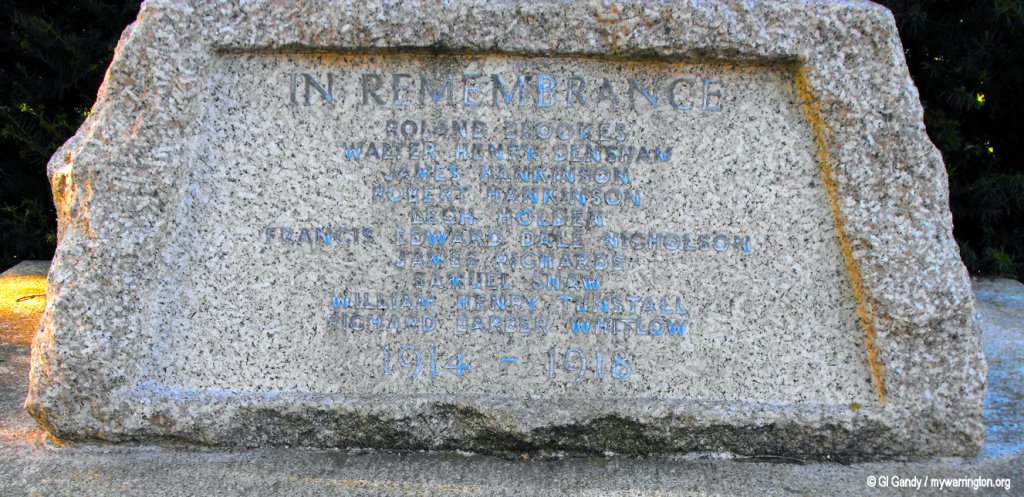
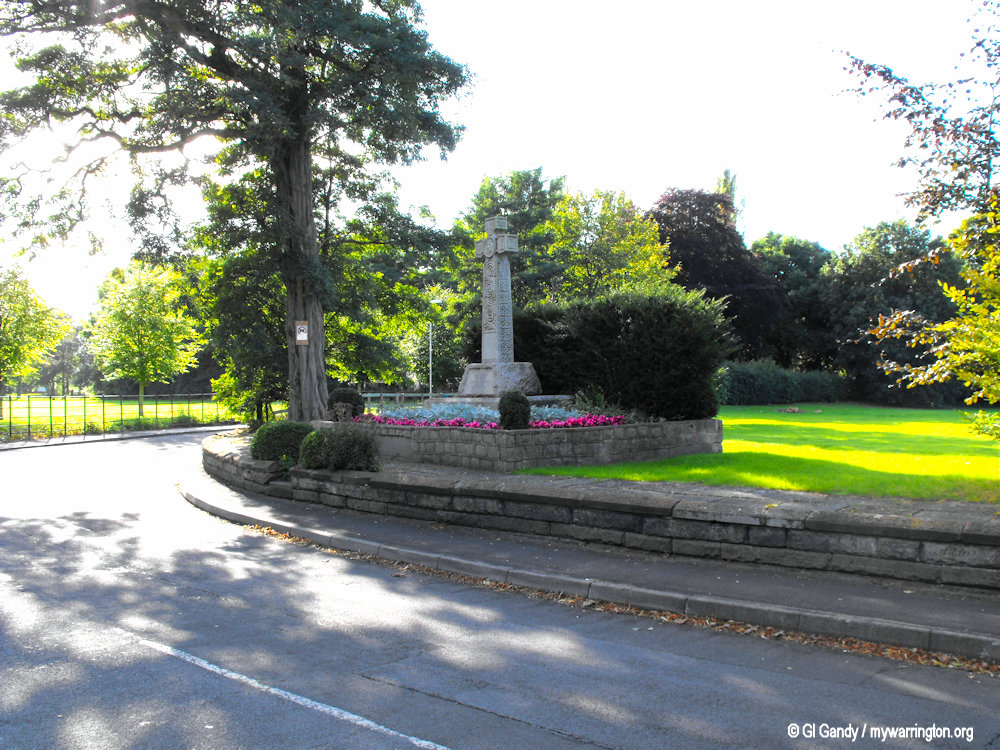
Thelwall War Memorial on Lymm Road (18 August 2010)
Post Office and Telephone Box
The village post office is on Barley Road, off Bell Lane, opposite the Pickering Arms pub. It has traded in the village for many years.
Outside is a Grade II Listed Building – the K6 telephone box. It was designed by Sir Giles Gilbert Scott in 1935 to commemorate the Silver Jubilee of King George V. It is made of cast iron and has a domed roof. Between 1936 and 1968, 60,000 examples of the K6 were installed. There are around 2,500 listings for the K6 kiosk in Great Britain and Northern Ireland. The Thelwall K6 received its listing status on 11 August 1987.
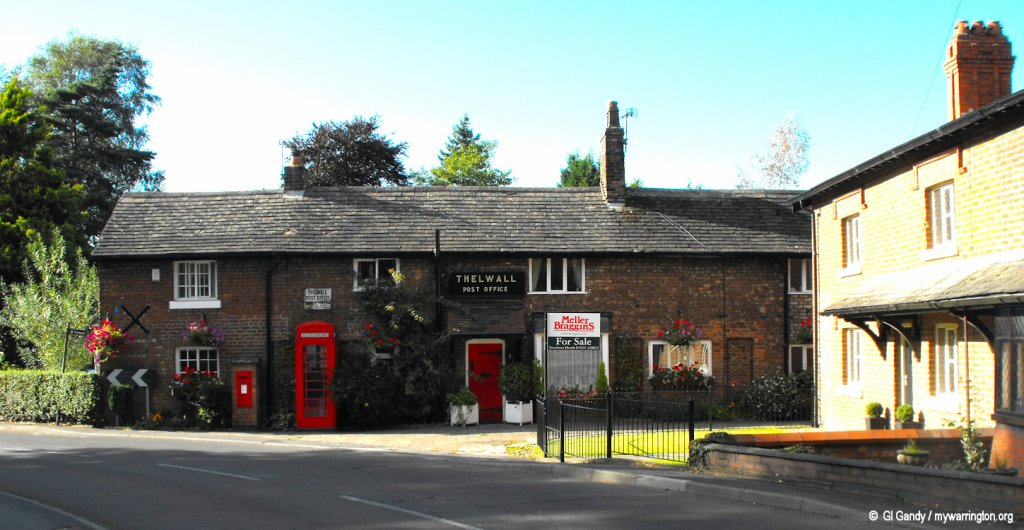
Thelwall post office and telephone box on 18 Aug 2010
Thelwall Ferry
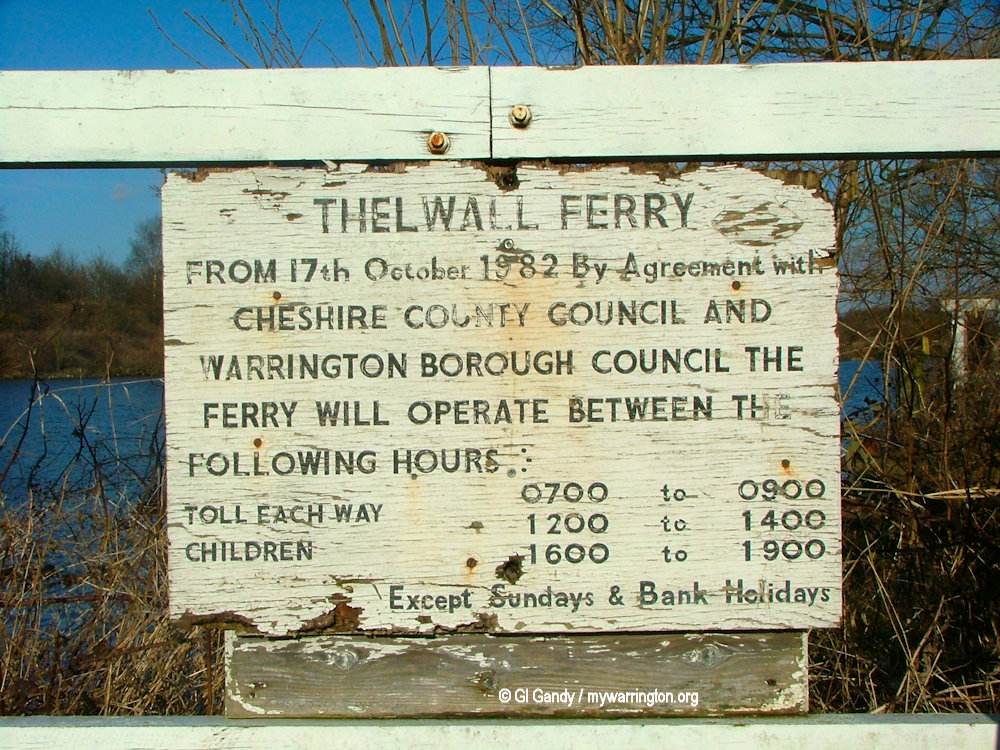
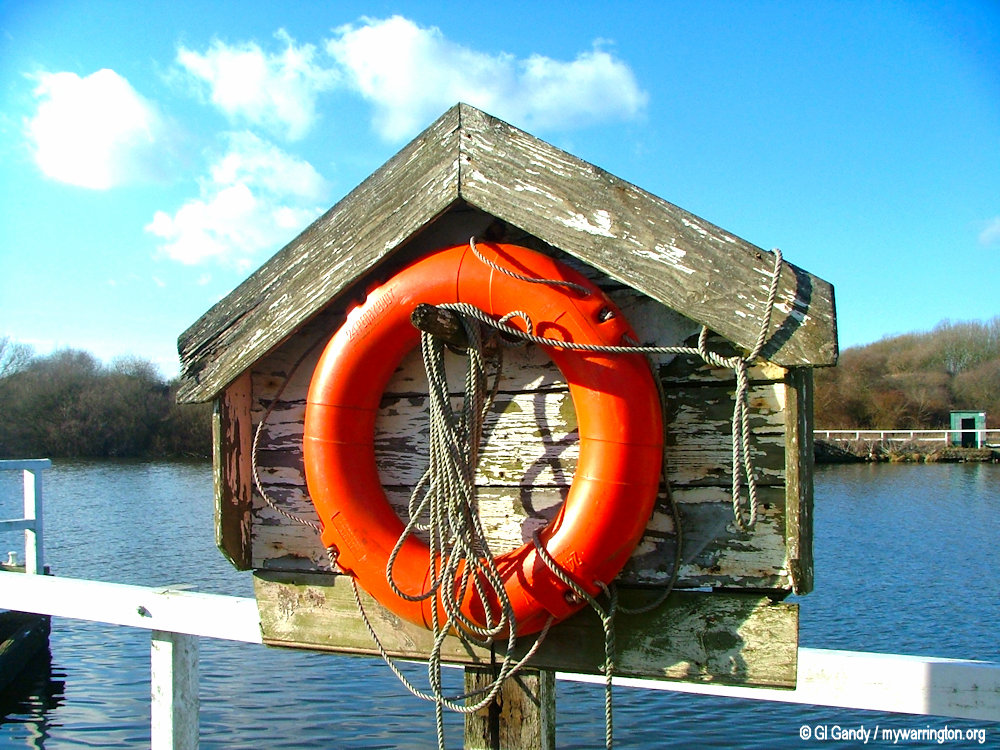
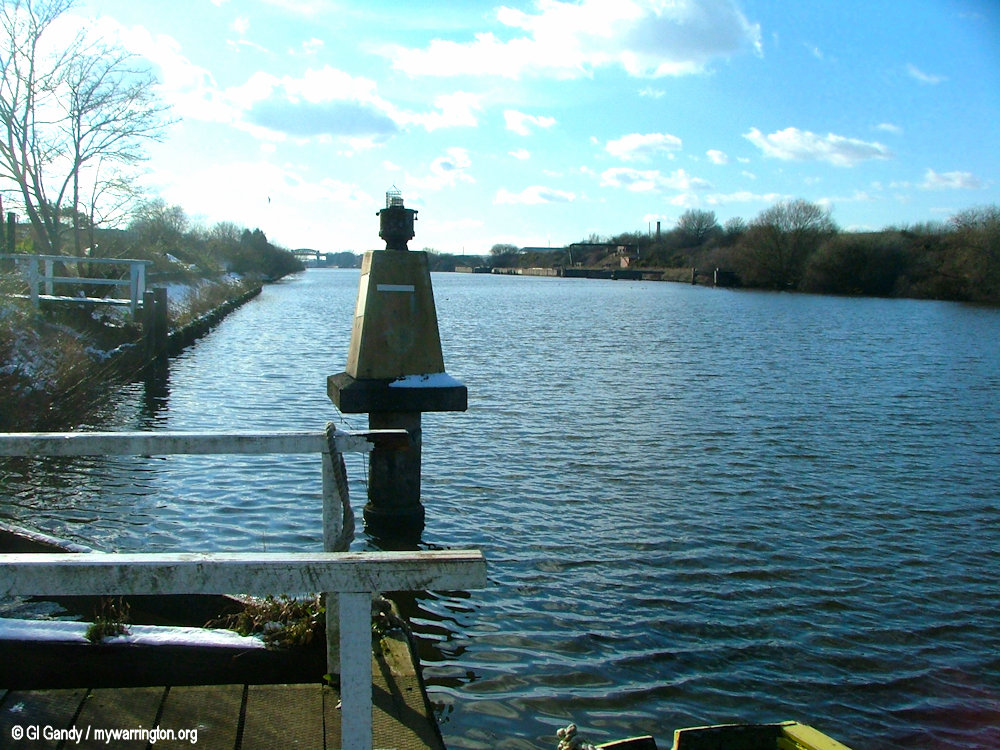
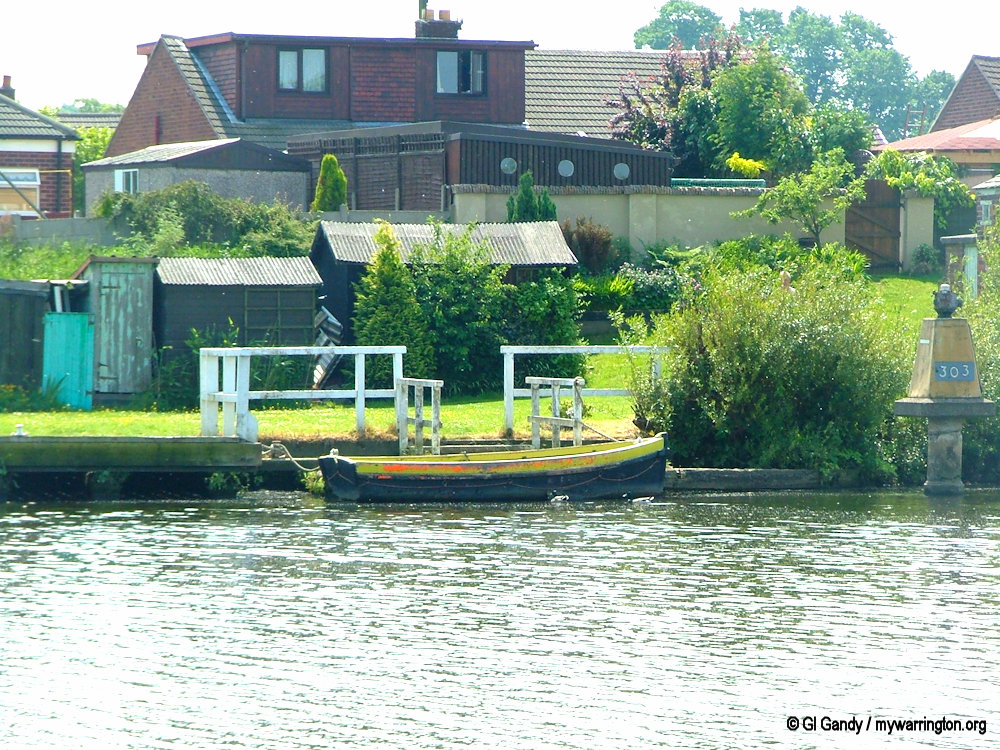
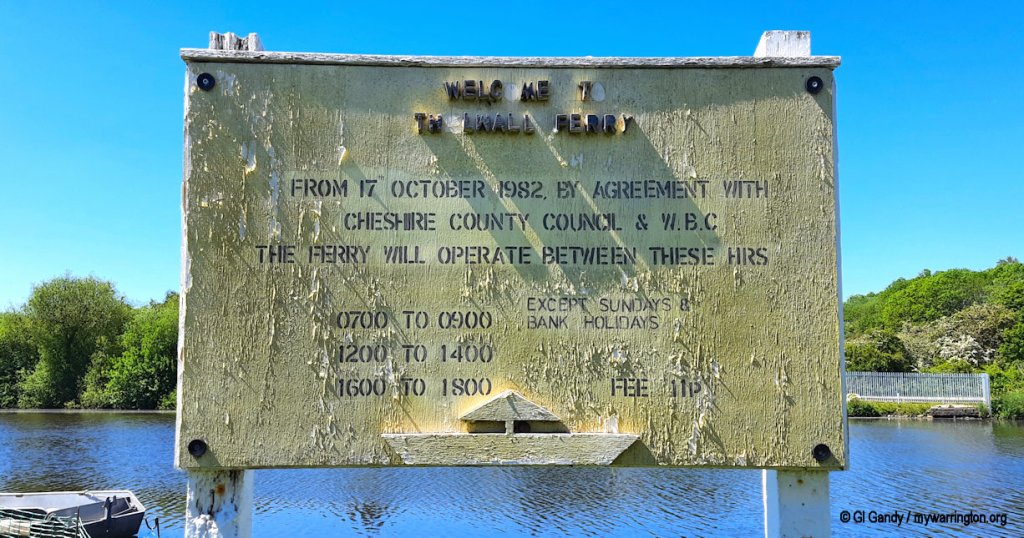
The Thelwall Ferry, also known as “The Penny Ferry,” was established in 1894 to maintain a public right of way after the Manchester Ship Canal was built, cutting through the farmland.
An Act of Parliament insists that the ferry be operated by the Manchester Ship Canal Company. Originally the area covered by the canal was filled with pathways and roads. It was not possible to replace them all when the canal was constructed so the ferry was brought in instead.
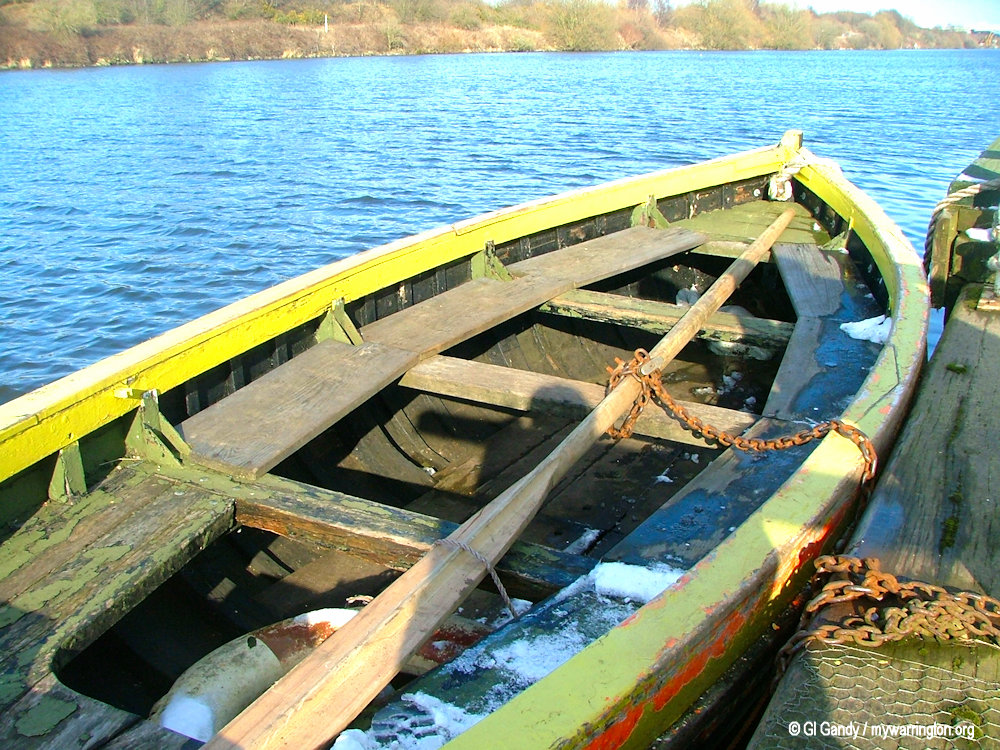
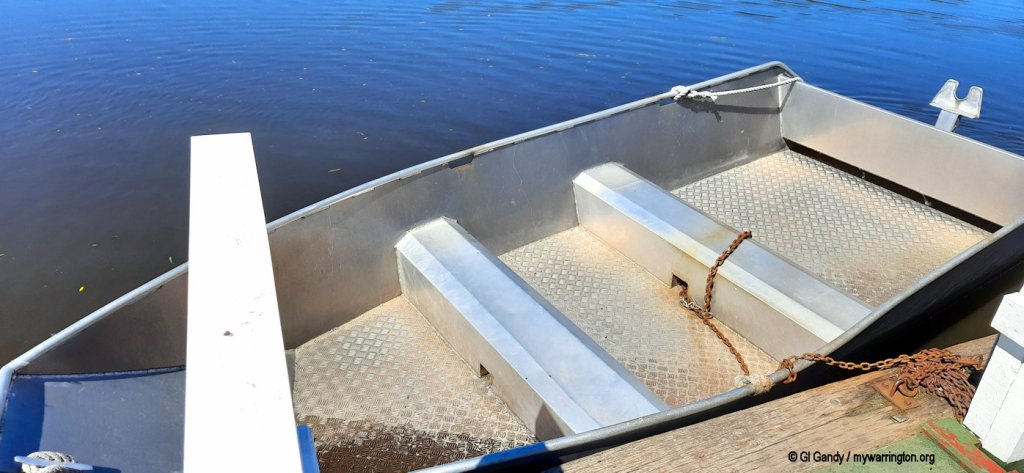
Initially, it used a large pontoon for transporting animals and farm produce, which later transitioned to a small rowing boat. In fact, the rowing boat has now been upgraded to a motorboat. See a photo of it here.
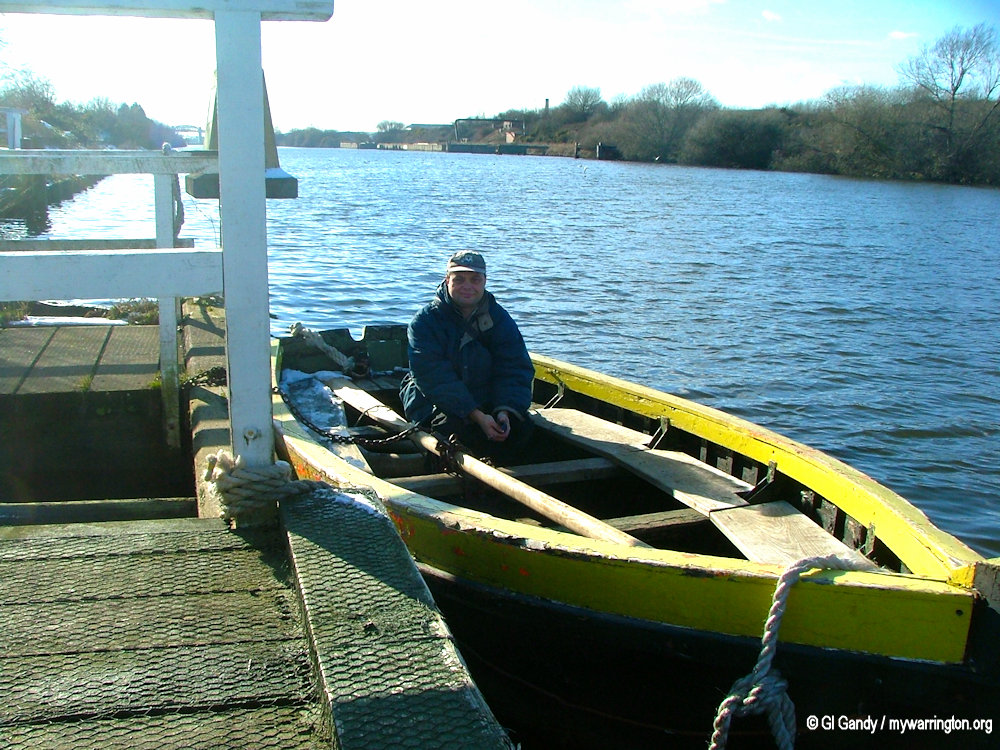
That Gordon Gandy fella on the Penny Ferry. I didn’t pay because it didn’t take me anywhere! 4 Mar 2006.
The name “Penny Ferry” comes from the original one penny fare for the crossing.
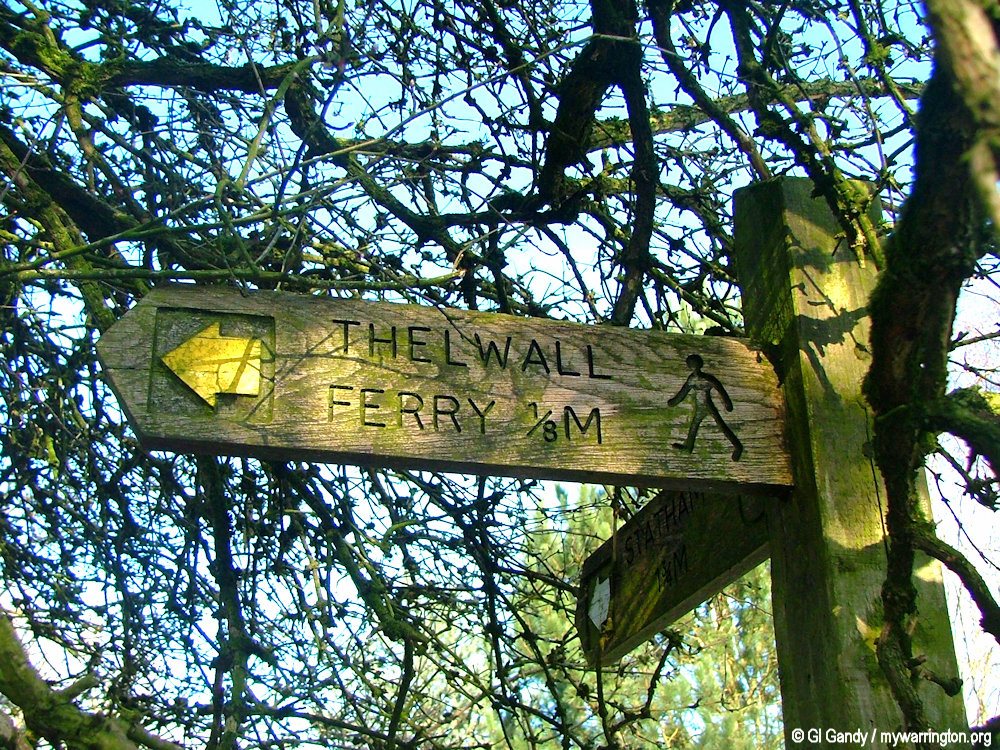
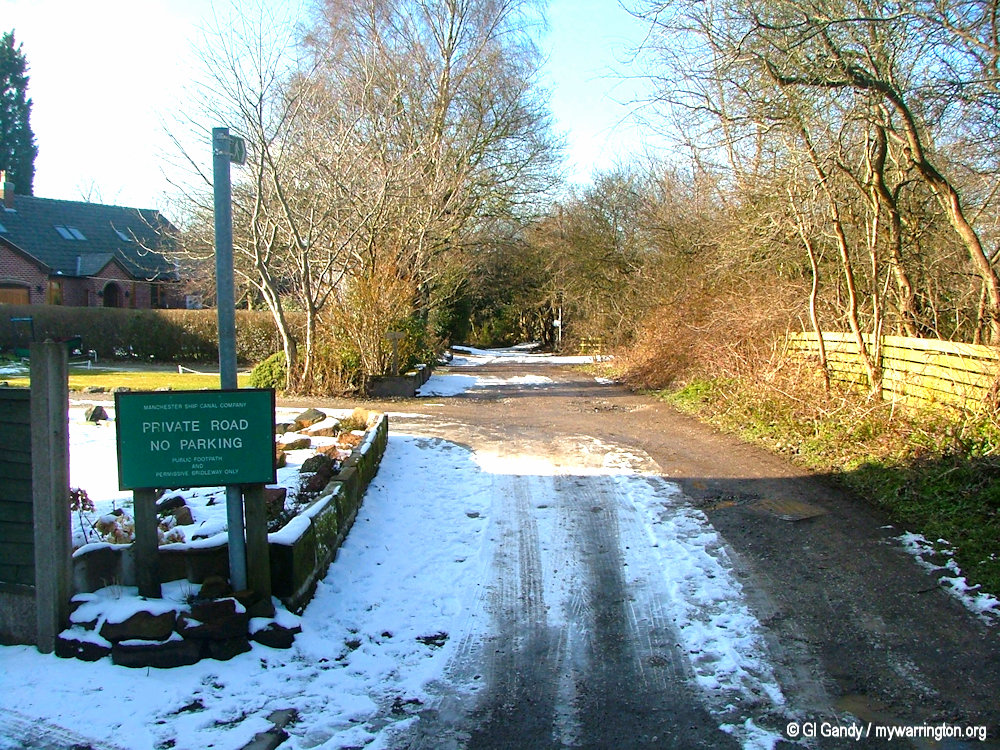
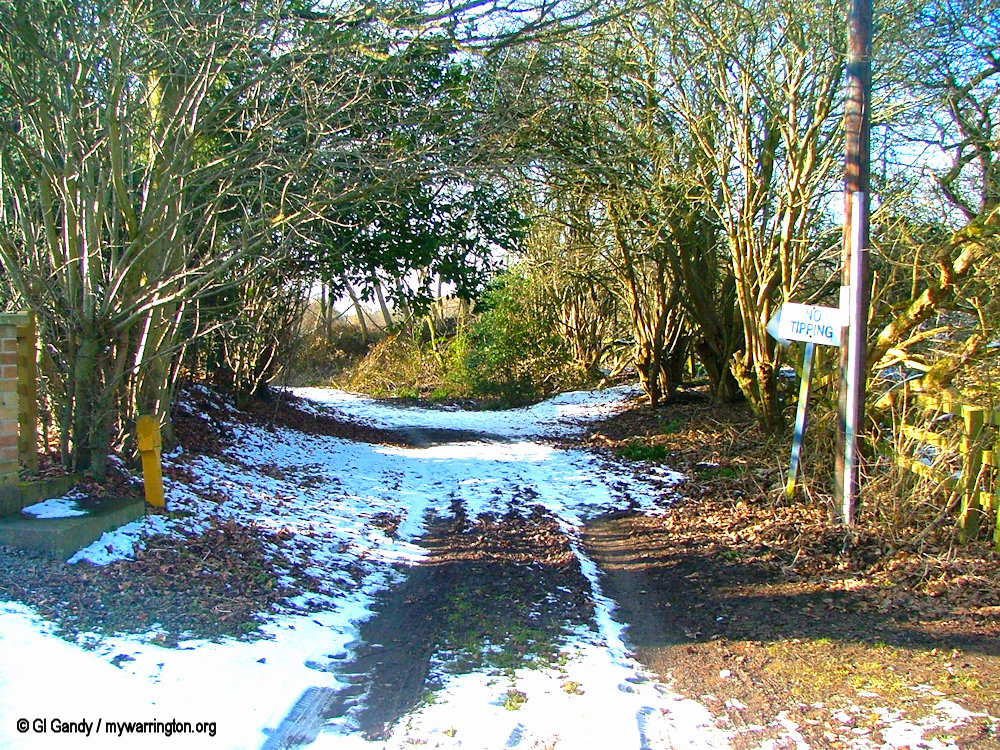
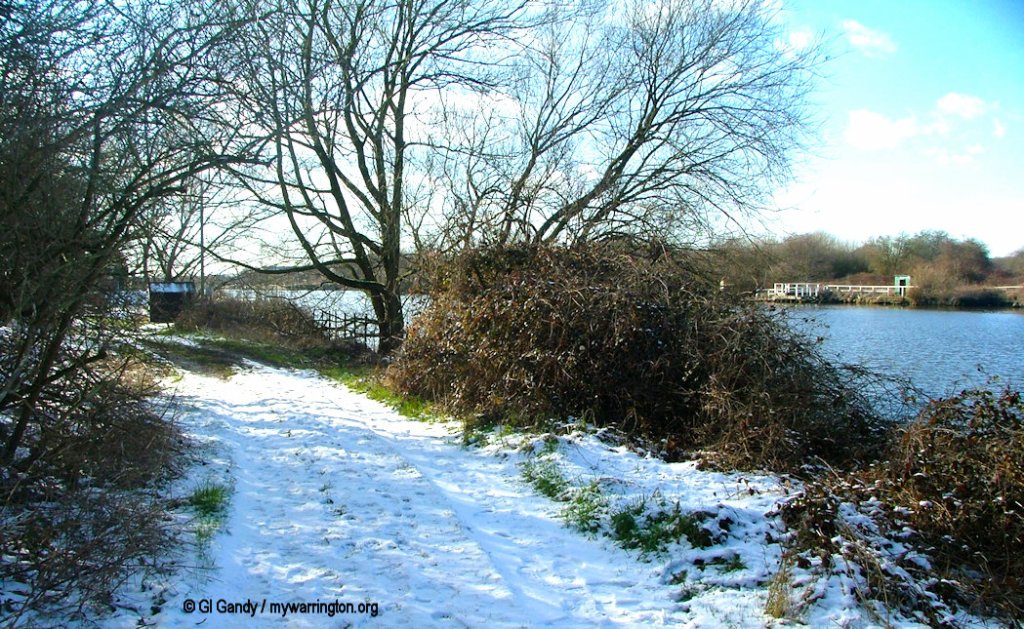
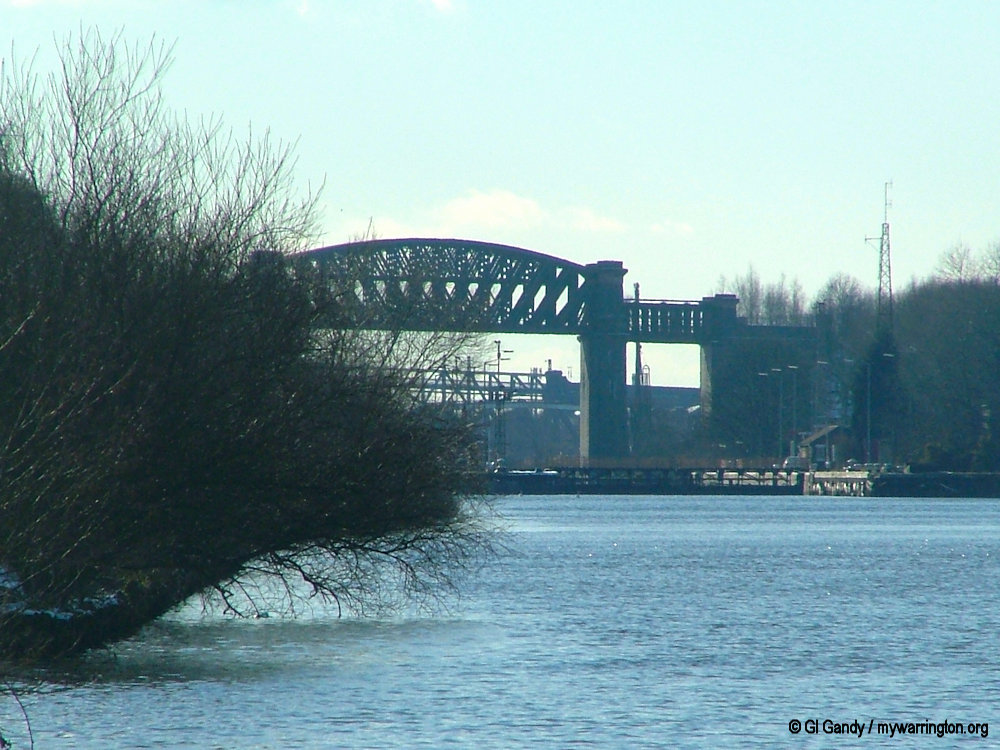
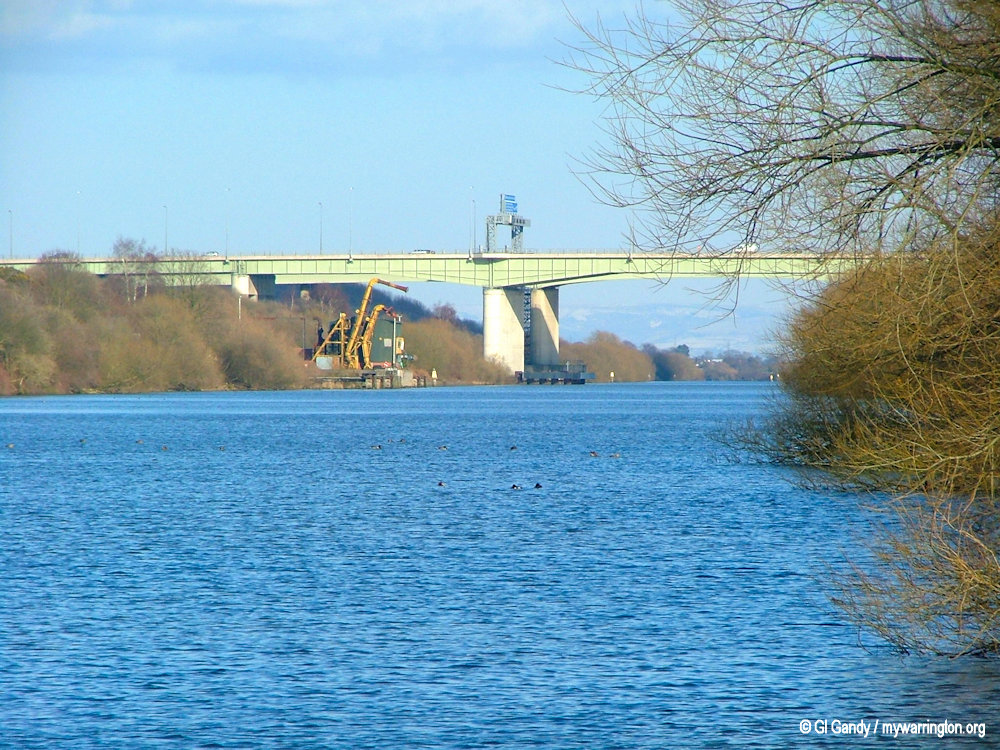
I first visited the ferry location on a snowy winter’s day to take my photos. I revisited again some years later. Below is a mixture of those photos.
Thelwall Viaduct

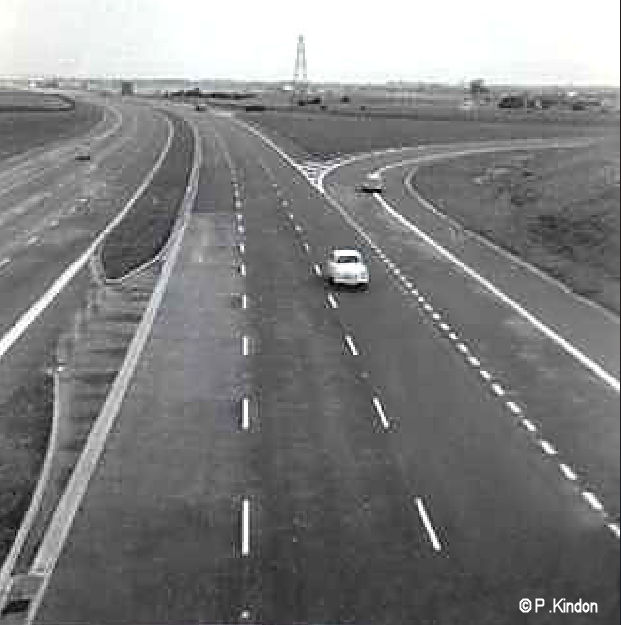
Thelwall Viaduct, opened in 1963, carries the M6 Motorway across the Manchester Ship Canal and River Mersey. A second carriageway was opened in 1995.
Thelwall viaduct is a steel composite girder viaduct between Lymm and Thelwall. It carries the M6 motorway across the Manchester Ship Canal and the River Mersey. Its location on the motorway network is between junctions 20 and 21 of the M6, the former being also known as junction 9 of the M56.
It actually comprises two entirely separate bridges, one of 4,414 feet long carrying the northbound carriageway, which was the longest motorway bridge in England when it was opened in July 1963, and one 4,500 feet long carrying the southbound carriageway which was opened in 1995. The longest single span is the one of 336 feet crossing the ship canal.
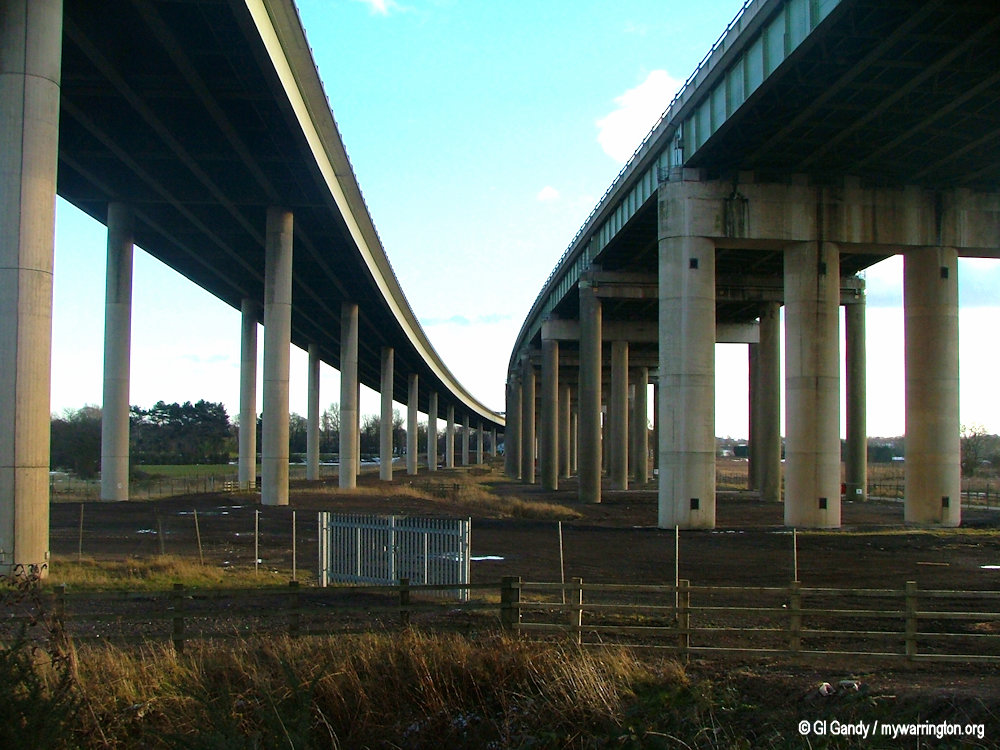
Thelwall Viaduct showing both carriageways on 4 March 2006.
In July 2002 a failed roller bearing was discovered and it became necessary to close all but one northbound lane. As the M6 at the time carried an estimated 150,000–160,000 vehicles per day, this led to serious congestion.
The viaduct was not completely reopened to daytime traffic until February 2005, and subsequently remained partially closed at night for further remedial work to take place. In all, 148 bearings were replaced, with the repair scheme costing around £52 million.
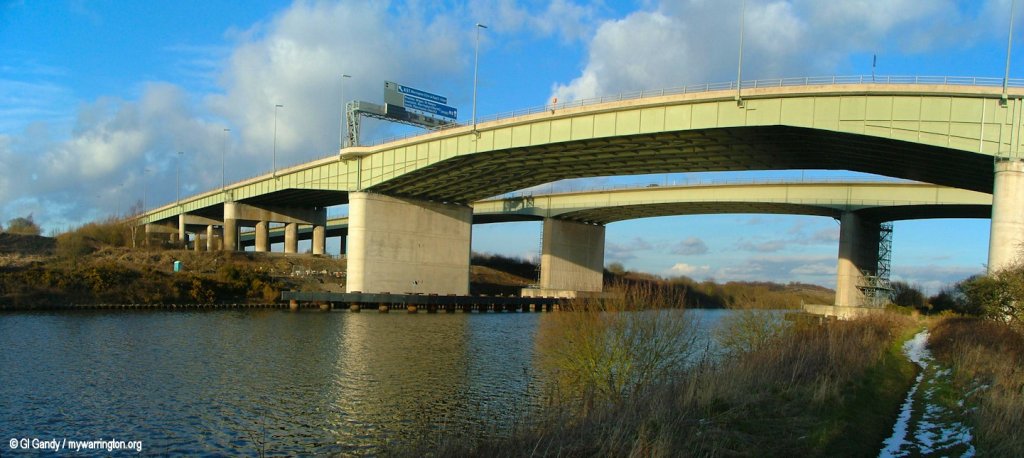
Thelwall Viaduct crosses the Manchester Ship Canal (seen here) and the River Mersey further north (photo 4 March 2006).
Given the bridge’s height and openness to the elements it has frequently been the subject of speed reductions due to strong gusts of wind that badly affect the stability of high-sided vehicles.
On several occasions lane closures have resulted as a consequence of articulated vehicles simply being blown over. However, the open sides of the bridge are a deliberate design feature to reduce the likelihood of snow drifts building on the carriageways.
In April 2011 a massive free party took place under the bridge, with reportedly over 5,000 ravers in attendance.
Some information: Wikipedia.
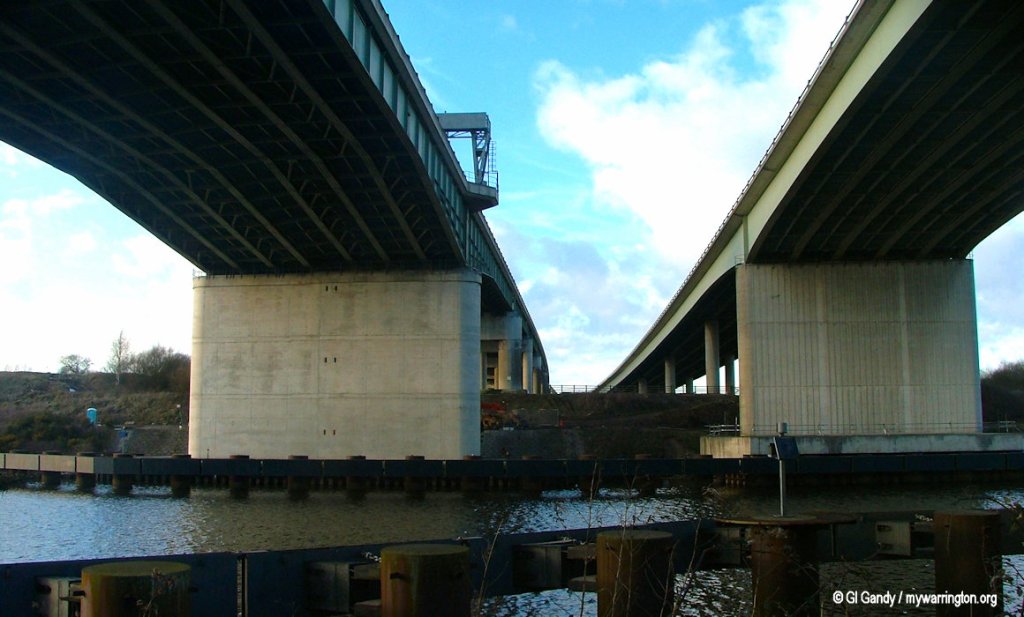
Thelwall Viaduct showing both carriageways on 4 March 2006.
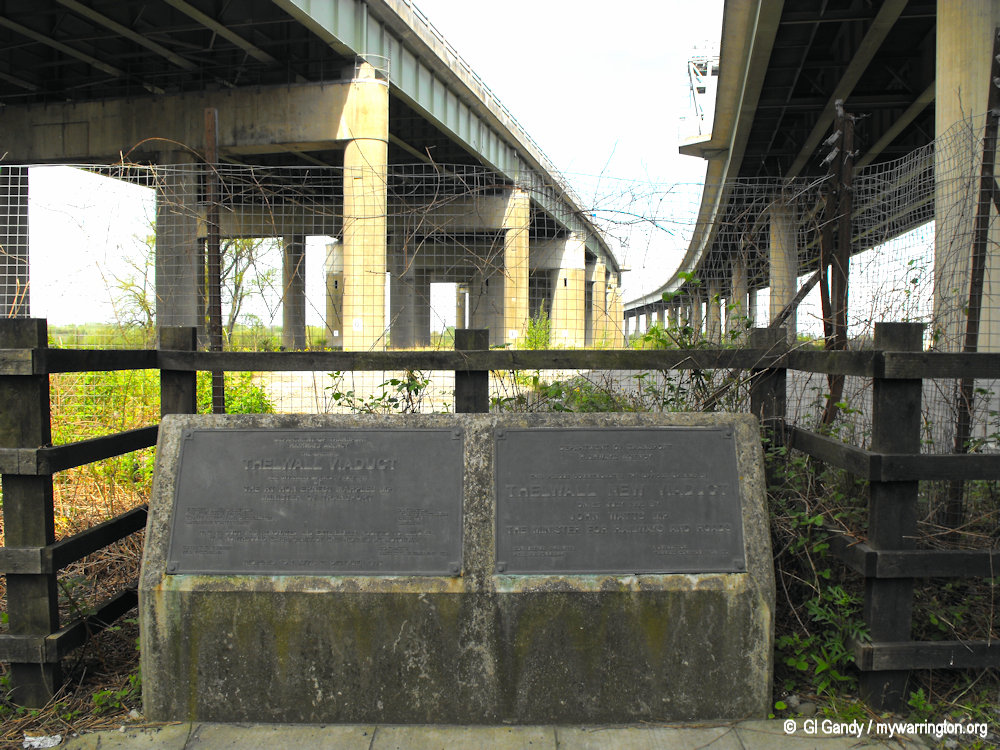
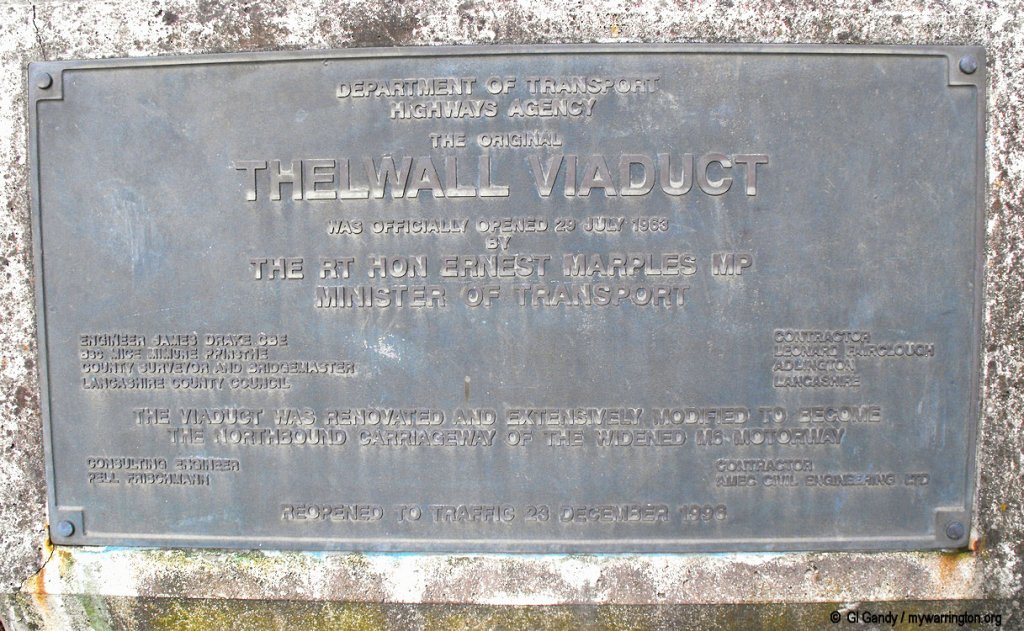
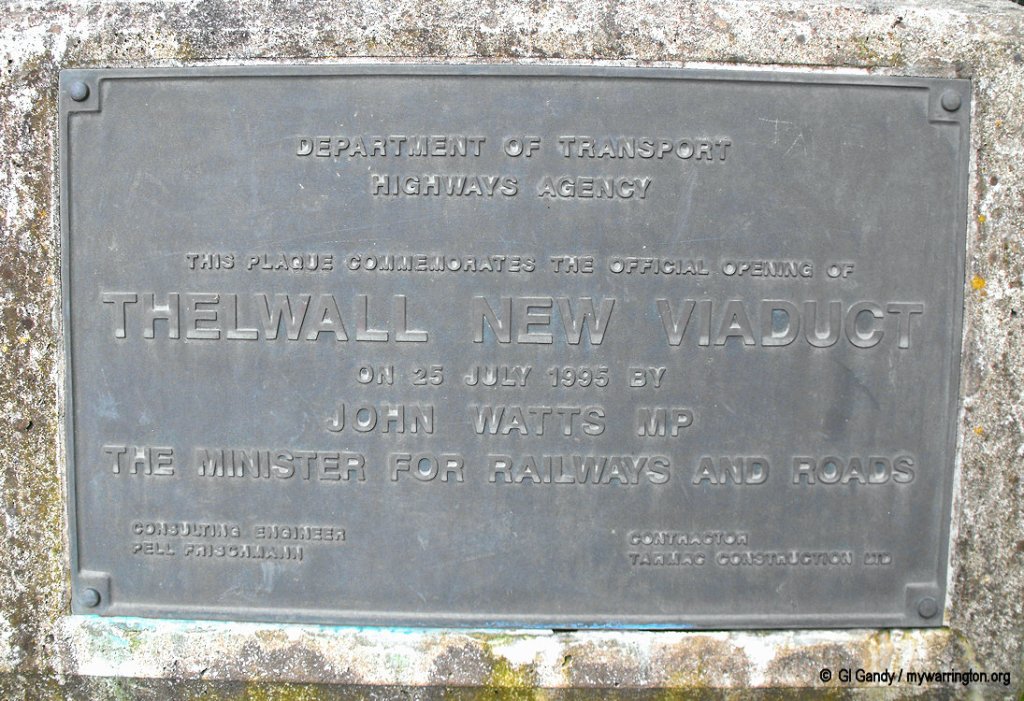
The memorial plaques from 1963 and 1995 (photo taken 3 May 2012)
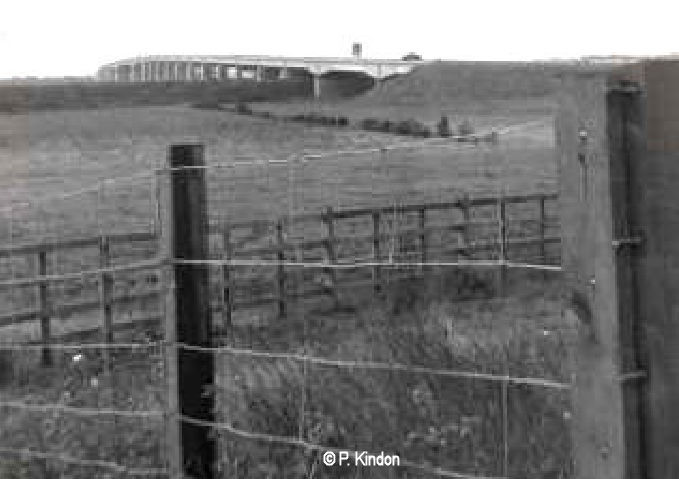
And finally for Thelwall Viaduct, two images from the opening of the motorway in 1963. thanks to P. Kindon for the images.
Thelwall Morris Men
In 1973 a group of regulars, enthused by seeing a team at a folk festival at Keele University, placed a small advertisement in a folk review magazine for a foreman. Chris Maple, then newly arrived in the northwest, had danced with Blackmoor MM and helped found Chelmsford MM and applied for the ‘job’ and became our first Foreman and Squire.
Although much has changed since, traditions have come and gone from the repertoire and subsequent Foremen have imposed their own ideas, our Bampton still bears the distinctive Maple style still shared, I suspect, with only Blackmoor. Read a more detailed history on the Thelwall Morris Men website.
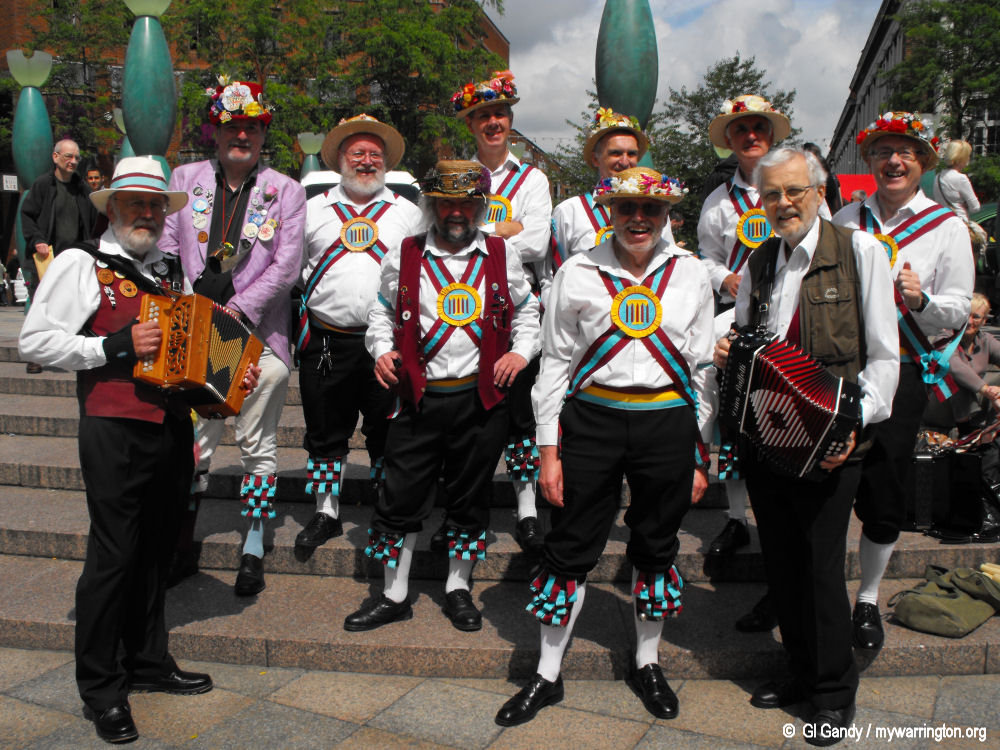
Thelwall Morris Men at a Warrington Market event on 9 July 2011.
The History of Morris Dancing
Morris dancing is a form of English folk dance. It is based on rhythmic stepping and the execution of choreographed figures by a group of dancers in costume, usually wearing bell pads on their shins, their shoes or both. A band or single musician, also costumed, will accompany them. Sticks, swords, handkerchiefs, and a variety of other implements may be wielded by the dancers.
Morris dancing is widely believed to have originated as a fertility rite, performed in spring and summer to ensure a good harvest, but this remains a theory without definitive proof. The dances often incorporate elements suggestive of fertility, such as bells and ribbons, and include actions like the “Bean Setting” dance, where performers jab the ground with sticks as if planting seeds.
Morris dancing first appeared in England in the 15th century. Its earliest surviving mention dates to 1448 and records the payment of seven shillings to Morris dancers by the Goldsmiths’ Company in London. The term Morris derives from the Spanish term morisco, although Morris dancing has no known historical connection to the Moors.
Today, the tradition continues through various national and international organizations, including the Morris Ring, the Morris Federation, and Open Morris. While historically performed by men, there are now many mixed-gender and women-only sides.
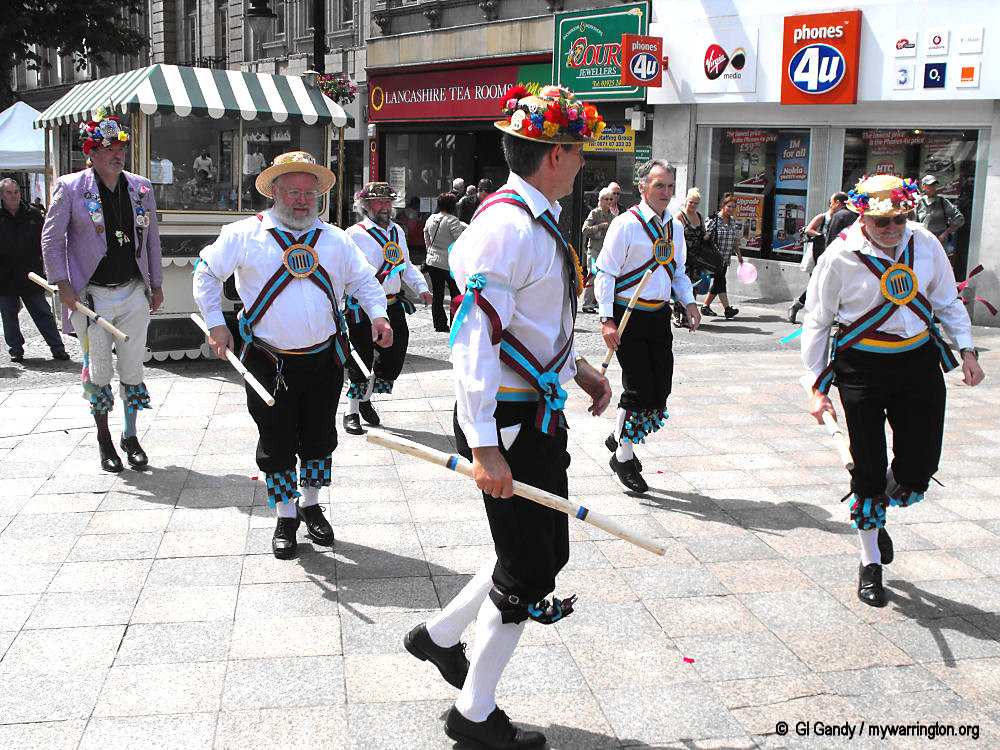
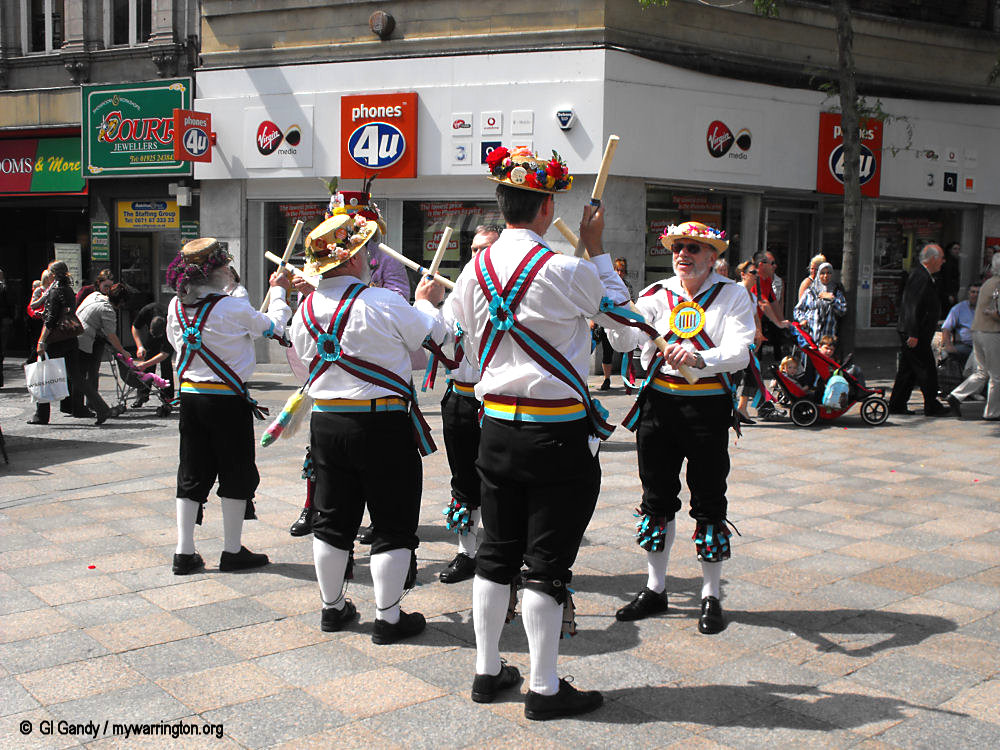
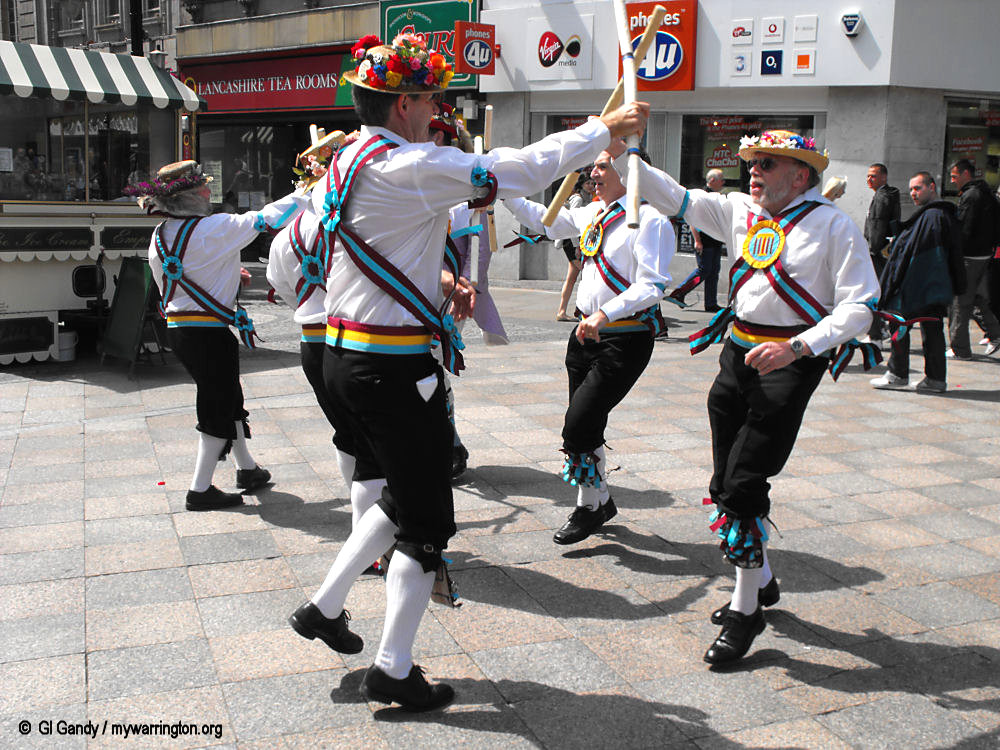
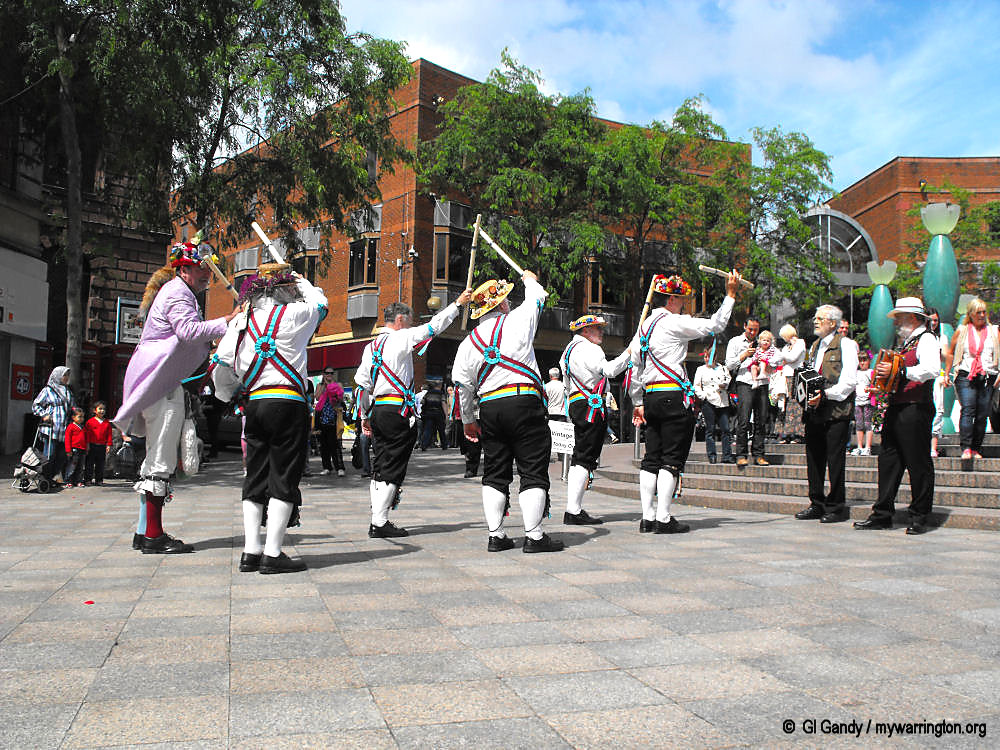
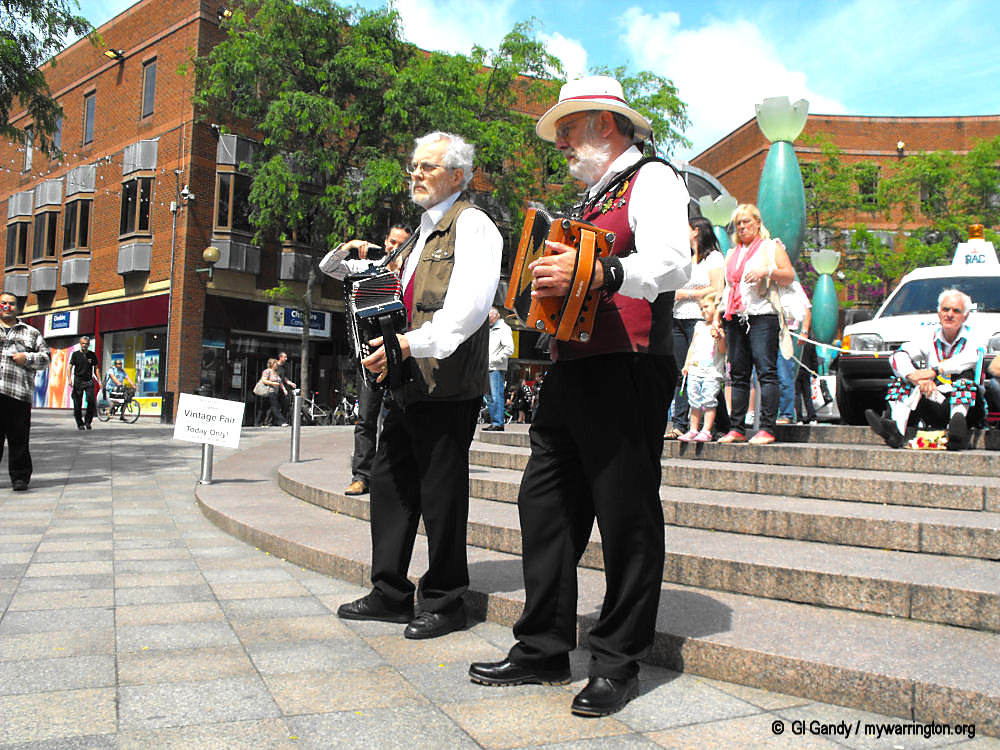
More photos of Thelwall Morris Men at a Warrington Market event on 9 July 2011.
Common elements of Morris Dancing:
- Rhythmic Stepping: Dancers use various steps, jumps, and hops, often marked by the ringing of bells on their shins.
- Props: Handkerchiefs and wooden sticks are common, but swords are also used in specific traditions.
- Character roles: Many sides include a “fool,” who acts as a master of ceremonies and interacts with the audience, and an animal-like “beast” or hobby horse.
- Traditional Music: The dances are performed to folk tunes, with each tradition often having specific tunes for its dances.
Information from Wikipedia and AI research.
The Bridgewater Players
In 1951, our Society began with six people on the stage of Eagle Brow Schoolroom, Lymm. The play was “The Rotters” (no one has heard of it since) and the aforementioned six people were all in the play, as well as doing all the stage work, make up, providing all the furniture and properties. If anyone forgot their lines they just had to prompt each other. But, small though it was, Lymm Amateur Dramatic Society was born.
After the first two or three plays, we had enlisted a few more members and we began to “tread the boards” at the old cinema. This meant going to the second house on a Saturday night, so that we were there to take down the cinema screen when the film finished, then spend all day Sunday erecting the set and painting the scenery. Sadly Lymm cinema closed in 1962 and Rainbow Nursery now stands on the site.
However, our time at the cinema was not very profitable, so back we went to Eagle Brow, where we remained and progressed – albeit slowly – until 1968. During our years at Eagle Brow, the Society made many good friends and we especially thank our audience, who supported us so loyally in those early days. Without them, we just wouldn’t have survived all these years.
We cannot let memories of our years at Eagle Brow pass without paying tribute to two of our most devoted members, Sam and Elsie Owen. They were with us in our very first play and, after Sam died, Elsie remained with us and practically carried us about. When plays were in production, we filled her house with costumes and bits and pieces and nearly emptied it by borrowing much of her furniture for our stage set. It was a great loss to us all when she too died in 1968 and both she and Sam will always be remembered with gratitude and affection.
Unfortunately, our long stay at Eagle Brow came to an end in 1968 as they needed the hall for themselves and we suddenly found ourselves homeless. Our last play there was “The Captives” – a very moving play that will not be forgotten by those who saw it.
So there we were, with nowhere to stage our plays, nowhere to store our scenery and equipment and all feeling very despondent, believing that our Society had met its end. But every cloud has a silver lining, and our good friend, Bill Burrows, allowed us to store our goods and chattels in his old Smithy at Heatley.
Mr Hall from Heatley Station gave us some storage space in one of his old waiting rooms, and we finally managed to move ourselves out of Eagle Brow all in one evening.
As we couldn’t find anywhere in Lymm suitable for staging our plays, one of our former members suggested we approach the Vicar of Thelwall with the view of using the Church Hall. We were greeted with great enthusiasm and Thelwall became the new home for Lymm Amateur Dramatic Society.
After making a few alterations to suit our needs, we produced our first play at Thelwall in January 1969, “Bonaventure”, a play we had presented some years previously.
We found the Vicar and officials at the parochial Church Council most helpful and co-operative, and our audience in Thelwall most enthusiastic. Since then we have grown our membership and audience. We are deeply grateful to all our loyal supporters who come from Lymm to see us and also to all our new friends from Thelwall and surrounding districts.
Once it became obvious that Thelwall was going to be our new home and we were there to stay, we decided to change our name to the
”Bridgewater Players”, this being the common link between Lymm and Thelwall in the form of the canal that runs through both villages. It was hoped that this might draw in more members and audience from both communities and over the years this has certainly been the case.
Of course, the dream of any drama group is to have “a place of its own” but with the ever-increasing costs associated with staging plays and running a hall it remains a dream unless we find ourselves a very rich benefactor.
Our main concern, of course, is to continue to entertain our audiences. We hope that in the past we have managed to amuse, to frighten and sometimes even to reduce the audience to tears, always in the hope we have managed to hold their interest and given them something to think about. In the meantime we continue to make progress at Thelwall and have now performed over 160 productions, which we are extremely proud to have achieved.
In closing, may we thank all our members, both past and present, for all their hard work that is done both on stage and behind the scenes. Without their willing help and support, The Bridgewater Players would not have reached the happy state we are in today.
Information supplied. See their website for latest information.
Thelwall Rose Queen
Thelwall Rose Queen first began in 1961 as All Saints Rose Queen Festival, the Rose Queen being chosen from the Sunday School. It is now an annual event and creates a great source of enjoyment for the community. Read more at the Thelwall Rose Queen website. See also the Thelwall Community website.
A Final Walkabout
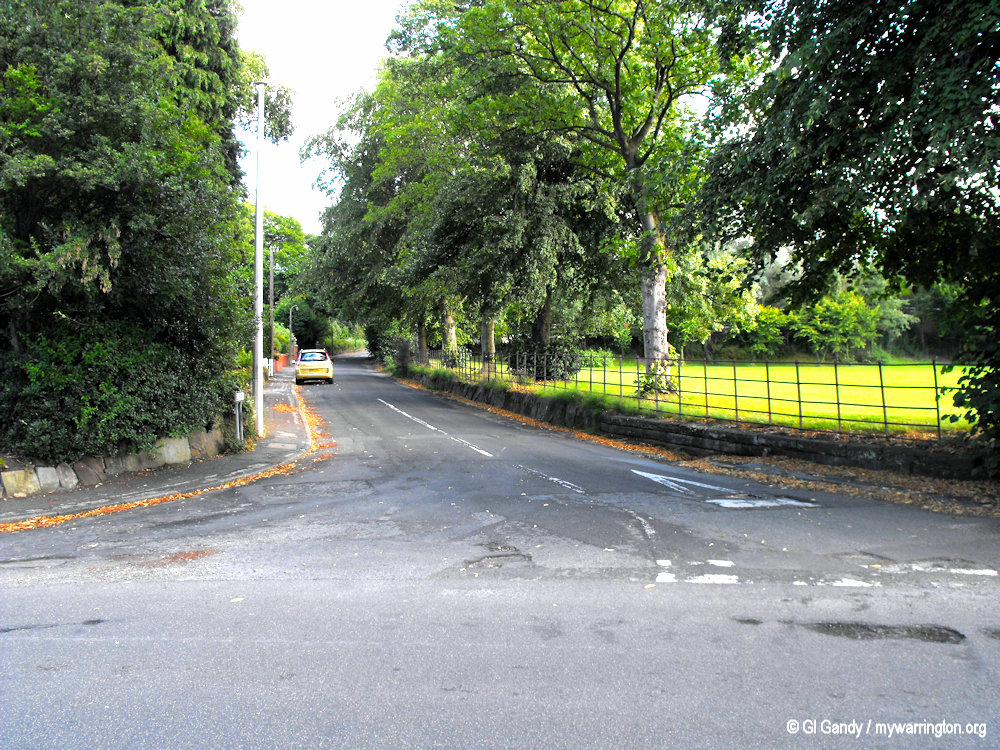
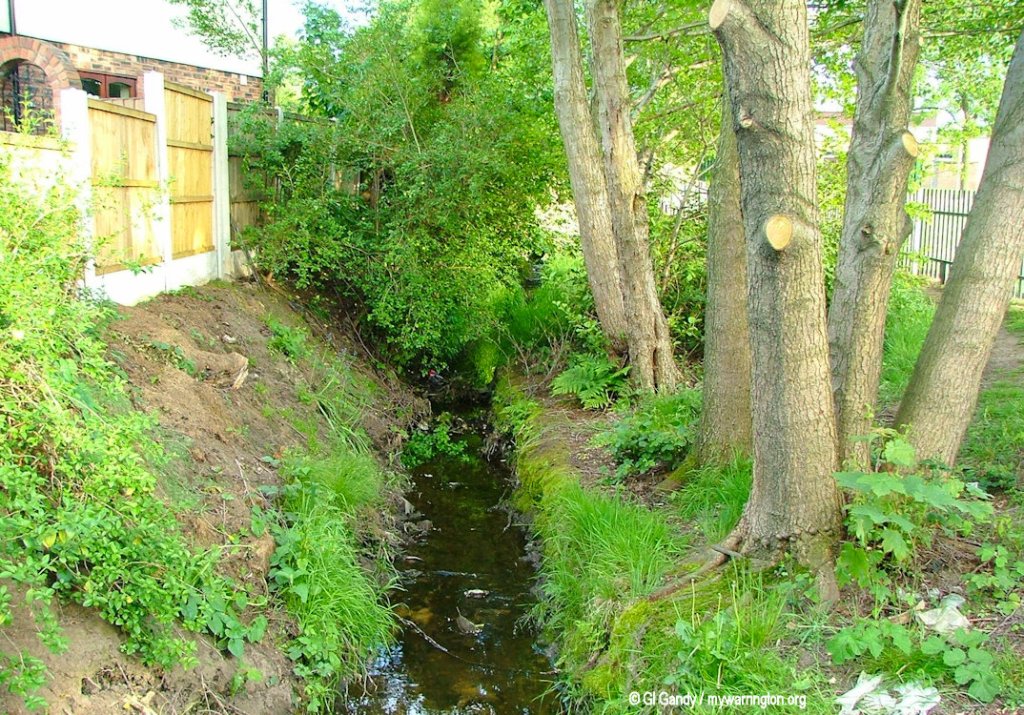
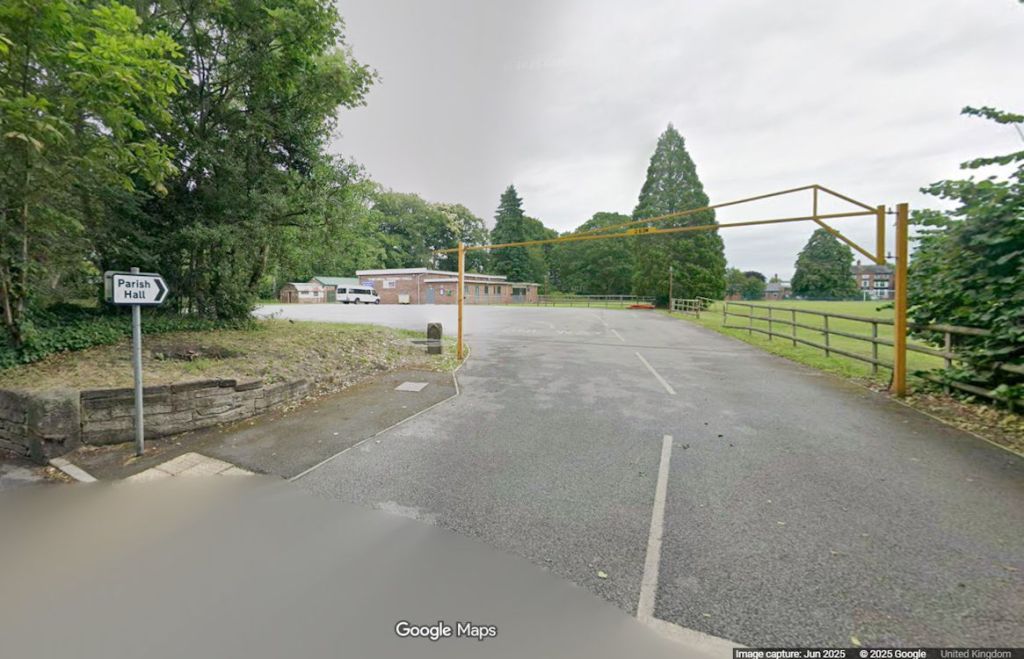
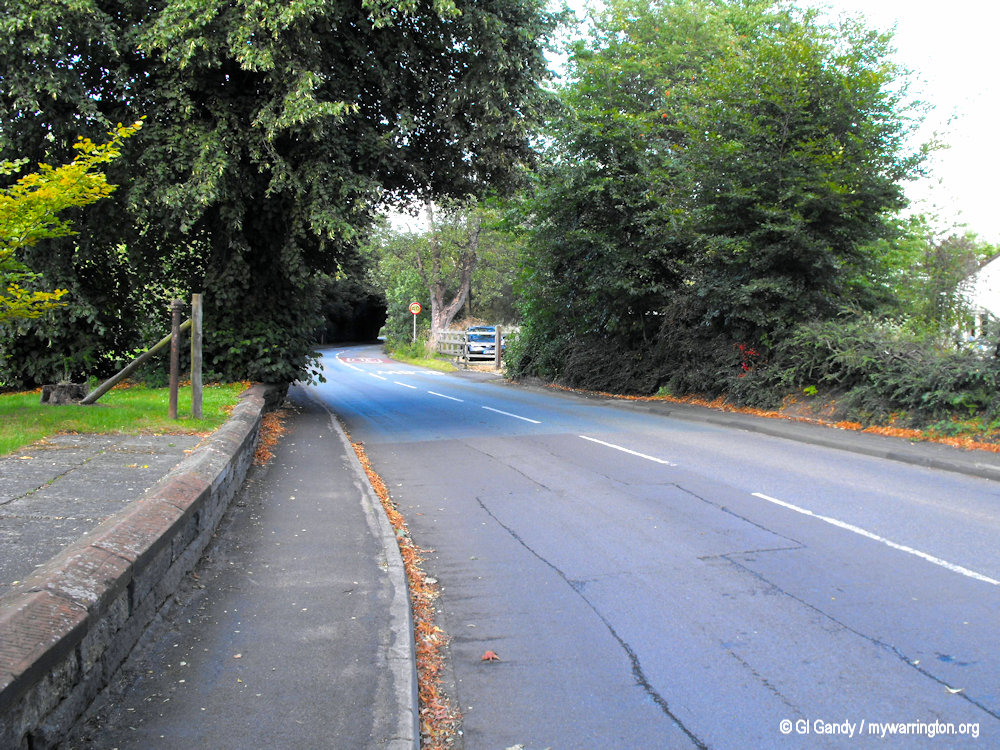
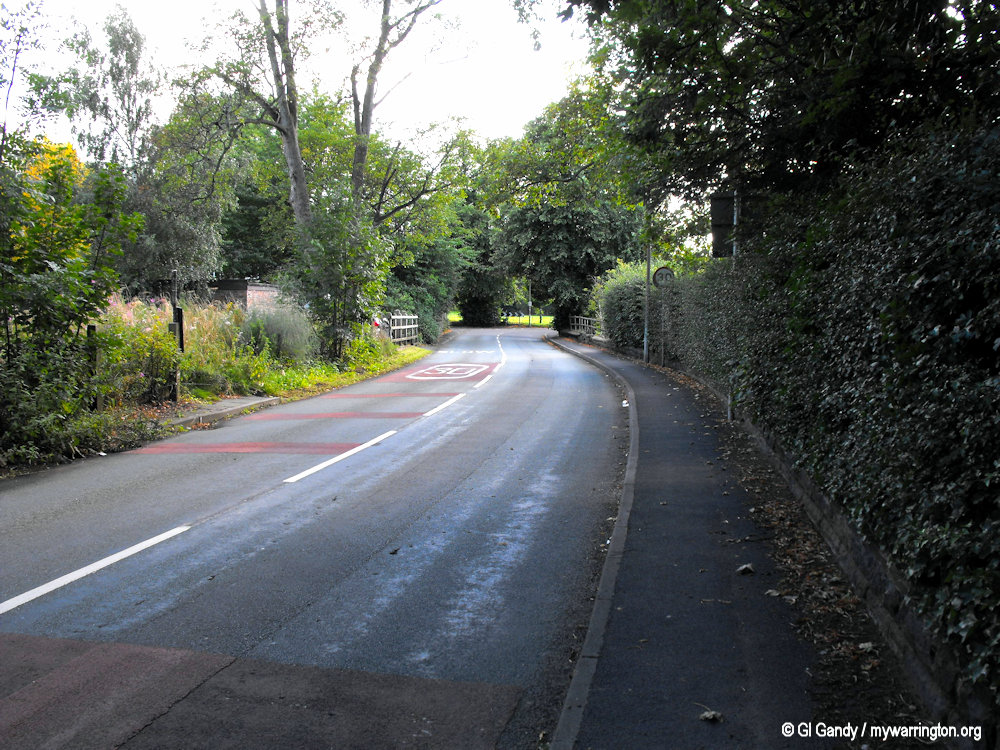
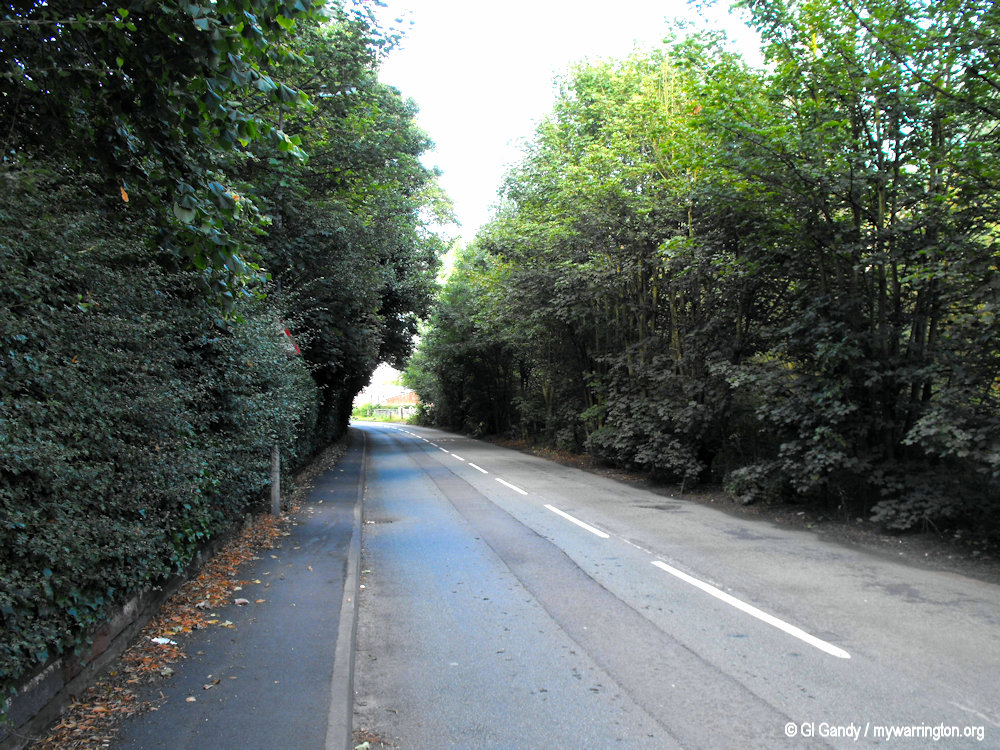
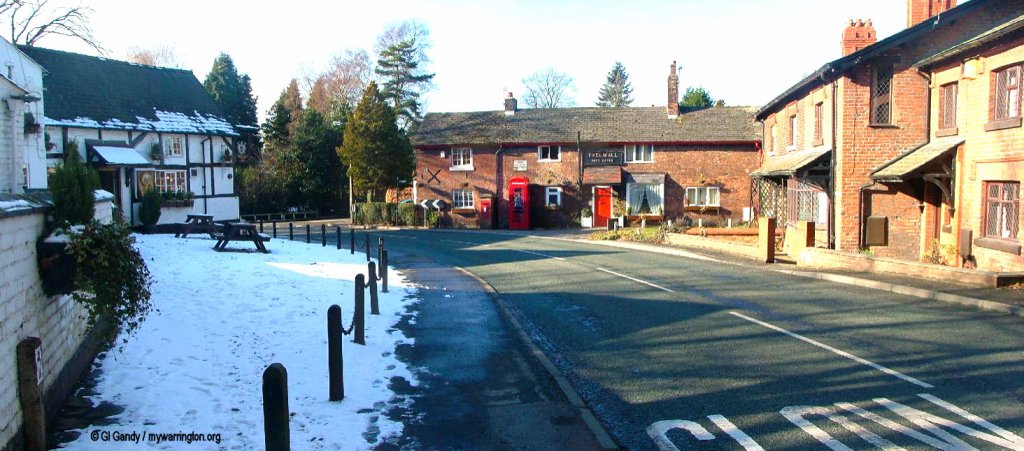
A winter’s day view of the Pickering Arms and Thelwall post office on 4 March 2006.
For a walking tour of the village, download the Thelwall Heritage Trail document here.
 mywarrington