

Contents
- Introduction
- King Oswald
- The Winwick Pig
- The Winwick Name
- The Domesday Survey
- St Oswald’s Church
- Winwick Chantry
- Winwick Grammar School
- The Battle of Winwick
- The Winwick Broad Oak
- Warrington Corporation Waterworks
- Winwick Church of England Primary School
- Captain Smith of The Titanic
- Winwick Hospital
- Hollins Park Trail
- Winwick Rail Crash (1934)
- Winwick Quay
- Around the Village
- A Final Walkabout
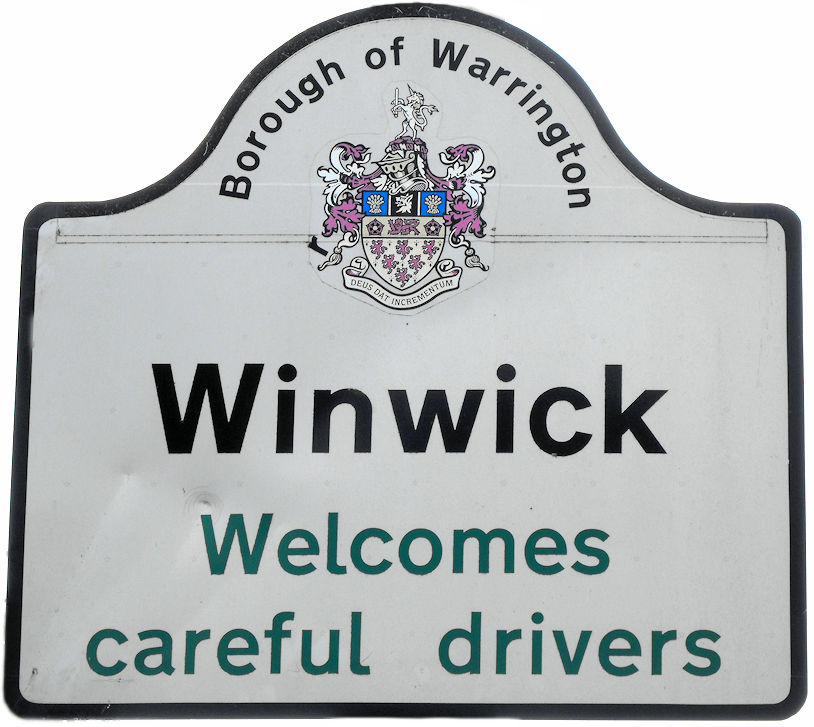
Introduction
In 1870-72, John Marius Wilson’s Imperial Gazetteer of England Wales described Winwick like this:
WINWICK, a township, a parish, and a sub-district, in Warrington district, Lancashire. The township lies 2 miles S by E of Newton r. station, and 2½ N of Warrington; bears the name of W.-with-Hulme; and has a post-office under Newton-le-Willows. Acres, 1,431. Real property, £3,579. …
Pop., 451. Houses, 87.—The parish includes Houghton, Middleton, and Arbury township; and comprises 2,270 acres. Pop., 704. Houses, 132. The property is much subdivided. W. Hall is the seat of the Rev. F. G. Hopwood. The living is a rectory in the diocese of Chester. Value, not reported.* Patron, the Earl of Derby. The church is chiefly ancient; was partly rebuilt in 1848, and extensively improved in 1858; and has a tower, with octagonal spire. There is an endowed grammar-school with £34 a year. –The sub-district includes Croft-with-Southworth parish.
GB Historical GIS / University of Portsmouth, History of Winwick, in Warrington and Lancashire | Map and description, A Vision of Britain through Time.
URL: http://www.visionofbritain.org.uk/place/11044
Date accessed: 12th November 2025
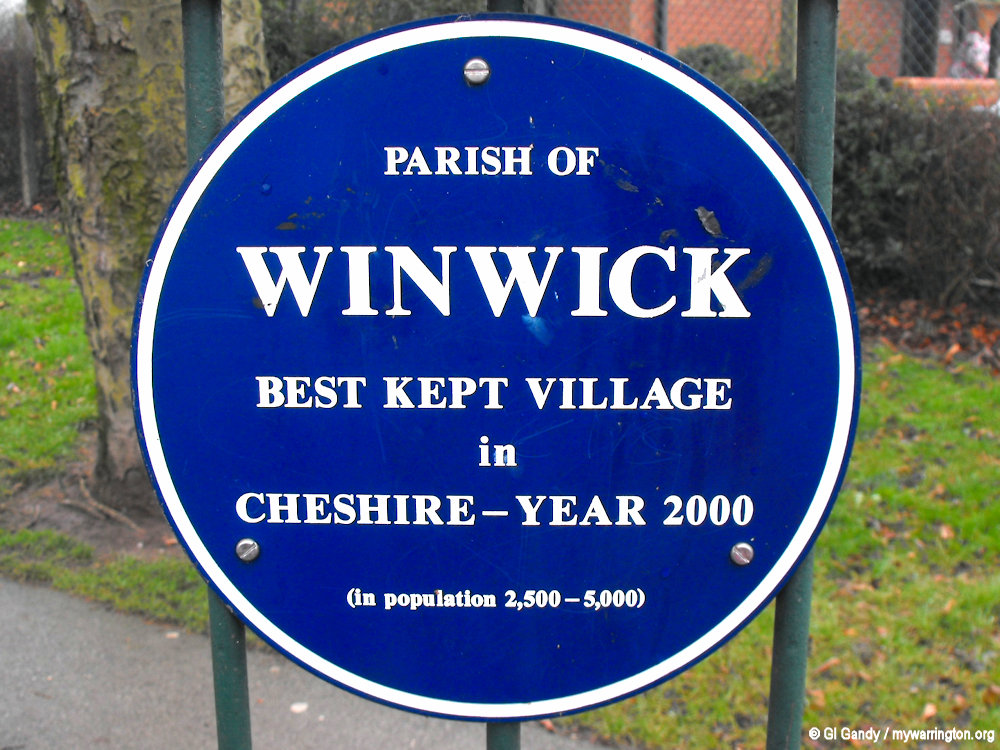
The parish of Winwick, comprising the townships of Newton, Haydock, Winwick with Hulme, Ashton, Golborne, Lowton, Kenyon, Culcheth, Houghton, Middleton and Arbury and Southworth with Croft was in the historical county of Lancashire, but parts are now in the ceremonial county of Cheshire, not far from Warrington.
The parish was said to be the richest rectory in the country and the Stanley family, earls of Derby, were patrons, owning the advowson. [An advowson is the right to appoint a clergyman to a church living, which is a church office with a salary and/or income.] The wealth of the living meant that the rectors were often wealthy pluralists such as Thomas Stanley, bishop of Sodor and Man, who also held the parish of Wigan.
A grammar school at Winwick was founded in the mid-sixteenth century after the dissolution of the chantries in Winwick church and refounded with the building of a new schoolhouse in 1618-1619.
Dr P. J. Cox Chester Consistory Court (accessed 14 November 2025)
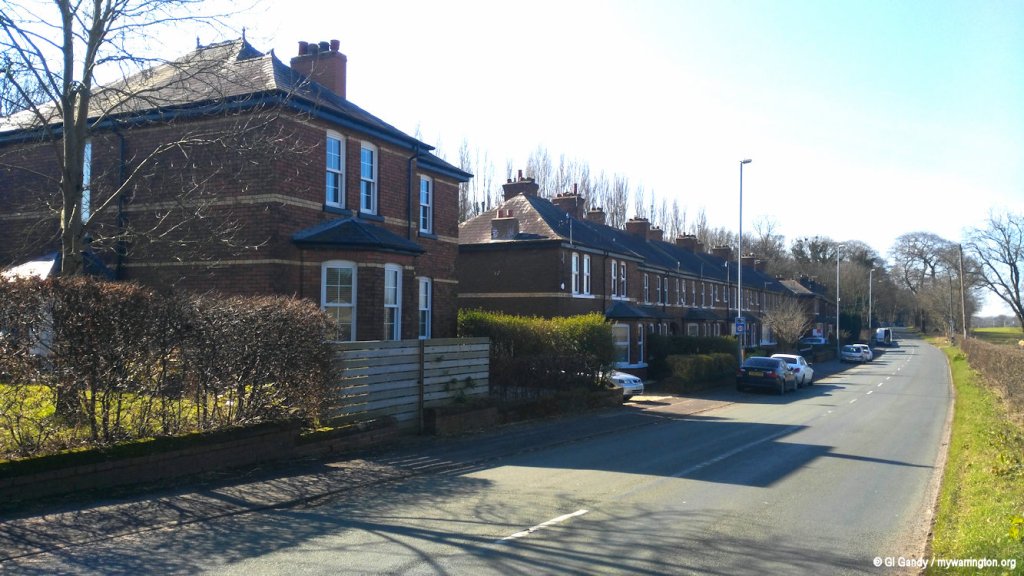
Hollins Lane leads to Burtonwood (14 March 2016)
Other Warrington areas listed under the parish of Winwick in Dr Fox’s notes are covered in their own sections of Downtown.
Winwick is a village and civil parish in north Warrington. Until 1974, the village was administered as part of Lancashire with the rest of north Warrington. It is located about three miles north of Warrington town centre, near Junction 22 of the M6 and Junction 9 of the M62 motorways. According to the 2001 census, the civil parish had a population of 4,366. The area is mainly arable and pasture land (potatoes, oats and wheat). Newton Road (A49) is the main road north through the village, which itself is to the east of the original Roman road running north to south through Warrington.
Although Winwick village is close to two motorways, it remains a relatively quiet village. Winwick post office used to occupy the white building on the left of the photo shown here. In 2025 the village has two hairdressers, an interior design shop and a convenience store. St Oswald’s Church of England runs the church and a primary school and there is one public house. Winwick was occupied by Middle Bronze Age settlers more than 2,000 years before the Domesday Survey of 1086.
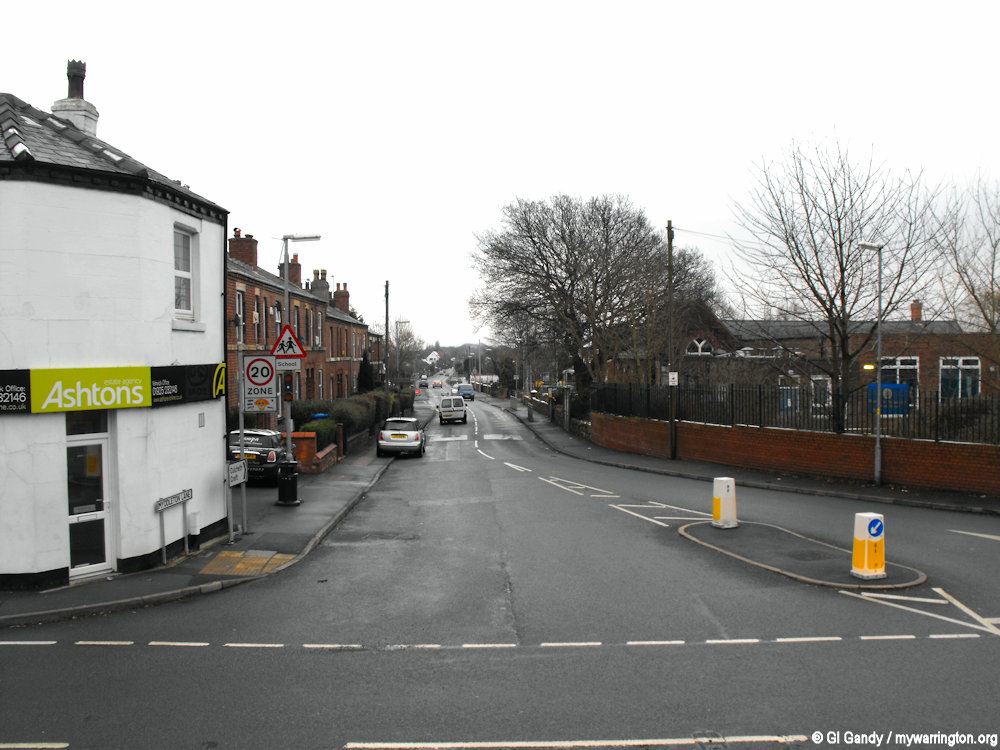
Myddleton Lane, the main road through the village (taken from the west on 5 February 2009).
King Oswald
At one time, a large part of England was split into two kingdoms, Northumbria and Mercia. In fact, they were the two most powerful Anglo-Saxon kingdoms in England, located in the north and in the Midlands respectively, with the River Humber and the River Mersey acting as the traditional borders. The Mersey was originally known as the River Merse, meaning “boundary river”.
King Oswald (c 604 – 5 August 641/642) was the King of Northumbria from 634 until his death. He is associated with Winwick because the Battle of Maserfield, where he was killed by King Penda of Mercia in 642 AD, is believed to have taken place there. However, other writers suggest the battle actually took place in Oswestry.
William Beamont in his Winwick: Its History and Antiquities tells us of a French historian, quoted by Sir Gilbert Scott, who says this about St Oswald: “Gentle and strong, serious and sincere, pious and intelligent, humble and bold, active and gracious, a soldier and a missionary, a king and a martyr, slain in the flower of his age, on the field of battle fighting for his country, and praying for his subjects. Where shall we find in all history a hero of nearly approaching the ideal, more richly gifted, more worthy of eternal remembrance?”
The local parish church, St. Oswald’s, is named after him, and a well and a carving known as the “Winwick Pig” also commemorate the king. We will expand on these stories as we go.
Read about St Oswald’s Well in the Hermitage Green section of Downtown.
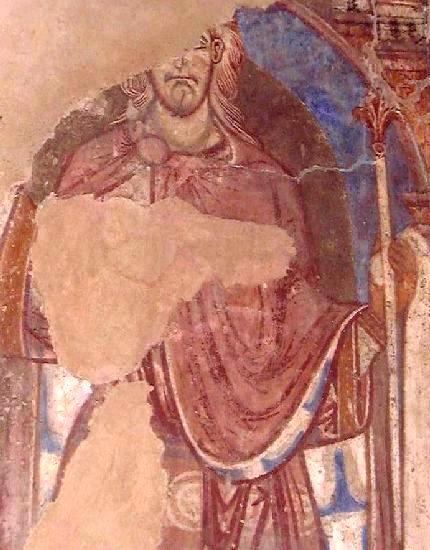
A twelfth century painting of St Oswald in Durham Cathedral by Robin Widdison at English Wikipedia (released into the public domain by him).
The Winwick Pig
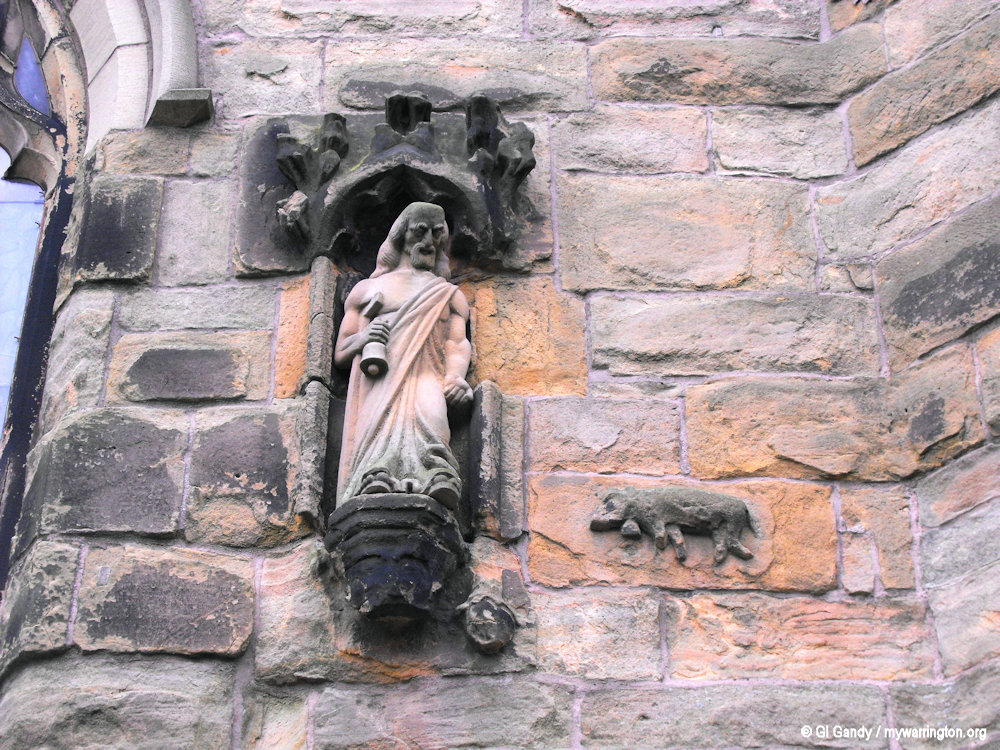
The parish church, dedicated to St Oswald, was reputedly located with guidance from the “Winwick Pig”, a carving of which can still be seen on the church wall. The story goes that King Oswald, King of Northumbria, was killed here in battle in AD 642, and many tales were told in his honour. Travellers would stop by and pay their respects and the spot was cared for by the elders of the village. There was a large stone placed nearby which many bowed down to. It was decided to erect a church in honour of the great king, and so the plans were marked out on the ground. As it was being constructed nobody noticed a pig wandering around the site. Stone and timber were gathered for the construction and the pig went about its day hunting for food. At the end of the day the workers went home, but next day they noticed something had changed. Overnight it was reported that the pig was seen moving stones from the original site of Winwick church to its current site, crying We-ee-wick, We-ee-wick as it ran, hence Weewick, Winwick. Originally the pig wanted to keep this story to himself but when he was offered as much pigswill as he could eat he eventually squealed! Well, everybody has his or her own take on the story – that is mine.
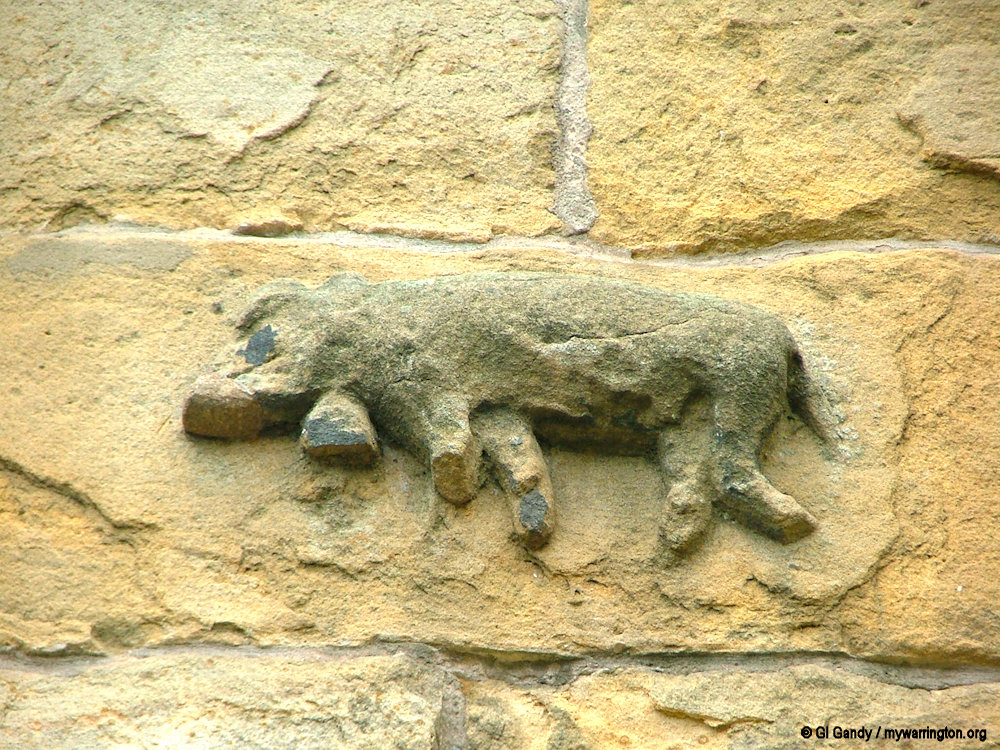
A carving of the Winwick Pig can be seen on the western wall of St Oswald’s Church (photo taken 5 February 2009).
The Winwick Name
Not wanting to spoil a good story with the facts, but there is a more reliable story for the origin of the name of the village. Old names for the village include an Anglican personal name, Wineca, and the Old English element “Wic” meaning “dwelling place”, giving the meaning “the dwelling place of Wineca”.
Previous spellings of the name are “Winequic” (1170) and “Wynewhik” (1192). Other variations are Winewich (1204), Wynewyc, Wynequic (1212) and Wynequick (1277).
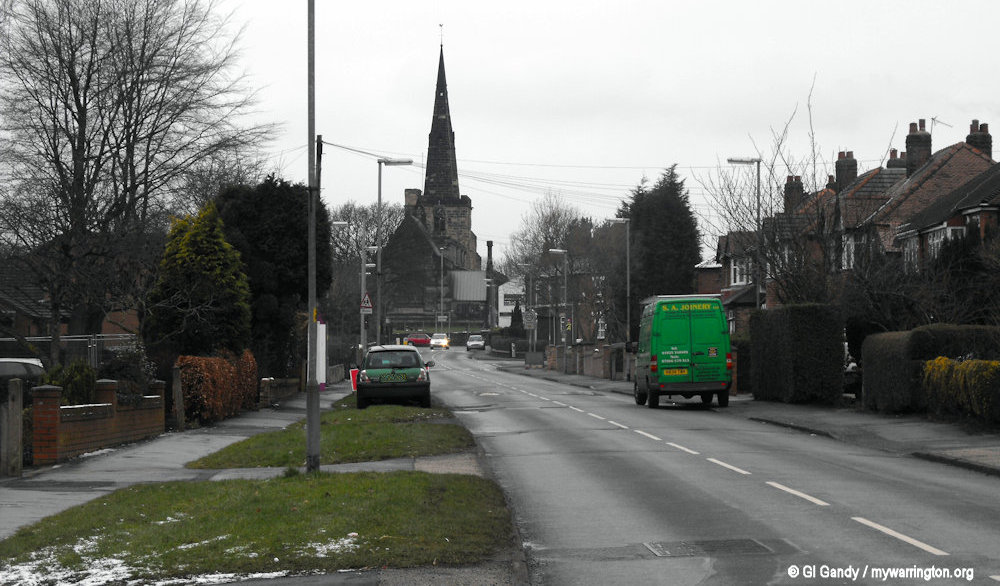
The current church can be seen in my view of Myddleton Lane on 5 February 2009.
The Domesday Survey
Sir Peter Leycester tells us from Camden that parishes in England began to be formed about 636 AD, which is so near to the period of which King Oswald fell that we may well imagine it to be an era when Winwick became a parish in Newton Hundred. It was the place where a church was, in due time, to be built and dedicated to him as it’s saint by a popular canonization. In 1086, when the Domesday Survey was made, this church had been built. and its district or parish is thus described as follows:
“In Newton, in King Edward’s time, there were five hides. One of these was in the demesne*see notes. The Church of the same manner had one carucate* of land, and St Oswald of the same vill had two carucates of land free of everything. The other land of this manor 15 men called drenghs* held for 15 manors, which were berewicks of the manor, and among them all these men rendered 30 shillings. There is a wood there, 10 leagues* long and six leagues and seven furlongs broad, and there are hawk’s aeries [nests]. All the freeman of this hundred except two had the same customs as the men of Derbeishire; but in August they moved two days more than they on the King’s tillage* lands. The two excepted men had five carucates of land and have the forfeitures for bloodshed and rape and pannage* in the woods for their man. The rest were the King’s. The whole manor rendered to the king a farm of 10 pounds and 10 shillings. There are now six drenghs, and 12 villeins* and four bordars* who have 9 carucates amongst them. The demesne is worth four pounds”.
Demesne – a piece of land attached to a manor and retained by the owner for their own use.
Carucate – a medieval unit of land area, typically the amount of land a team of eight oxen could plow in a year (approx. 120 acres or 49 hectares).
Drengh – a specific type of medieval English landholder, particularly in ancient Northumbria.
League – approx 3 miles (4.83 km).
Furlong – 220 yards (201 m). There are 8 furlongs in a mile.
Tillage – the agricultural process of preparing soil by mechanical agitation, such as digging, stirring, and overturning, typically before planting.
Pannage – the traditional practice of turning out domestic pigs into a forest to feed on fallen acorns and nuts, particularly in the New Forest.
Villein – a peasant bound to the land under the feudal system in medieval Europe.
Bordar – a medieval peasant.
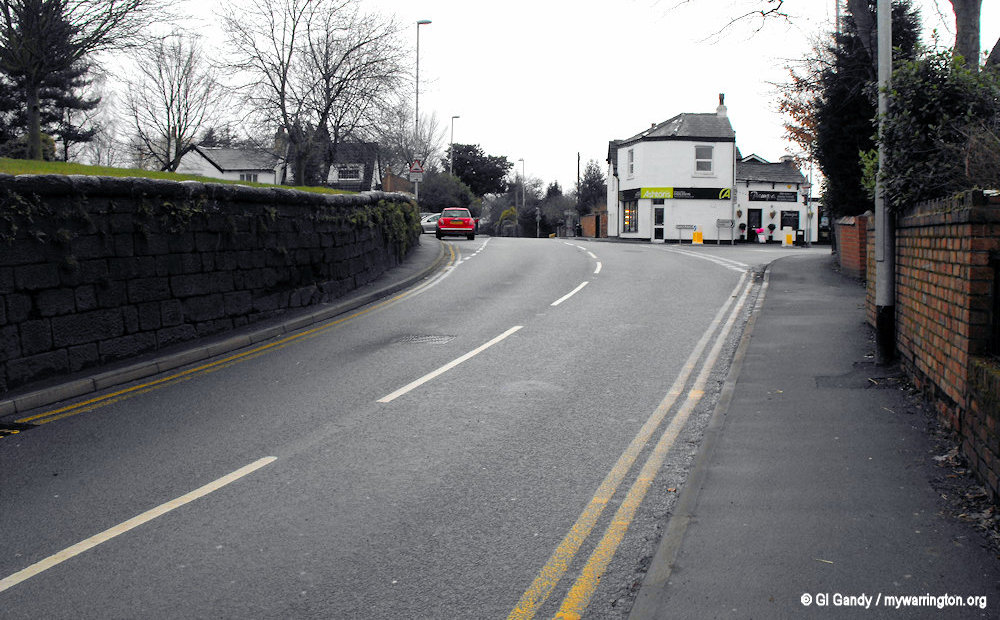
Golborne Road runs alongside the church wall. In the distance we can see the old post office building in white (photo taken 5 February 2009).
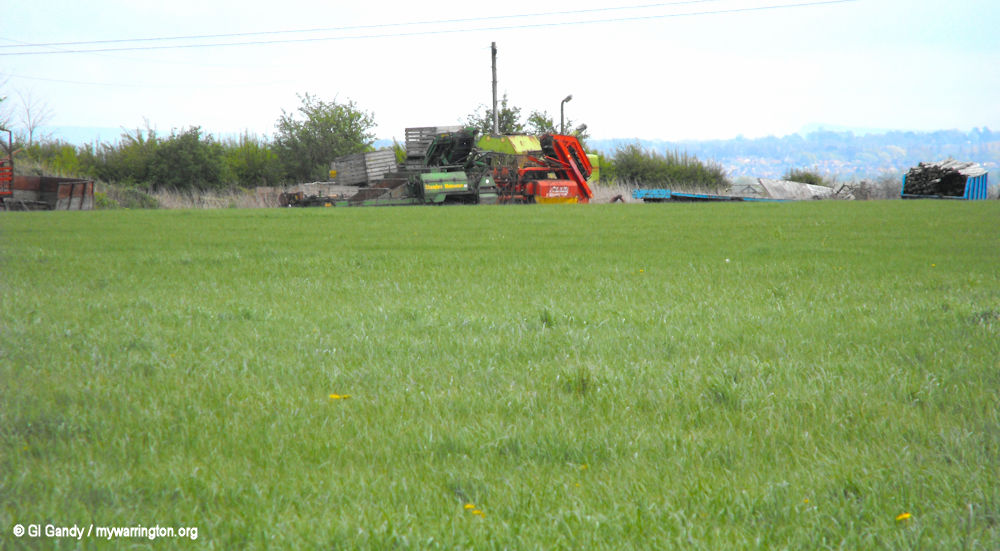
Farm machinery off Golborne Road (20 Apr 2012).
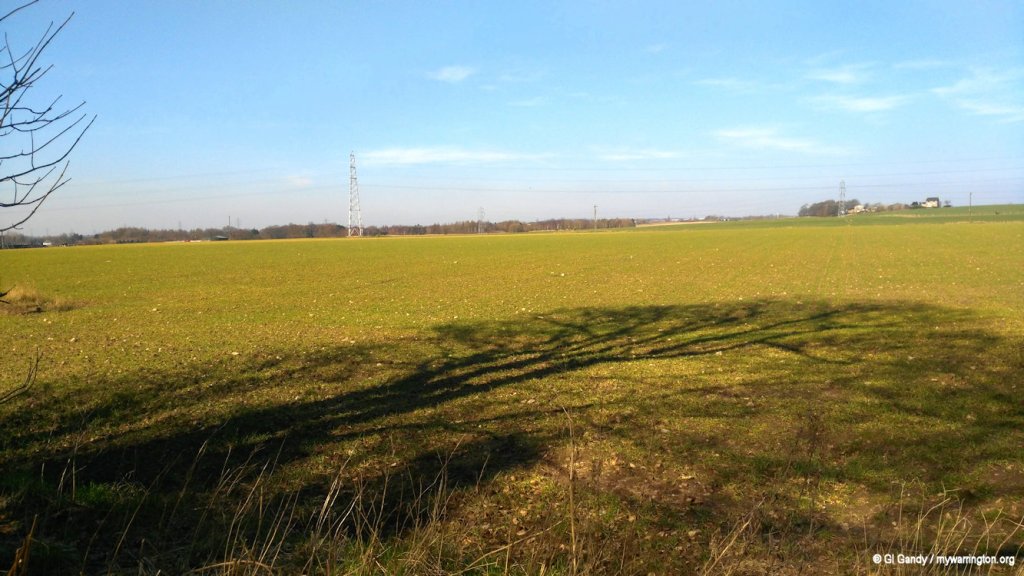
Land off Hollins Lane on the western side of the village (14 March 2016).
St Oswald’s Church
St Oswald’s Church is a Grade I listed building and run by the Church of England. A church at Winwick is recorded in the Domesday Book, built around 636 AD). The earliest parts of the present church are the bases of the north arcade, which date from the early 13th century, and the walls of the Legh Chapel and the organ chamber, which are dated 1330. The west tower was built in 1358 and the walls and north arcade of the nave date from 1580. The south porch was added in 1720 and the south arcade of the nave was rebuilt in 1836 reusing earlier stones. The chancel, sanctuary and vestry were rebuilt by Pugin in 1847–49 for the 13th Earl of Derby. Much damage was done to the church in 1648 when Oliver Cromwell stationed his troops in the church after the Battle of Red Bank.
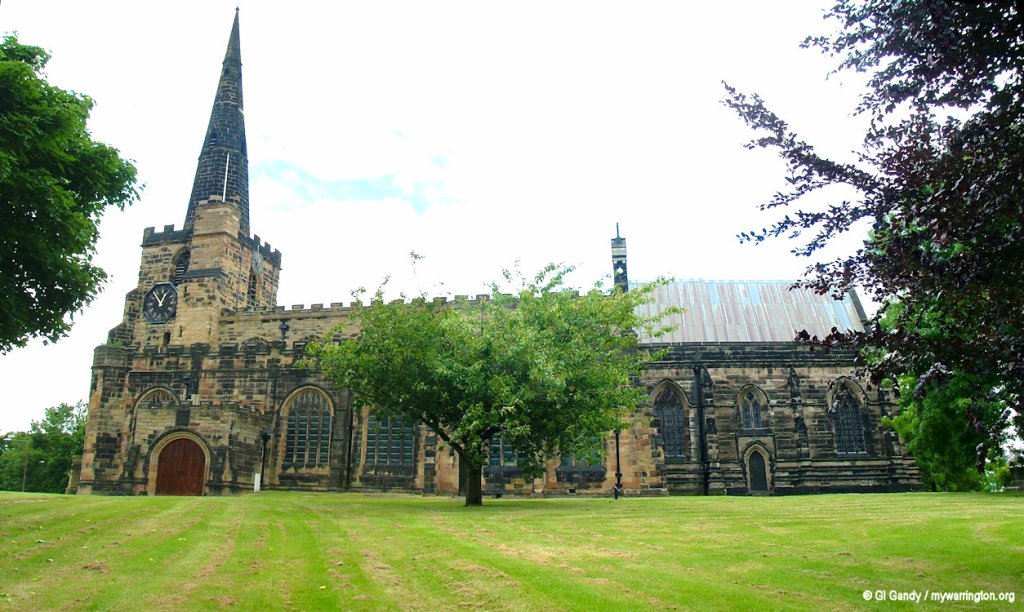
St Oswald’s Church from the south (13 Jun 2008)
The church is built of sandstone with a stainless steel roof. Its plan consists of a west tower, a nave of six bays with a clerestory (a high wall with a narrow band of windows along the very top), north and south aisles, a south porch, a chapel in the east bay of each aisle, a chancel and sanctuary of three bays, and a north vestry. The south chapel is the Legh Chapel and the north chapel belonged to the Gerard family. The tower is in three stages and has a recessed spire. On the west face is a door above which is a three-light window. On each side of the window are niches containing restored statues of Saints Anthony and Oswald. To the right of St Anthony is a carved pig. On the west and east sides are clock faces. Above these are two-light belfry windows; the parapet is crenellated, i.e. has battlements. The parapet of the north aisle is plain, that of the south aisle is crenellated. On the west gable of the chancel is a bell cote.
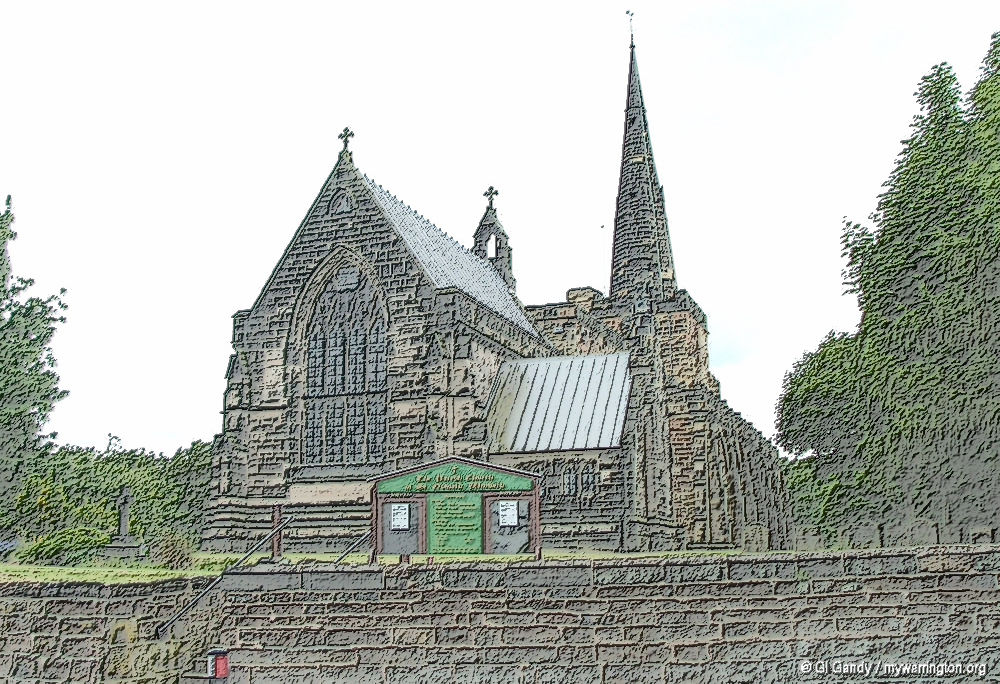
My artistic impression of St Oswald’s Church from the east (5 Feb 2009)
St Anthony is often depicted with a pig. He is the patron saint of swineherds, among many other things.
His relationship with pigs and patronage of swineherds is a little complicated. Skin diseases were sometimes treated with applications of pork fat, which reduced inflammation and itching. As Anthony’s intervention aided in the same conditions, he was shown in art accompanied by a pig.
People who saw the art work, but did not have it explained, thought there was a direct connection between Anthony and pigs – and people who worked with swine took him as their patron.
The nave and aisles have camber beam panelled oak roofs dated 1711. The Legh Chapel has a 16th century panelled roof. In the Legh Chapel is a brass to Sir Peter Legh dated 1527.
Also in the chapel are monuments to other members of the Legh family, including one to Mrs Ellen Legh, who died in 1831, by R J Wyatt. In the Gerard Chapel is a damaged font dating from around 1400 and a brass to Peter Gerard who died in 1495.
Beneath the floor of this chapel is the family vault, but this has not been used since the Reformation. At the east end is a communion table dated 1725. On the north wall is an aumbry (a small recess or cupboard in the wall of a church). On a window-ledge in the Gerard Chapel is the cross-arm of an Anglo-Saxon preaching cross dating from around 750.
The pews, furnishings and glass in the chancel and sanctuary were designed by Pugin. The timber screen between the nave and the tower was erected in 1920 as a First World War memorial. The ring is of six bells.
Information: Wikipedia.
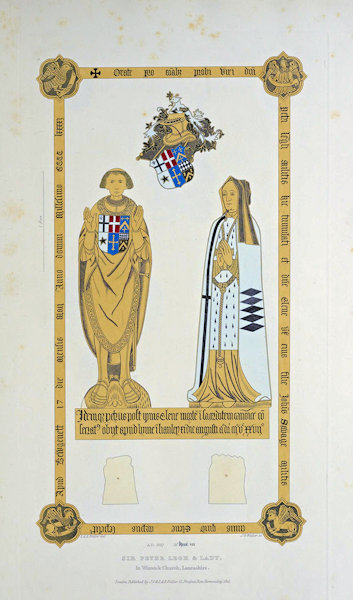
Memorial brass to Sir Peter and Dame Ellen Legh, St Oswald, Winwick, Lancashire. From: A series of monumental brasses, extending from the reign of Edward I. to that of Elizabeth, 1840.
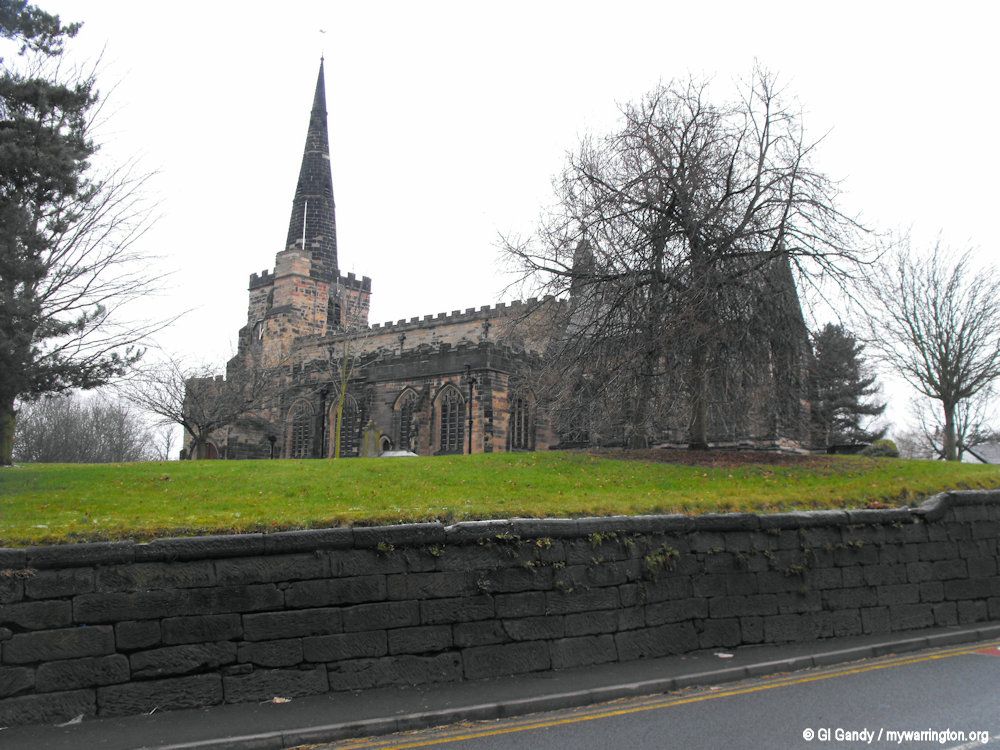
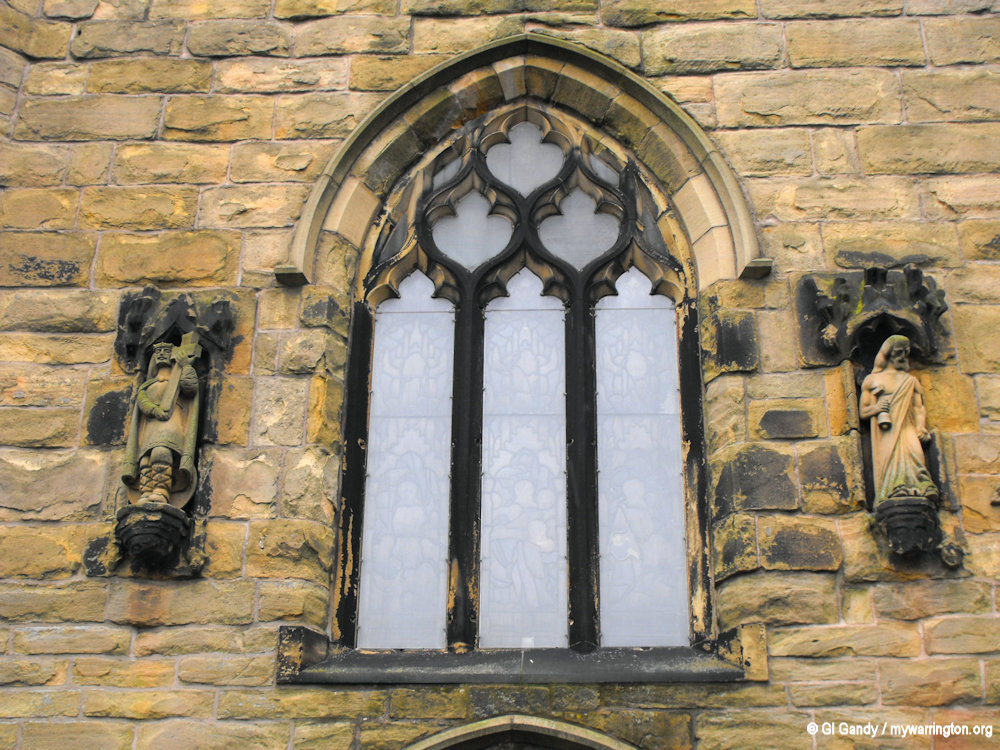
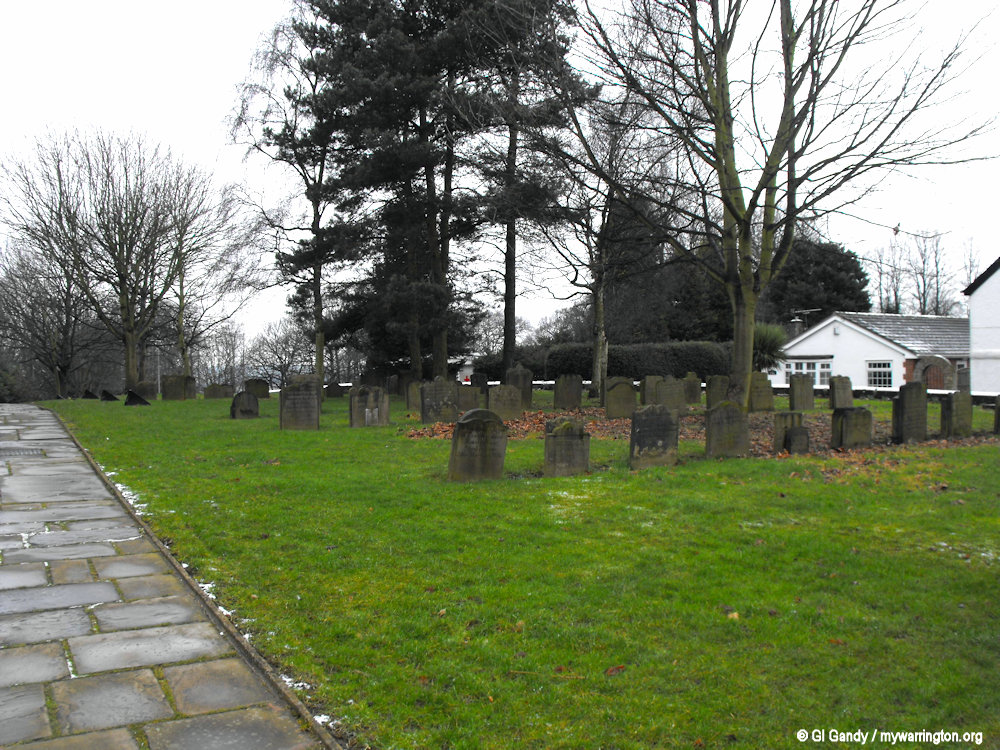
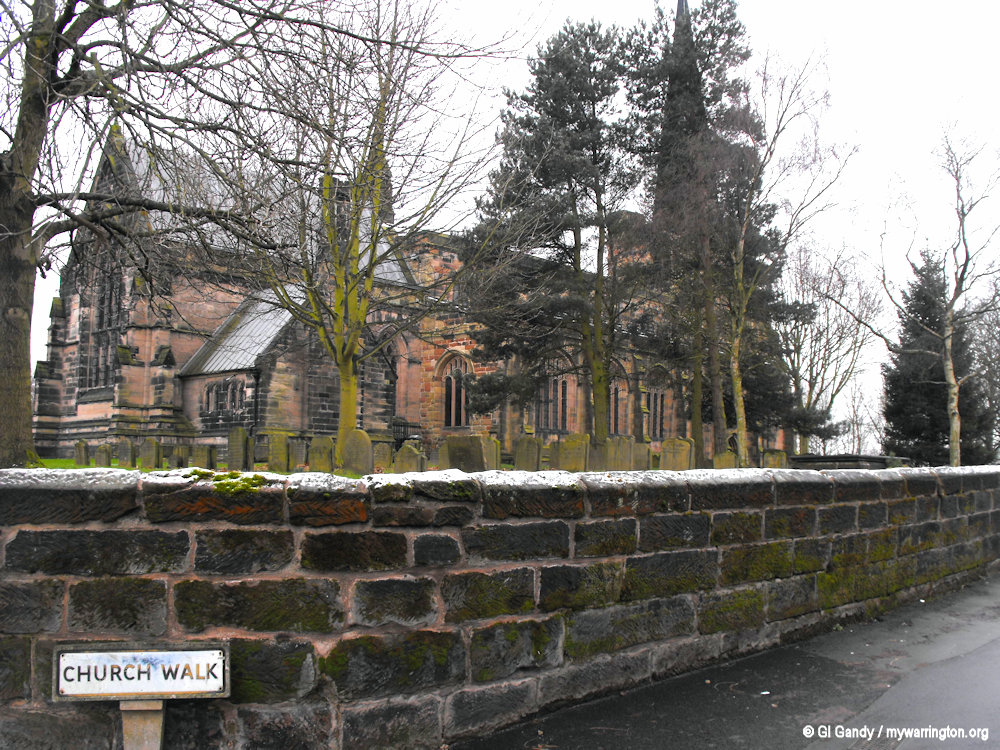
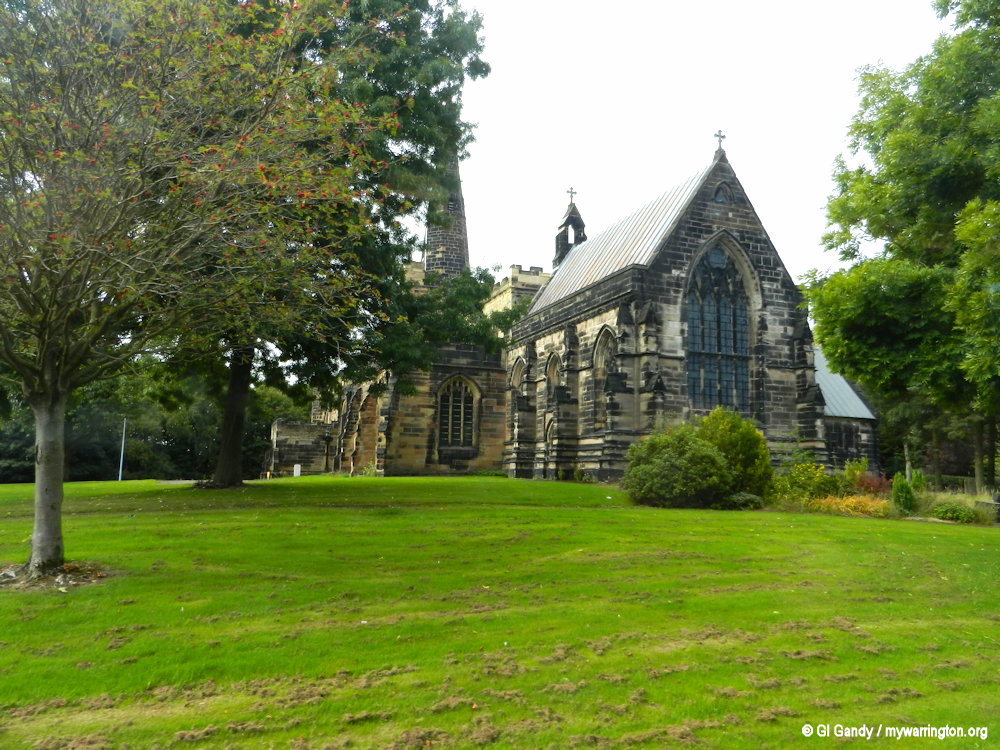
More photos of the church
A major Anglo-Saxon crosshead was discovered in the churchyard in 1830, and parts of the church have Roman and Norman masonry, suggesting a long history of settlement at the site.
Outside the southern entrance to the church grounds is a memorial to John Thompson of the parish highways department.
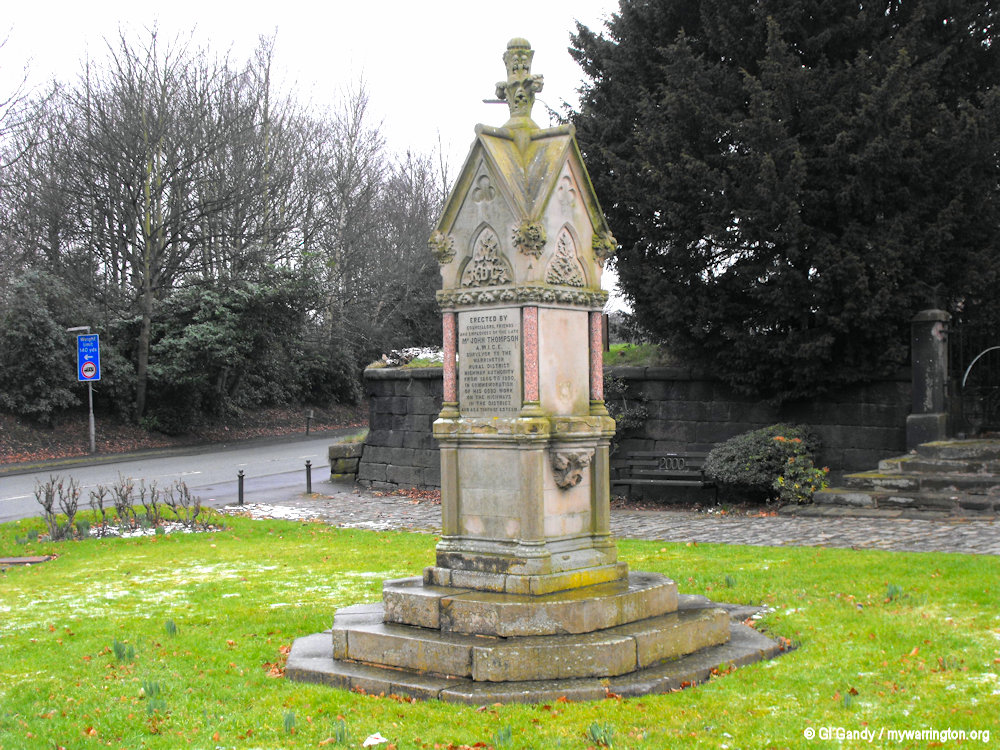
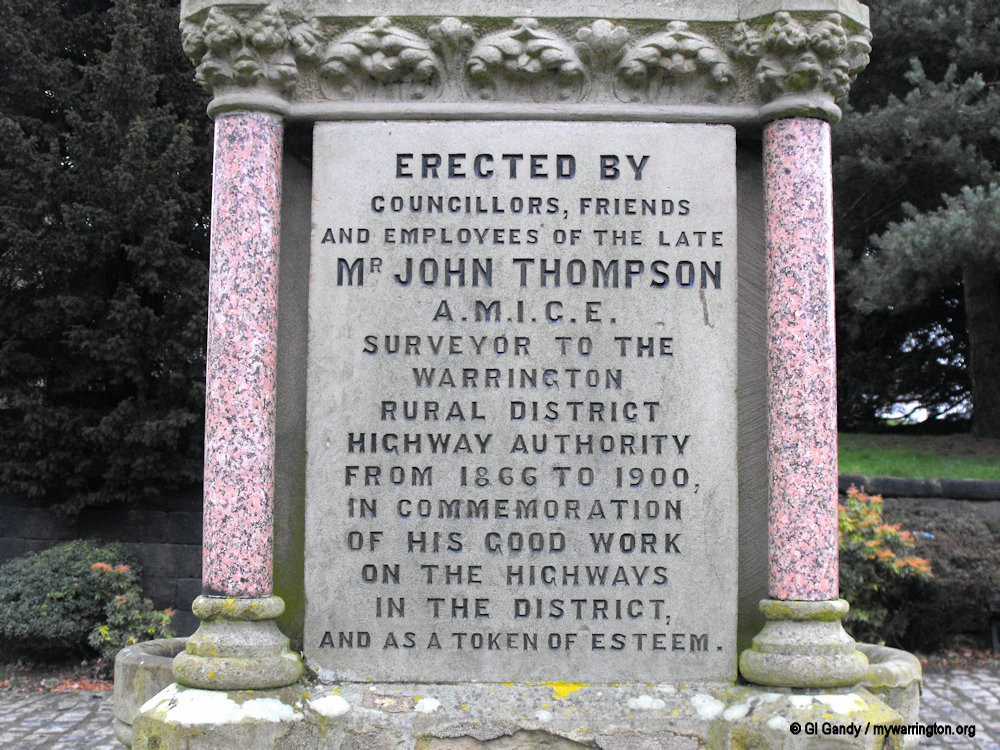
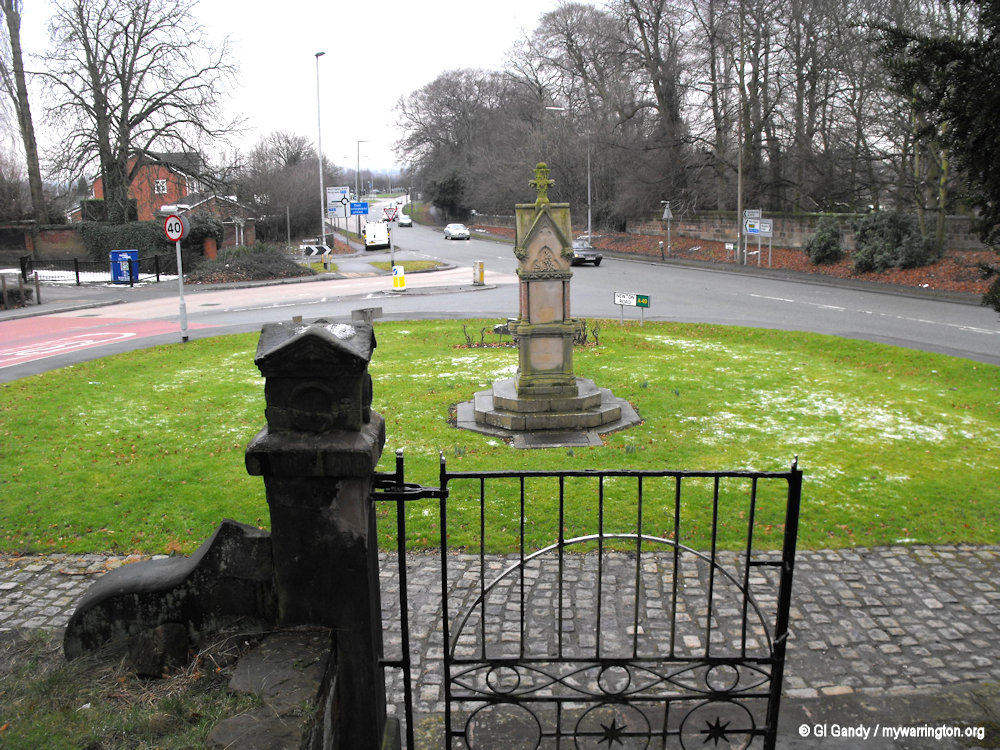
Winwick Chantry
Towards the beginning of the 14th century, the riches which had flowed into the religious houses had produced upon their inmates such damaging habits of pride and luxury, as led to a new direction being given to religious gifts, leading the donors, instead of endowing monasteries, to found chantries, such as the Holy Trinity in Winwick Church, which arose out of this feeling and had this beginning.
A chantry, for those not in the know, is one of two things: a chantry service, a set of Christian liturgical celebrations for the dead (made up of the Requiem Mass and the Office of the Dead), or a chantry chapel, a building on private land, or an area in a parish church or cathedral reserved for the performance of these celebrations. In the Medieval Era through to the Age of Enlightenment it was commonly believed such liturgies might help atone for misdeeds and assist the soul to obtain eternal peace. Sorry to spoil your story with the facts, but Ephesians 2: 8-9 says we are saved by grace through faith, not by works, lest anyone should boast.
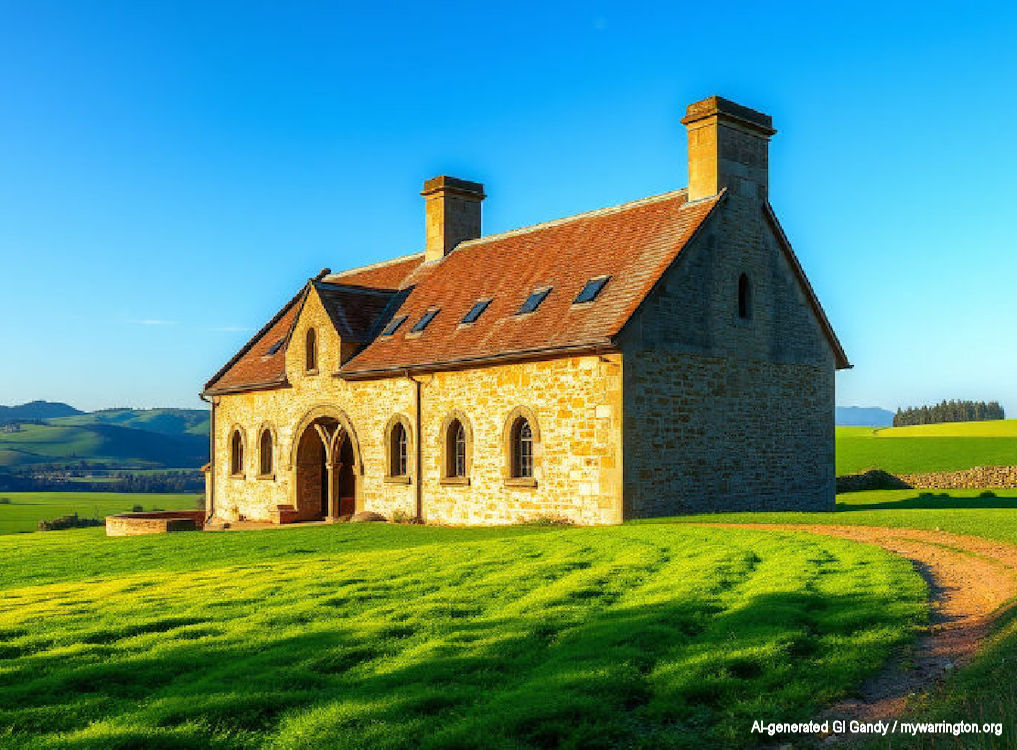
My AI-generated image of a chantry.
This chantry was founded by Sir Gilbert de Haydoc, of Haydoc, in the parish of Winwick, knight, who in 1330 during the reign of Edward III, presented his petition to Richard de Northburgh, formerly archdeacon of Richmond, for a licence to build and endow it. For evidence of those beliefs about chantries, in the same year it is written that for the good of his soul after death, and for the souls of his father and mother, for the souls of all his ancestors and of all the faithful deceased, and for the increase of divine love, the same Sir Gilbert obtained the King’s licence by a writ of ad quod damnum (to which loss), which issued to Edward III, together with the consent of the rector of Wynquek and others, to found such chantry. He thereupon in pure and perpetual alms, and for the sustentation of a chaplain [I’d love it if his name was Charlie], to say divine offices in the chapel of Holy Trinity, in the parish of Wynquick.

Field off Golborne Road in Winwick village (20 Apr 2012)
The chaplain was to provide such chalices, books, vestments and other ornaments as the said chantry might need, or might be required for the greater glory of God, those first used being provided by the founder himself. The chaplain was to pray for all those who might be notified during the life of the founder, and after his death by Matthew de Haydock, his son and heir. The founder’s heir were to nominate a fit chaplain after the death of Humphrey Pindere (he was appointed the first priest of the Holy Trinity of Winwick on 24 December 1330), who was to receive during the term of his natural life, even though he became infirm and unable to discharge his duties, a fixed and certain salary. in order that he might be decently supported out of the endowment of the said chantry until the impediment should cease.
Following the English Reformation in England initiated by King Henry VIII, Parliament passed an Act in 1545 which defined chantries as representing misapplied funds and misappropriated lands. The Act provided that all chantries and their properties would thenceforth belong to the King for as long as he should live. King Edward VI, signed a new Act in 1547, which ended 2,374 chantries and guild chapels and seized their assets.
Notes from Winwick: Its History and Antiquities by William Beamont.
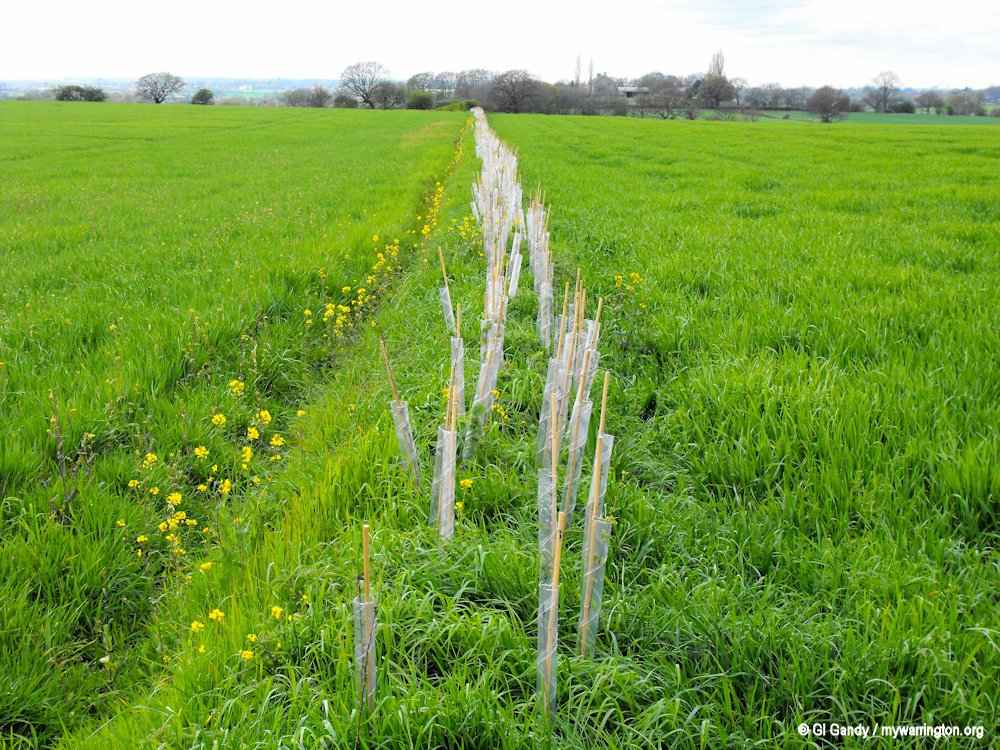
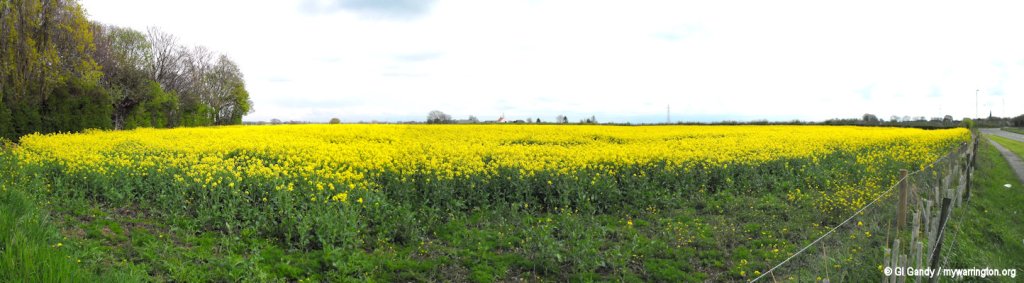
Fields off Golborne Road in Winwick village (20 Apr 2012)
Winwick Grammar School
Winwick Grammar School appears to have been founded prior to 1553, but subsequent to 1546, by Gualter or Gowther Legh, of Woodcroft, in the parish of Winwick. In 1546 he made a will without any mention of the school but he died in 1553, having in the meantime endowed it with £10 a year. Not a large amount, but the school did send boys to the universities in the 17th century.
The grammar school was erected in 1618 by Sir Peter Legh, great-nephew of Gaulter Legh, but it is probable that an earlier, if only a temporary, school house existed, since we are told by Mr. Beamont that in 1817 a copper-plate, bearing, in Hebrew characters, the inscription, “A building raised to learning in 1600,” was dug up in the parish churchyard.
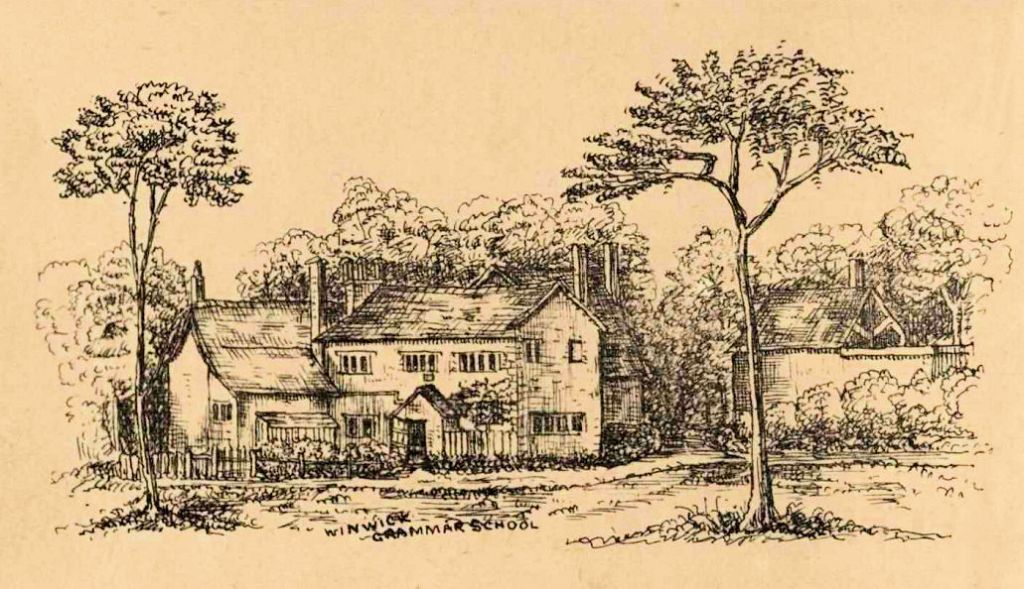
Winwick Grammar School in an illustration from Warrington Local Sketches by James Kendrick
An inscription inside the building at the time says:
This howse was builte by Sir Peter Legh, knight, upon his owne charges, in the yere of our Lord, 1618, to be a schoole-hous for ever, for the free schoole of Winwicke, founded by Gualter Legh, Esquire, great uncle of the said Sir Peter Legh, which Gualter gave ten pounds of yerly rent for the perpetual maintenance of the said school; and the said Sir Peter hath augmented the same with ten pounds per annum mor, which he hath assured to be yearlye paide to the same free schoole for ever, for his zeal to God’s glorye and his love to the parish of Winwick and common good of the countrey.
Delph Lane, Winwick (27 June 2012)
The first appointed schoolmaster was Richard Mather, although he was only 15 years old at the time, in 1611. Two main subjects taught at the school were Latin and Greek. In 1612, Mather undertook the mastership of a public school in Toxteth Park, where he had as one of his pupils the celebrated astronomer Jeremiah Horrocks, a native of Toxteth. In 1635, Richard Mather left Toxteth and after emigrating to New England, joined the Pilgrim Fathers on the Mayflower in 1620. He was subsequently the father of Increase Mather, and grandfather of the still more celebrated Cotton Mather. He died in America in 1669, and some years after his death the following absurd epitaph was placed on his grave:
Under this stone lies Richard Mather,
Who had a son greater than his father,
And eke a grandson greater than either.
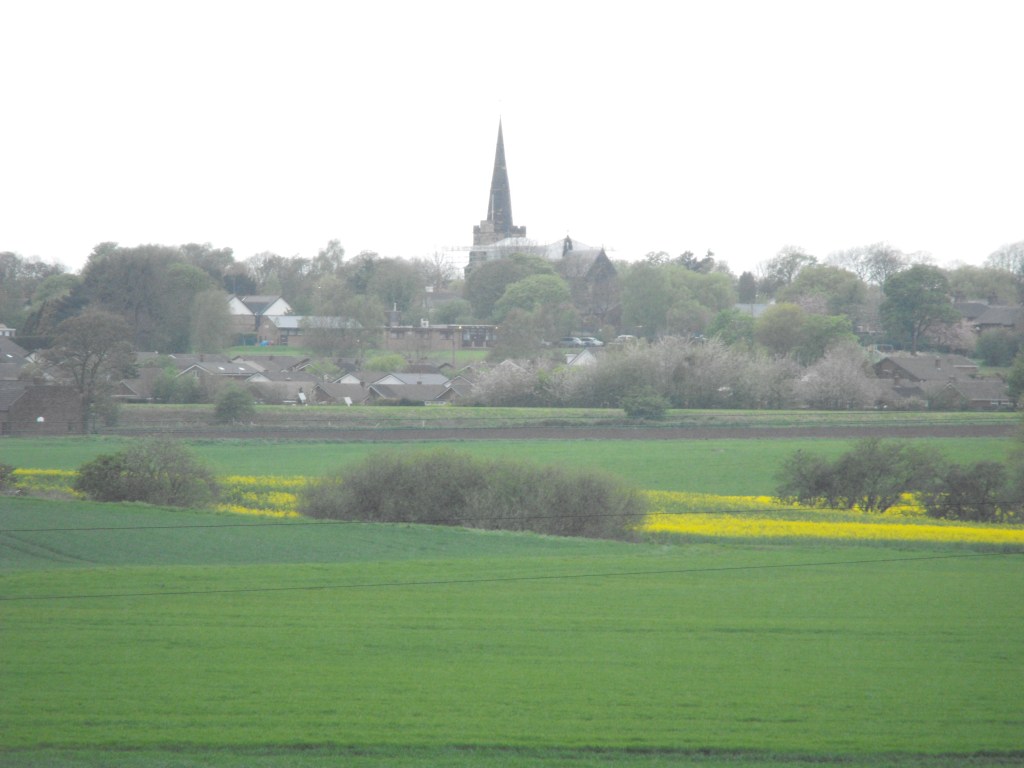
St Oswald’s Church, as seen from Delph Lane by the M62 motorway (27 April 2012)
The school was in operation until it was replaced by a new Church of England school in 1870, which was built to replace the grammar school and other existing schools.
Notes from Warrington Local Sketches by James Kendrick (1876).
The Battle of Winwick
Background
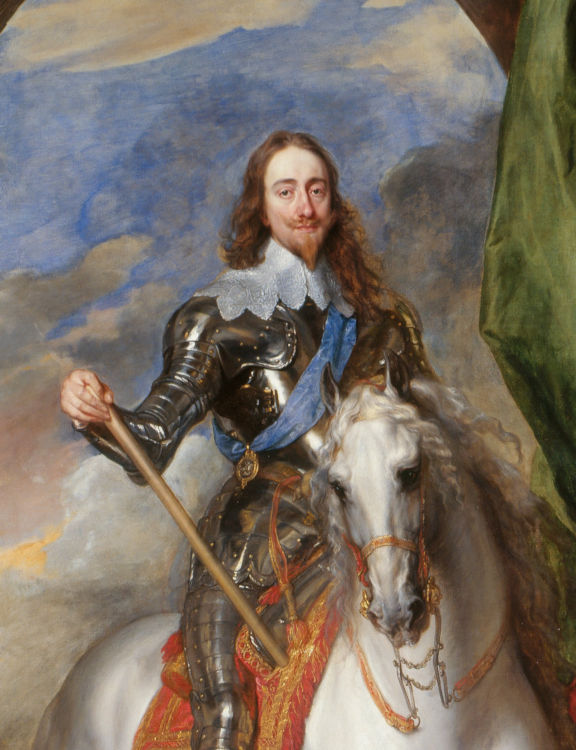
The First English Civil War between Royalist supporters of Charles I and an alliance of Parliamentarian and Scottish forces ended in 1646 with Charles defeated and a prisoner. He continued to negotiate with several factions among his opponents and this sparked the Second English Civil War in 1648: a series of mutinies and Royalist uprisings in England and Wales, and a Scottish Royalist invasion of north-west England. The invading army was attacked and defeated by a smaller Parliamentarian army at the battle of Preston on 17 August.
The Battle of Winwick (also known as the Battle of Red Bank) was fought on 19 August 1648 near Winwick between part of a Royalist army under Lieutenant General William Baillie and a Parliamentarian army commanded by Lieutenant General Oliver Cromwell.
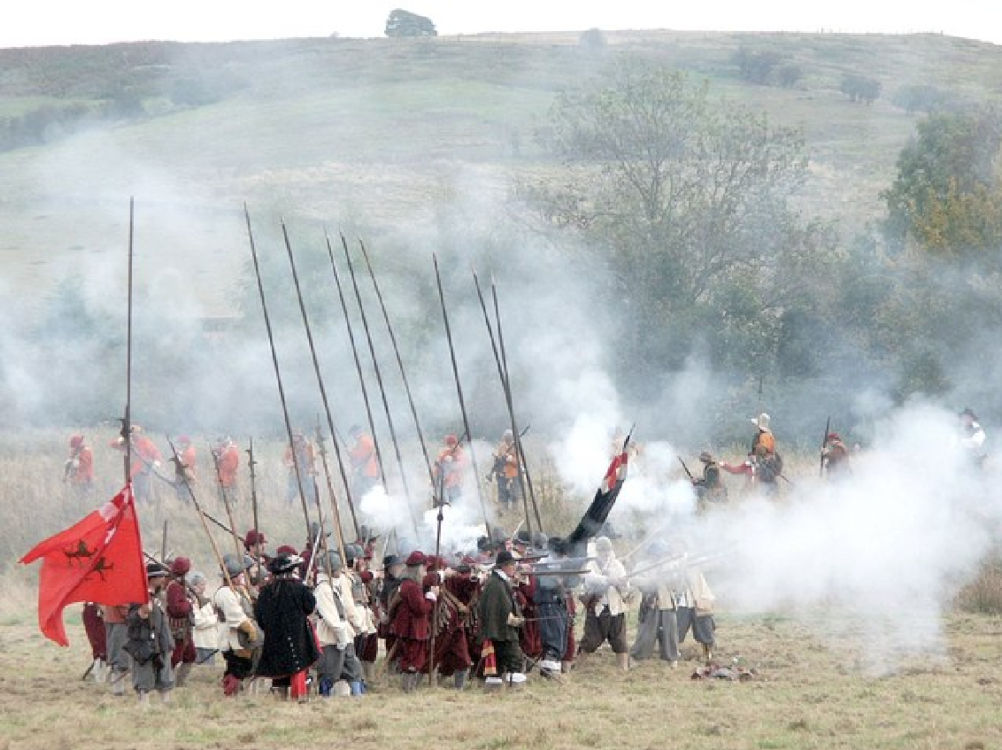
The Siege of Bolingbroke Castle Musketeers and pikemen group together (Civil War re-enactment group for illustration purposes). Photo by Dave Hitchborne (Creative Commons Attribution-Share Alike 2.0 Generic license.)
The majority of the Royalists, mostly Scots, had not been engaged but they fled south, closely pursued by the Parliamentarians, mostly of the New Model Army. On 19 August, hungry, cold, soaking wet, exhausted and short of dry powder, the Scottish infantry turned to fight at Winwick. Their cavalry waited 3 miles (5 km) away at Warrington. The Parliamentarian advance guard was put to flight with heavy casualties. After a lengthy pause, Parliamentarian infantry arrived: they attempted to storm the Scottish position and were thrown back. A full-scale assault was then launched which resulted in more than three hours of furious but indecisive close-quarters fighting. The Parliamentarians fell back again, pinned the Scots in place with their cavalry and sent their infantry on a circuitous flank march. As soon as the Scots saw this force appear on their right flank they broke and fled. Parliamentarian cavalry pursued, killing many. All of the surviving Scots surrendered: their infantry either at Winwick church or in Warrington, their cavalry on 24 August at Uttoxeter. Winwick was the final battle of the war. In its aftermath Charles was beheaded on 30 January 1649 and England became a republic on 19 May.
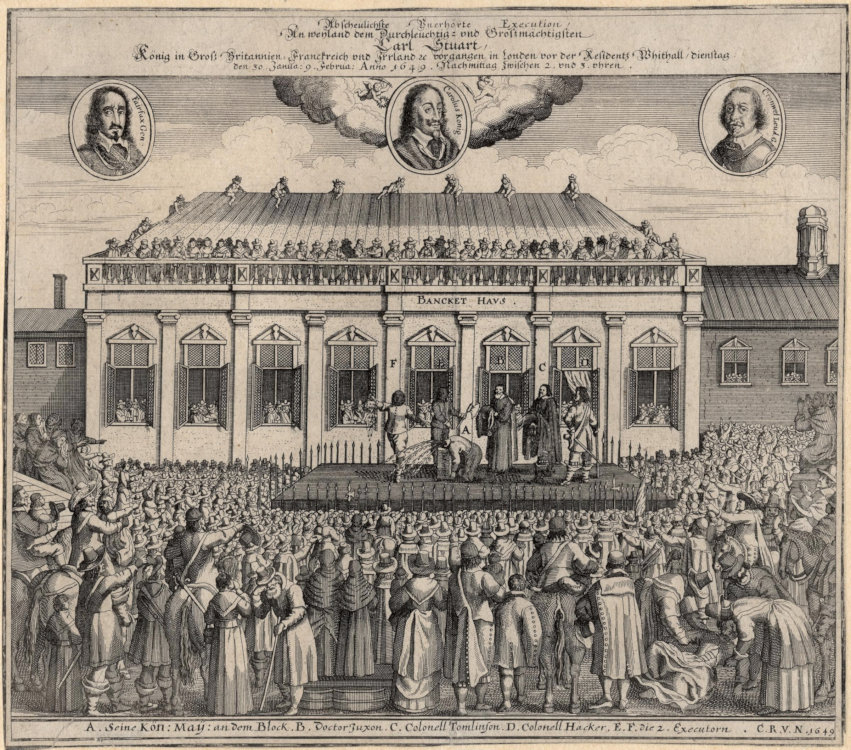
The execution of King Charles I (artist unknown).
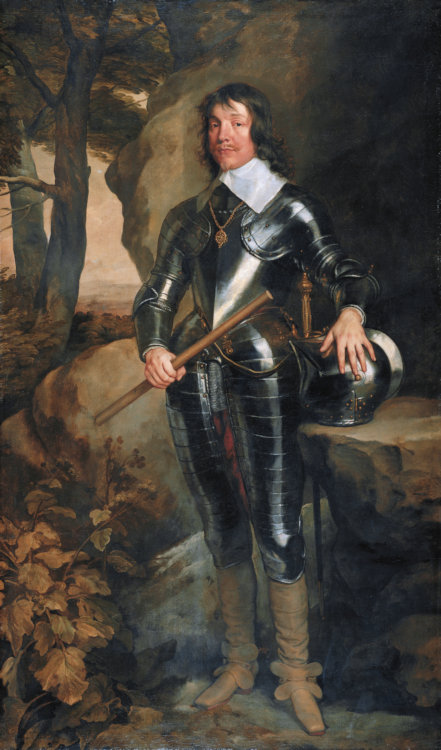
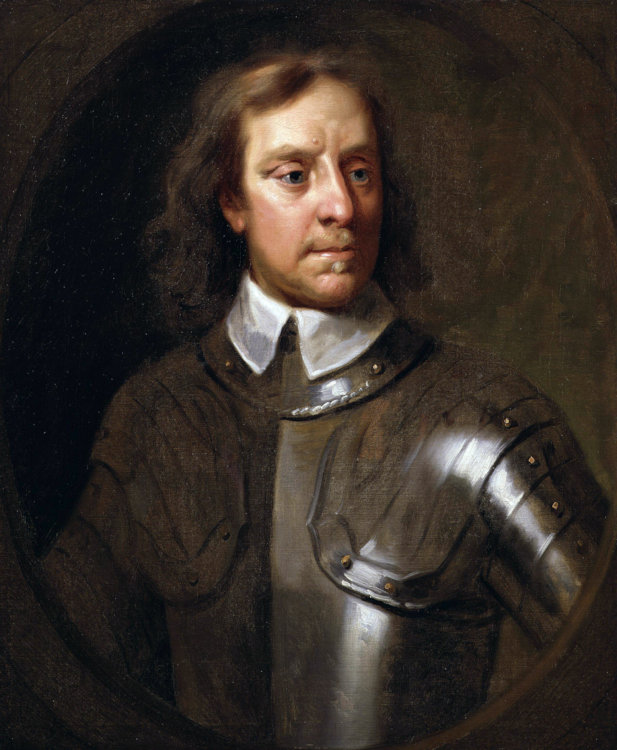
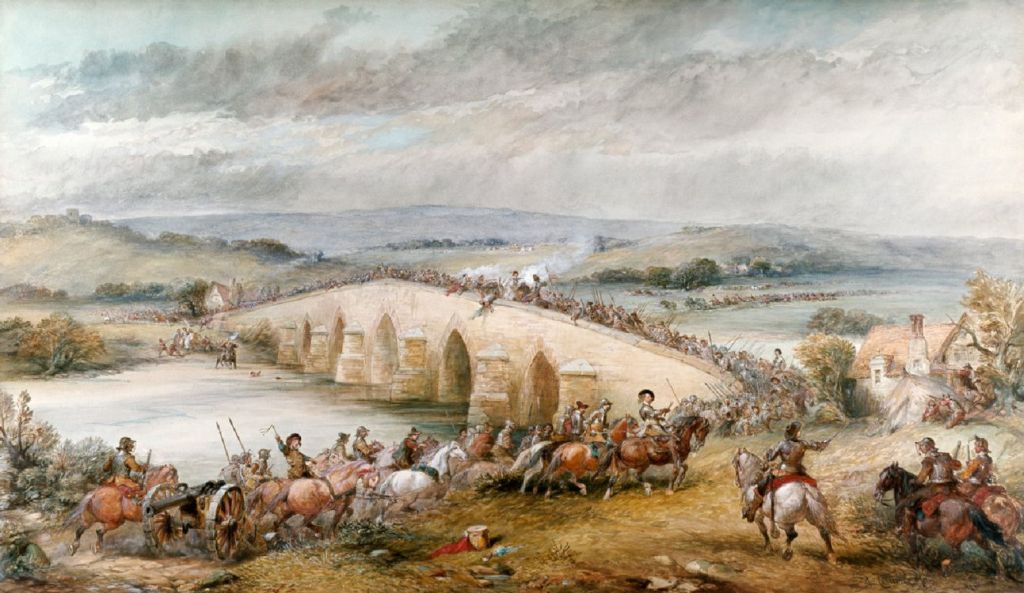
Information: Wikipedia.
The Winwick Broad Oak
The Winwick Broad Oak was a famous, large oak tree in the village, known for its beauty and size. It was a local landmark where public events, such as a dinner for Admiral Sir Phipps Hornby, were held beneath its branches. It is also said that 1,000 soldiers once gathered beneath it. The tree was destroyed in a severe gale on 4 February 1850.
The oak tree bore none of the customary signs of great age, though it died of a sadly premature decay, occasioned by the unchecked trampling of cattle round its base.
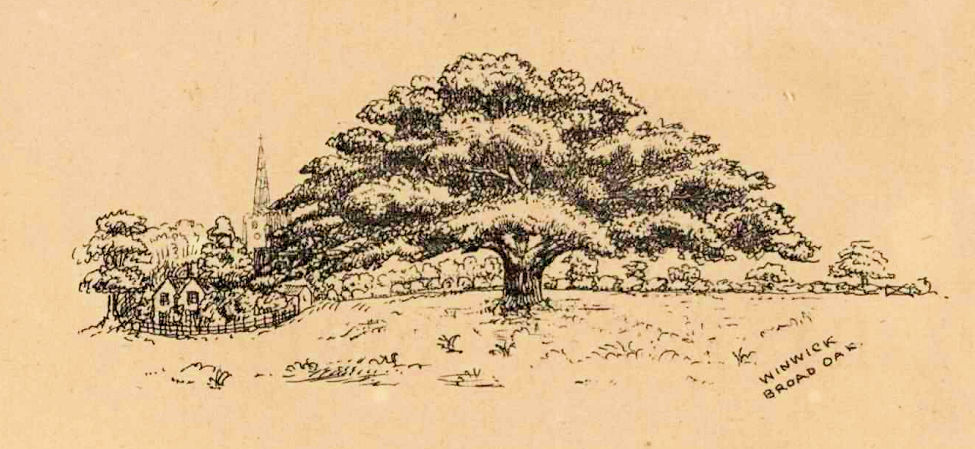
A drawing of the Winwick Broad Oak in James Kendrick’s Warrington Local Sketches (1876)
Still, it had for many years been famous throughout the country for its beautiful symmetry, and for the marvellous extent of its wide-spreading branches.
The extent of the spreading branches from north to south was 99 feet (30 m), and from east to west 87 feet (26.5 m). The girth of the trunk at the base was 14 feet (4.27 m), and at five feet (1.52 m) higher it was 11½ feet (3.51 m). The first branch was given off from the trunk at 7½ feet (2.29 m) from the ground.
But from the year 1811 it attained additional celebrity from a public dinner which was given beneath its shade to the late Admiral Sir Phipps Hornby, then captain of the English ship “Volage.”
This was in commemoration of his heroic conduct and success in capturing the French line-of-battle ship “Corona,” off the island of Lissa in the Adriatic, on 13 March 1811.
The “Volage” formed one of a squadron of four vessels under Captain Hoste, which completely defeated a much superior French fleet.
In this battle the British captured or destroyed four frigates of superior force, and compelled the remainder to seek safety from capture by an inglorious flight.
On 28 August 1811 following, the public dinner already spoken of was given to Captain Hornby by the gentlemen of Winwick, of which village he was a native, his father, the Rev. Jeffrey Hornby, being the rector.
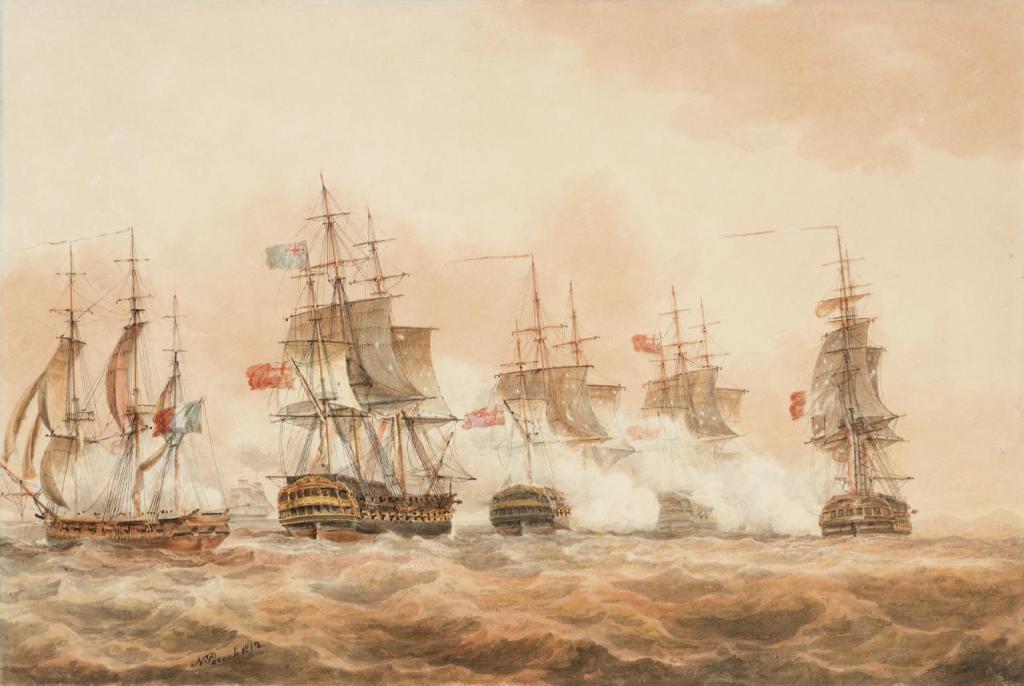
The Battle of Lissa 1812 Nicholas Pocock 1741-1821
From the extreme branches of the Broad Oak an outer and inner awning were suspended, the space thereby enclosed being occupied by three long tables, at which all, or nearly all, the local aristocracy and gentry took their seats.
After a substantial dinner, speeches were made, toasts were given, and songs, of course, were sung (several of the last being original), to the several tunes of “Rule Britannia,” “The Death of Abercromby,” and “Aristippus’s Rules,” and highly commendatory of the brave guest of the day, and of his superior officer, Captain Hoste, who was present on the occasion.
Notes from Warrington Local Sketches by James Kendrick (1876).
Warrington Corporation Waterworks
Prior to 1847 it appears that there was no organised system of water supply for the town of Warrington. Supplies were obtained from numerous wells and pumps scattered about the town, which even by the standards of those days, must have produced water a very poor quality. Under an Act of Parliament of June 1846, the Warrington Waterworks Company was incorporated under the direction of John Wilson Patten, Thomas Lyon, Thomas Parr, William Stubbs, Gilbert Greenall, William Hall, John Greenall, John Allan, Samuel Edelsten and Joseph Baxter Edelsten.
The act was entitled “for the better supply with water the town and borough of Warrington or parts thereof, in the counties of Lancaster and Chester and the Township of Latchford and Appleton in the last-mentioned county”. The authorised capital of the company was £16,000 and work was commenced upon the Appleton reservoir. In 1849 an increase of capital by £8,000 was authorised, and again in 1855 the authorised share capital was increased to £45,000.
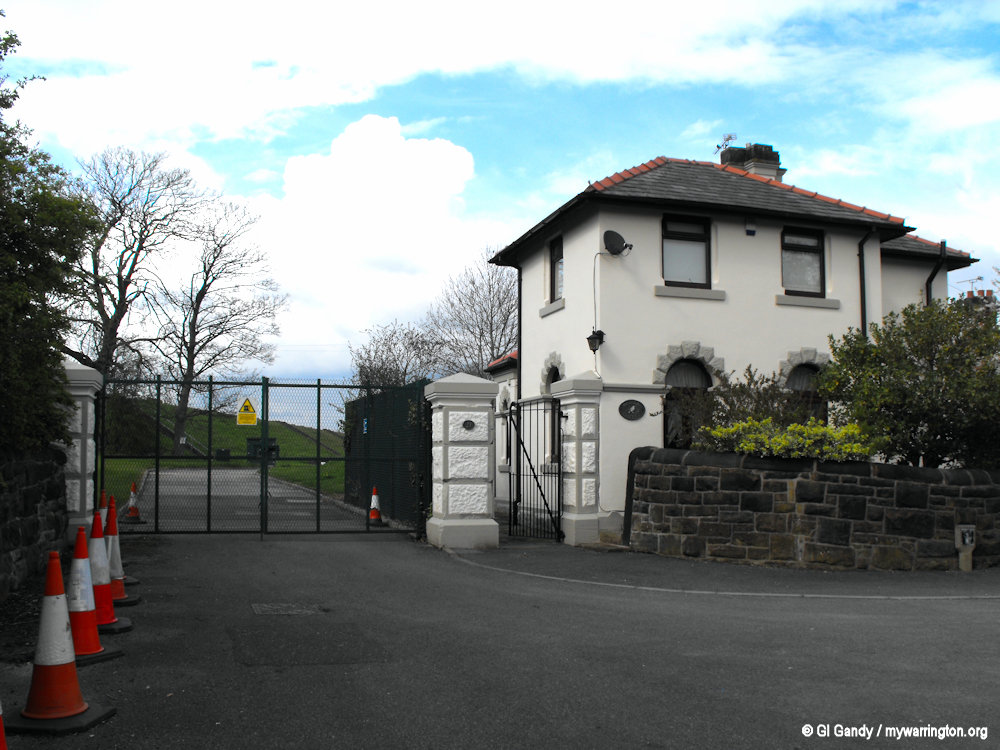
Entrance to the waterworks with Waterworks Cottage, now a private dwelling. 20 Apr 2012.
In 1868 the waterworks company obtained powers to sink wells and adits near Winwick and in 1878 obtained powers to execute further work at Winwick. An “adit” is a nearly horizontal tunnel that provides access to an underground mine for purposes like mineral extraction, ventilation, or drainage.
The act of 1878 imposed an obligation upon the water undertakers (subject to certain provisos) never again to supply water for domestic use from the Appleton reservoir but empowered them to lay and maintain a separate system of mains for the supply of water for trade or manufacturing purposes. This was the inception of Warrington’s separate trade system of water supply, which is a feature shared by only one or two other towns in the country.
By an act of 1890 the whole of the works and assets of the waterworks company were purchased by Warrington corporation as from 1 July 1891, the purchase price being £278,000.
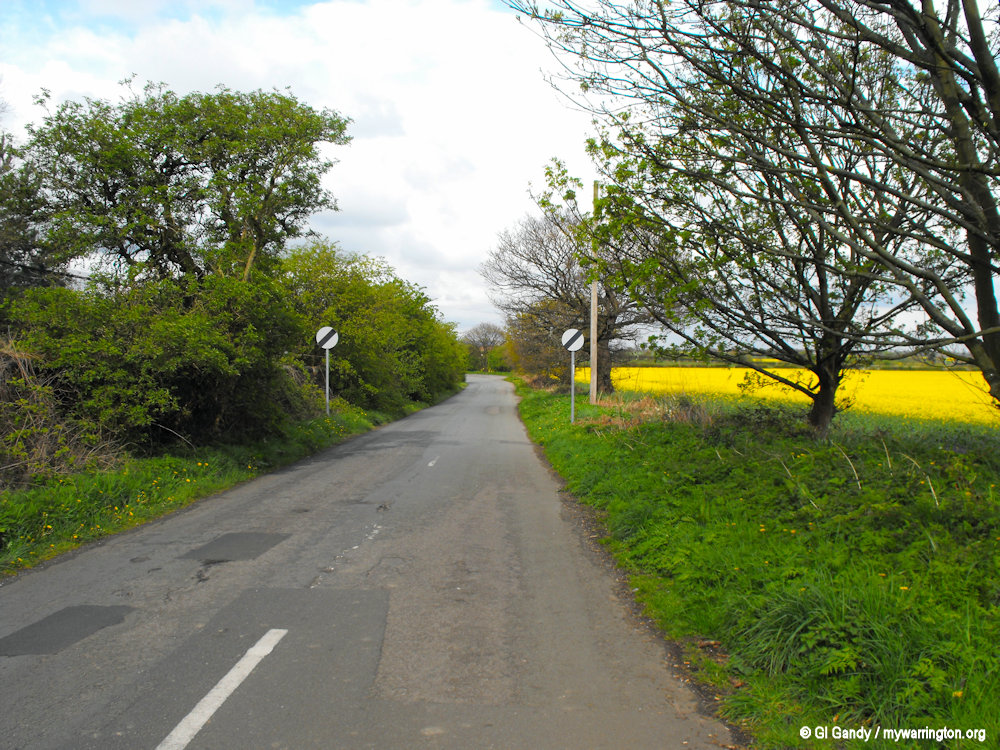
Waterworks Lane on 20 April 2012.
Under an Act of 1899, the corporation constructed the Houghton Green pumping station, erected the Hill Warren Service Reservoir, enlarged the Winwick Service Reservoir and altered the works at Appleton Reservoir. The works were completed in 1903.
With a constantly increasing demand for water the corporation promoted a bill in 1923 with the object of obtaining a water supply from the valley of the Ceiriog in North Wales, but his was withdrawn at the second reading. With that supply not available, Warrington, in 1928, exercised its right to take a bulk supply of water from the Vyrnwy Aqueduct of the Liverpool Corporation.
To ease the demand which manufacturing firms were placing upon the resources is of the domestic supply, the Howley River Treatment Works were built in 1930, and these were extended further in 1939.
In addition to the County Borough of Warrington itself, Warrington supplied water to Burtonwood and Glazebrook in the north and Keckwick, Hatton, Whitley and Appleton in the south, with around 135,000 people benefitting.
From Warrington Hundred (1947). See the National Library of Scotland side-by-side map for a view of the waterworks.
Winwick Church of England Primary School
The present St Oswald’s Church of England School Winwick opened on 4 March 1872 with 81 children, 42 boys and 39 girls. The building, still in use after nearly a century, was erected as a direct consequence of Forster’s Education Act of 1870 which allowed school boards to be elected to provide elementary education in those areas where the voluntary system was either non-existent or inadequate. The cost of building the school came to a little over £656 on land provided by St Oswald’s Church.
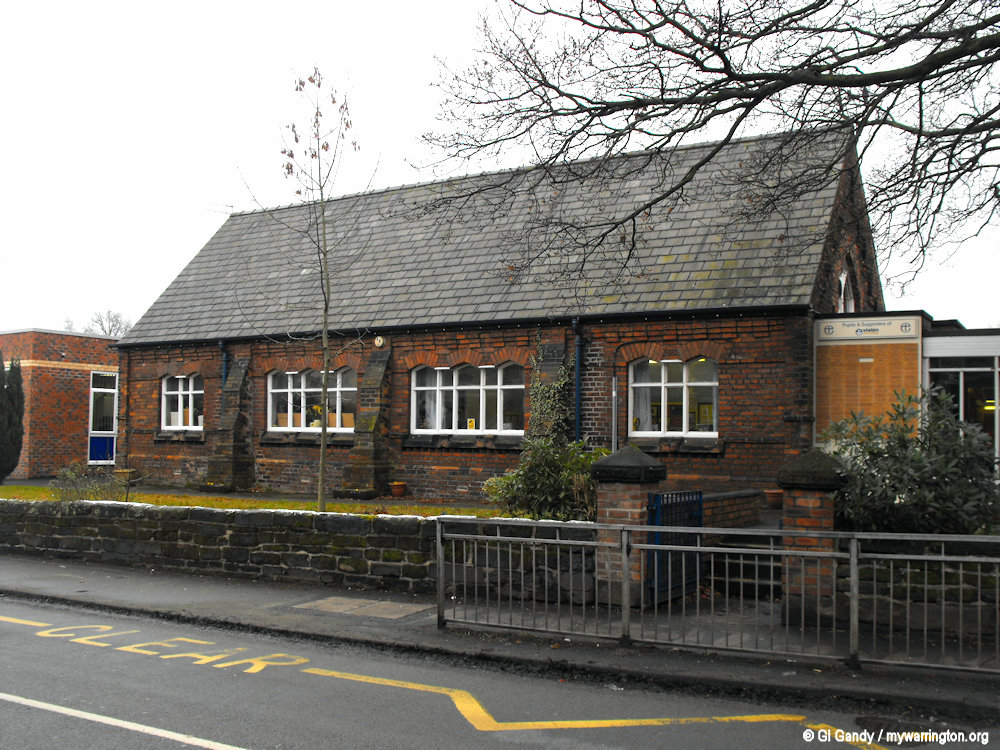
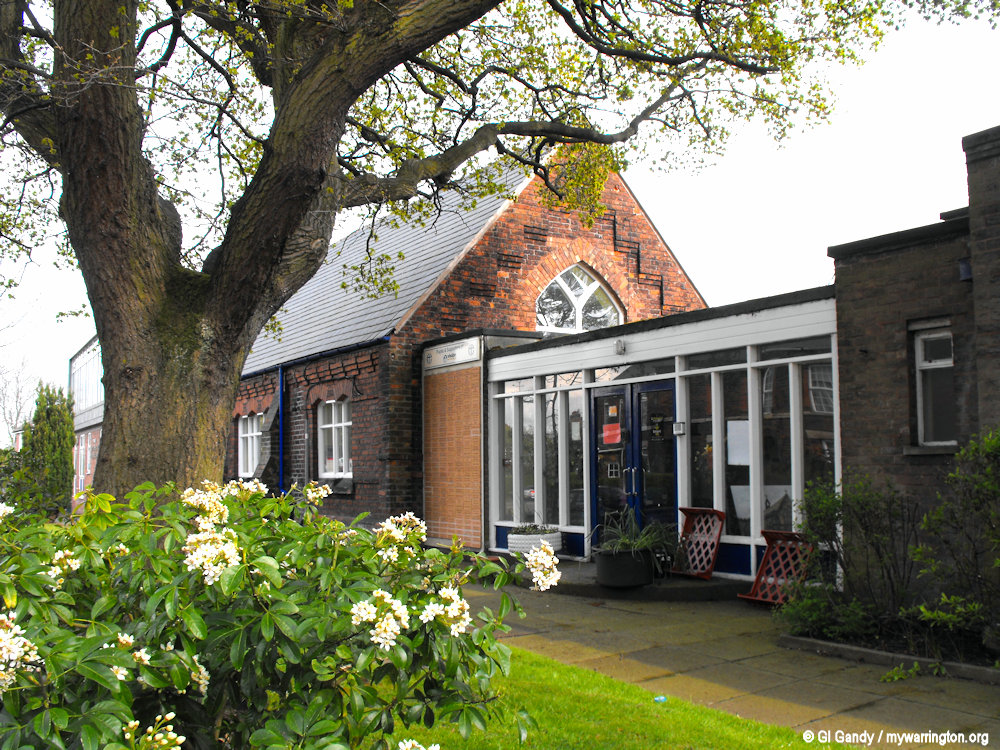
Part of the school building as it looked on 5 Feb 2009.
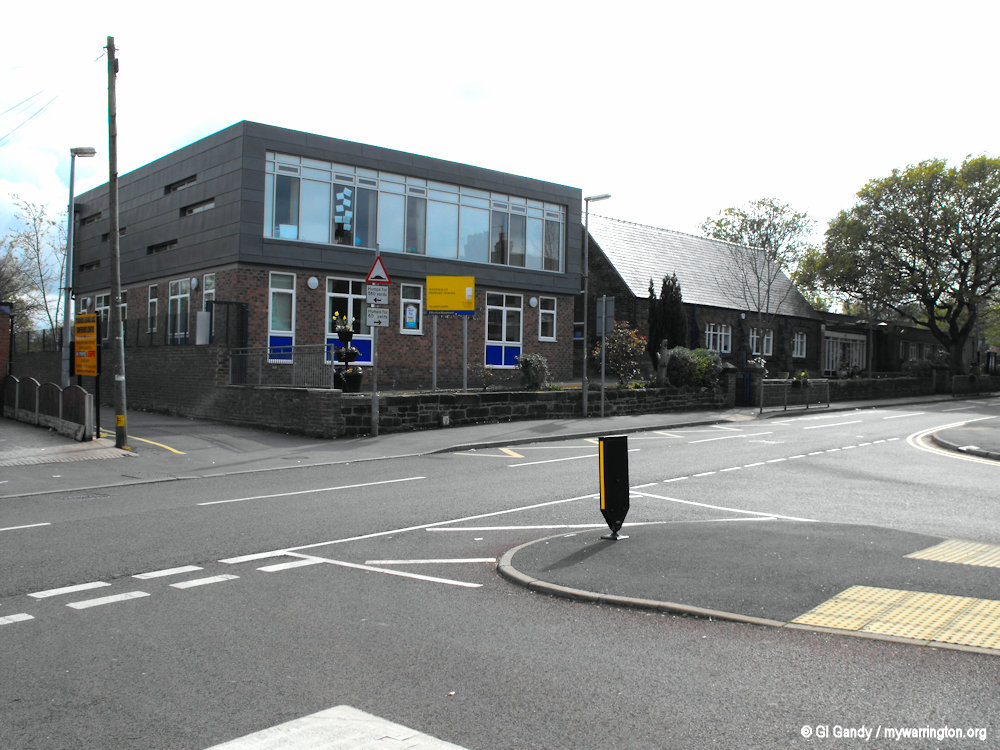
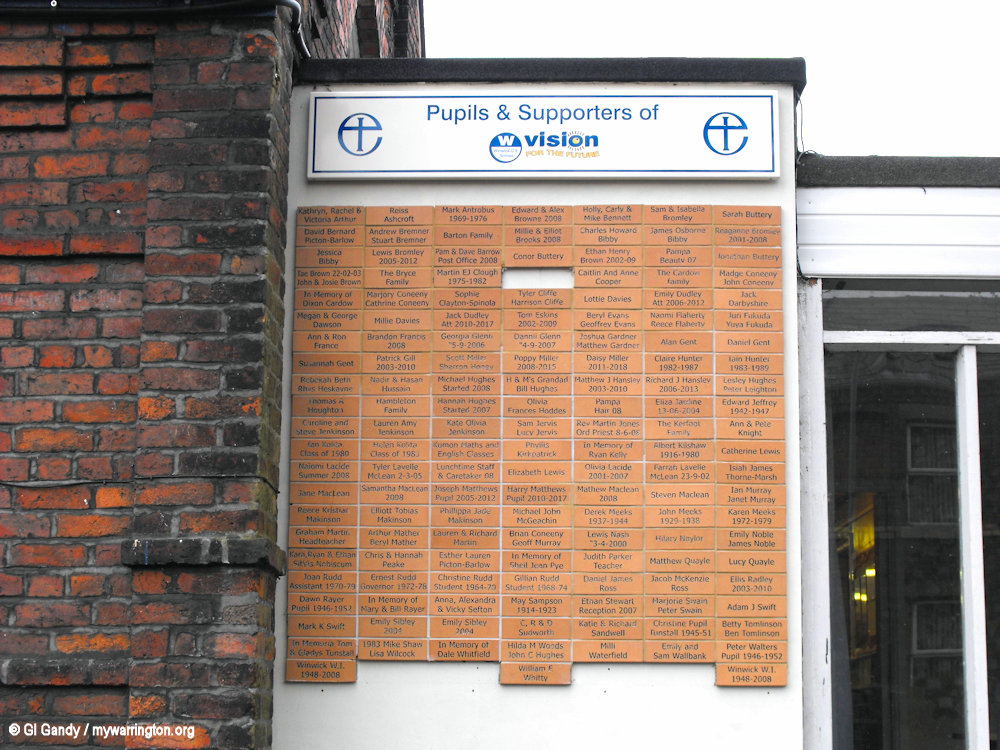
The school building as it looked on 5 Feb 2009.
Captain Smith of The Titanic
Captain of the RMS Titanic, Edward Smith, married Sarah Eleanor Pennington on 13 January 1887 at St. Oswald’s Church. After his marriage he lived at Spar Cottage in Winwick.
Read his profile in Warrington People.
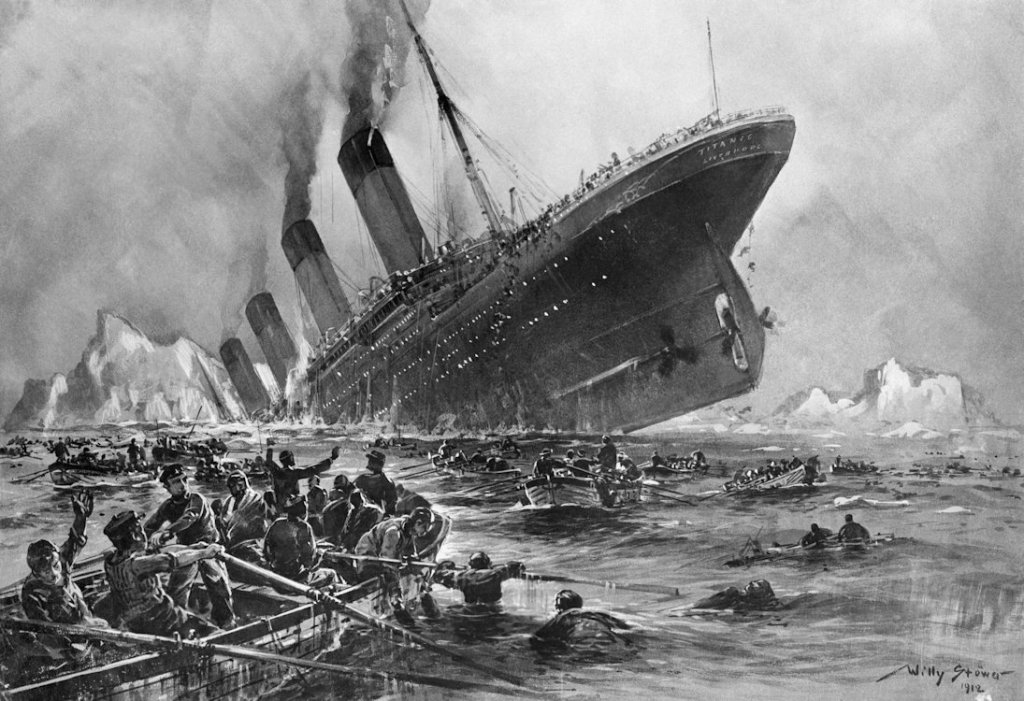
Sinking of the Titanic by Willy Stöwer
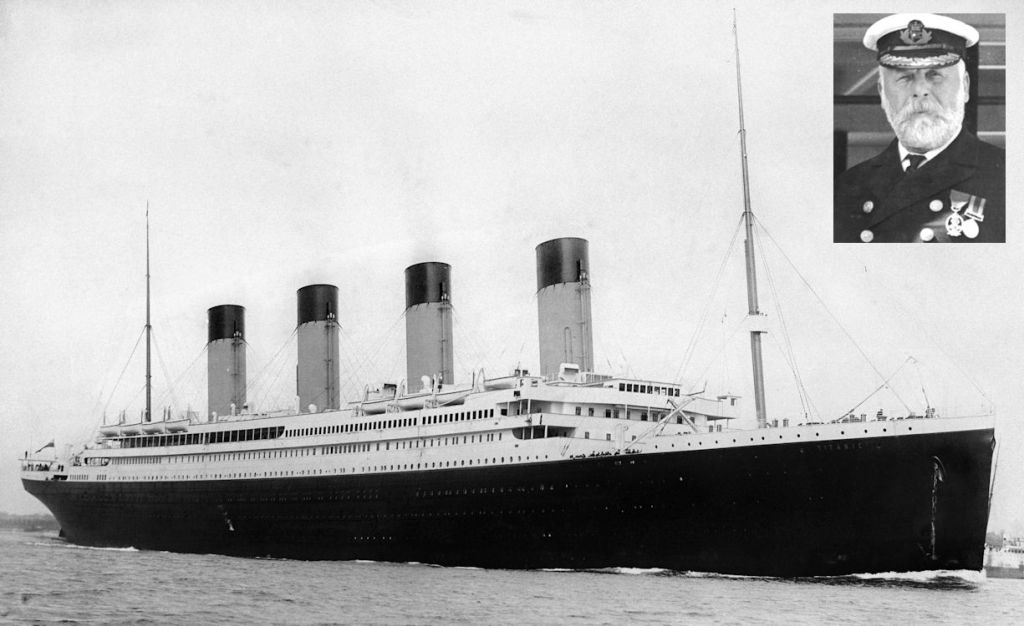
Titanic departing from Southampton on 10 April 1912.
Winwick Hospital
Winwick Hospital was a mental health facility located off Hollins Lane, west of the main village. The hospital site was previously part of the Winwick Hall estate. The hall, which was initially converted for use as a residential home for boys with mental health difficulties, opened for patients in September 1897. A purpose-built asylum was designed by Henry Crisp, George Oatley and William Swinton Skinner using a Compact Arrow layout and opened as the Fifth Lancashire County Asylum on 2 January 1902. It was requisitioned for military use as the Lord Derby War Hospital during the First World War. After the war the facility became Lancashire County Mental Hospital.
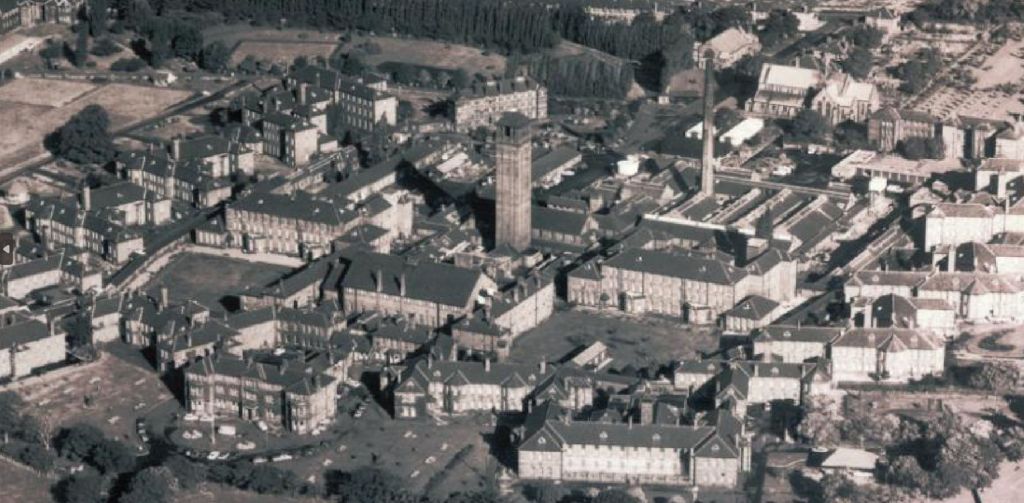
The hospital from the air (copyright unknown)
The hospital was also supplied with coal for the boilers directly from the West Coast Main Line railway via its own branch line into the grounds. Throughout its history, it underwent significant changes, particularly after the Mental Treatment Act of 1930 and the Mental Health Act of 1959, which shifted the focus from custodial care to treatment and community-based services.
The Mental Treatment Act of 1930 revised the Lunacy Laws, replacing the term ‘asylum’ with ‘mental hospital’, permitting voluntary admission for treatment, and introducing psychiatric out-patient clinics. The hospital joined the National Health Service as Winwick Hospital in 1948. There was also a facility called the Delph Hospital on the opposite side of Winwick Road accessed via a footbridge in my younger days. The footbridge is no longer here.
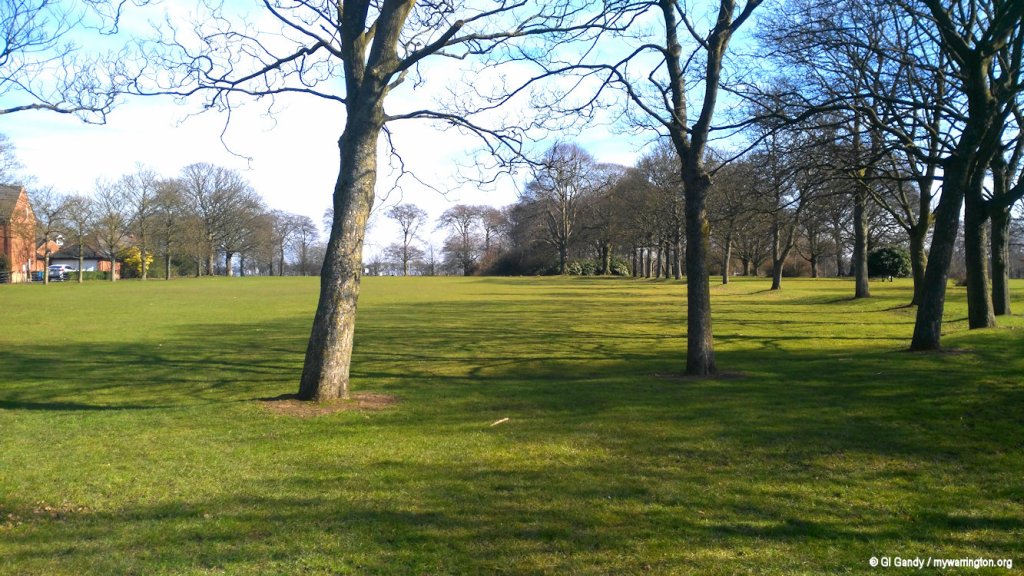
The grounds of Winwick Hospital, now a public green space close to the houses built on the site of the hospital (photo 14 March 2016).
After the introduction of Care in the Community in the early 1980s, the hospital went into a period of decline and closed in March 1997. Apart from the Roman Catholic Chapel, all buildings have been demolished and the site was redeveloped for residential use. A small facility known as Hollins Park Hospital, which opened in 1999, remains on the site. Hollins Park Hospital was also the headquarters for North West Boroughs Healthcare NHS Foundation Trust. The Trust delivered mental health and learning disability services in Halton, Knowsley, St Helens, Warrington and Wigan, as well as community-based physical health services in Halton, Knowsley, St Helens and Sefton.
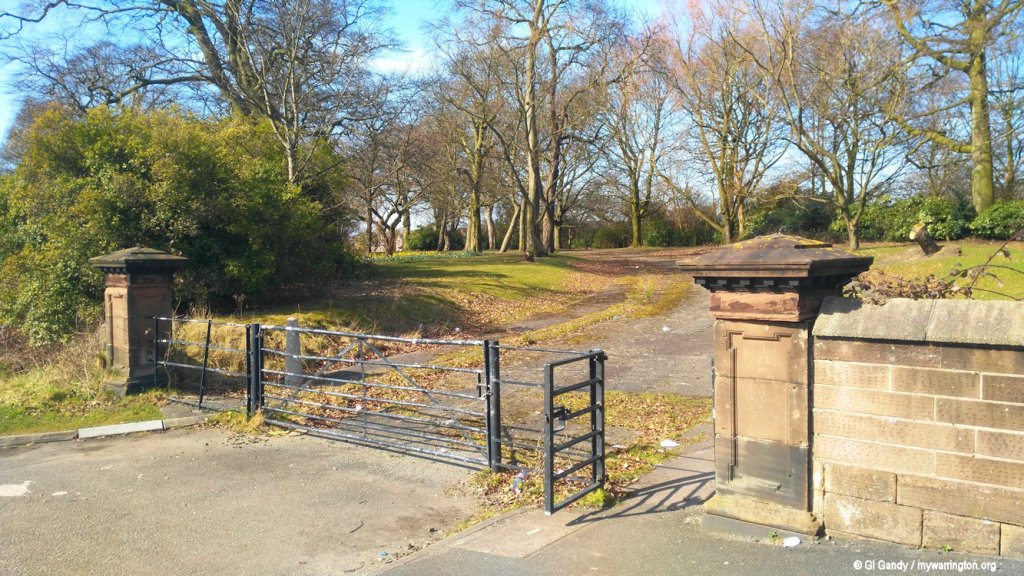
The former entrance to Winwick Hospital grounds from Delph Lane (14 March 2016)
Spiritual needs of patients were provided by the Roman Catholic church. The building was Grade II listed on 14 November 1997. It dates from c1900. The architects were Synott, Synott & Powell of Liverpool. It has dark red brick, with ashlar dressings and gabled and hipped Westmorland slate roofs. The windows have simple tracery and stone mullions. The chancel has three flat-headed windows, three lights, and a similar two-light window to the south. On the east side, there is a hipped porch, single storey, with a chamfered doorway under a crenellated parapet. Behind this, a canted stair tower with slit windows, and a prominent cruciform stack with chamfered coping. There is a pointed arched opening containing the choir gallery and organ. For a full description, see the notes on the Historic England website.
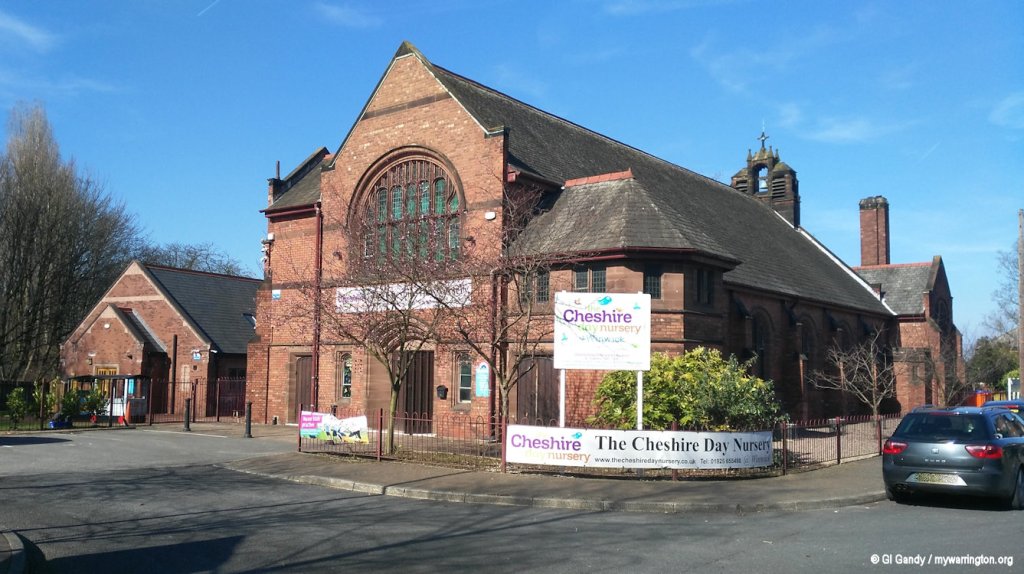
The Roman Catholic church in the grounds of the hospital, now used by Cheshire Day Nursery (14 March 2016).
Hollins Park Trail
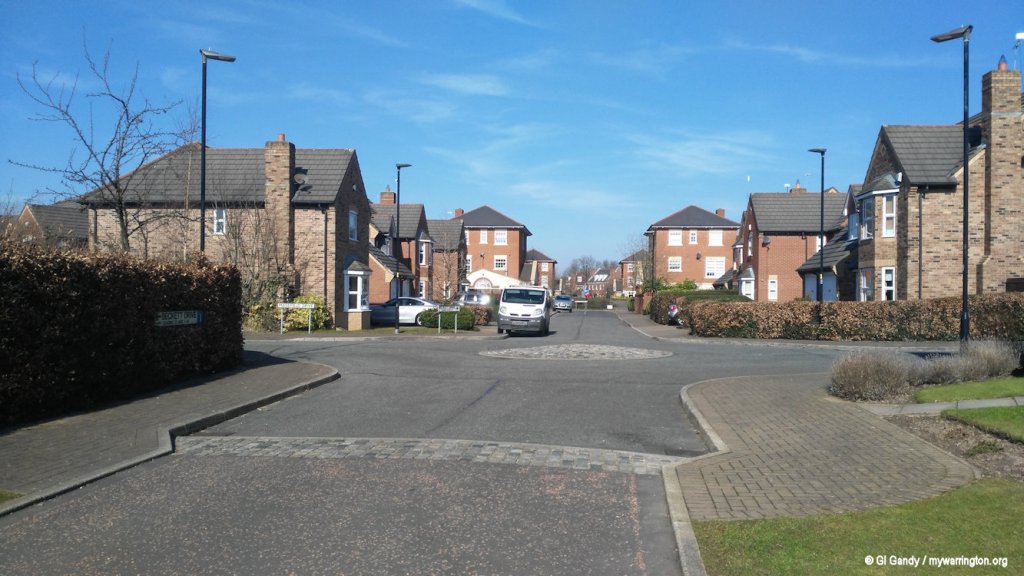
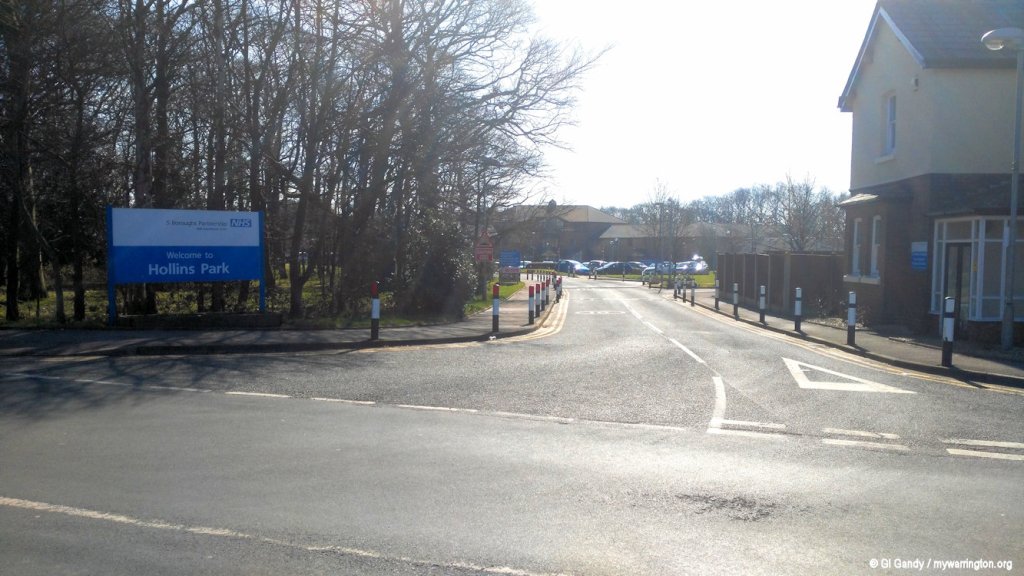
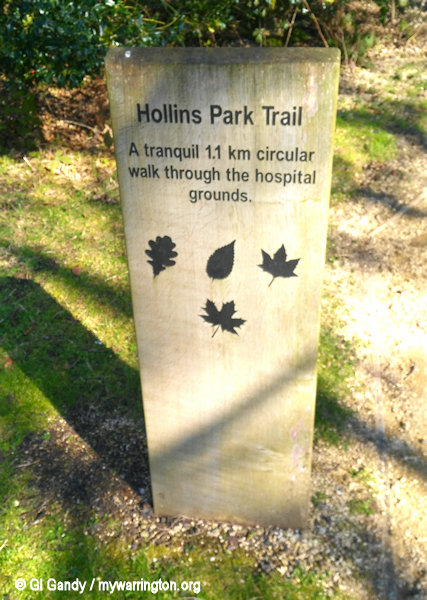
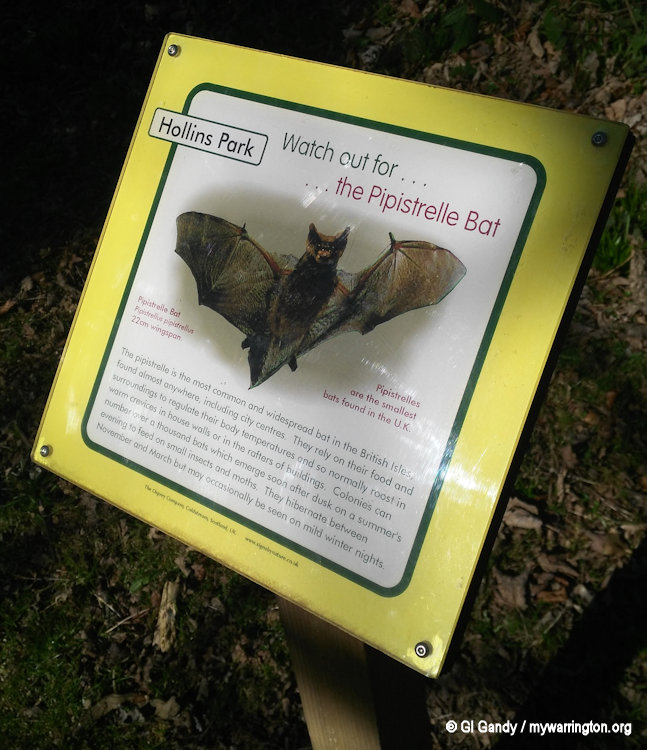
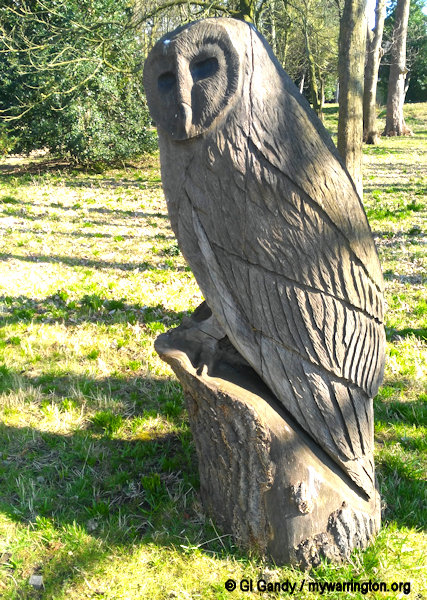
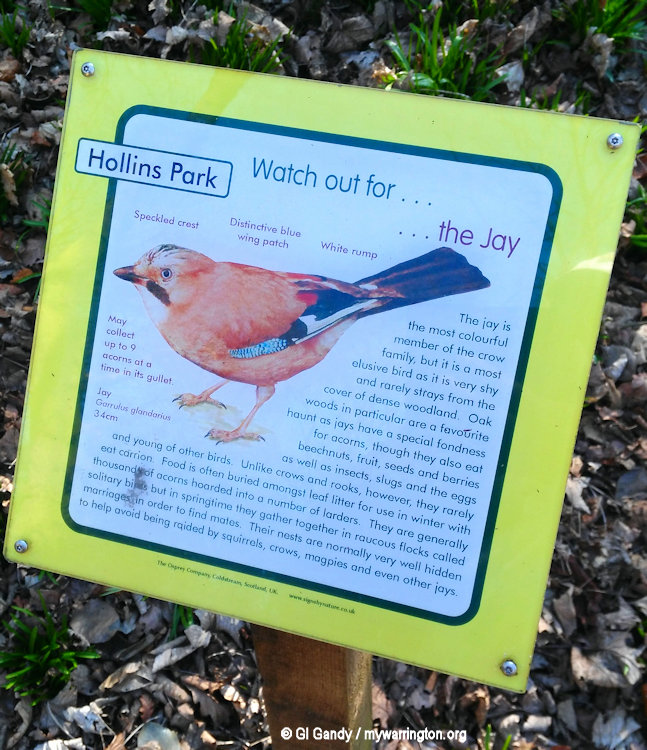
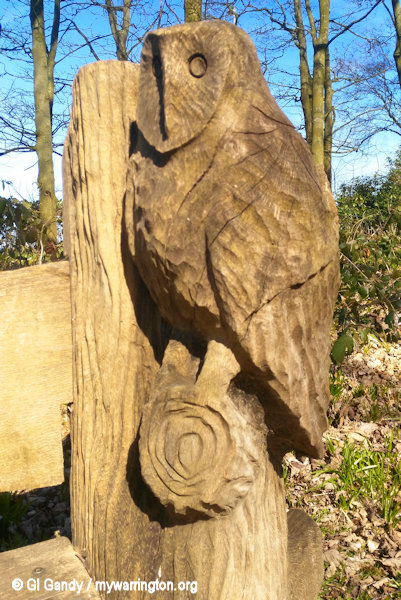
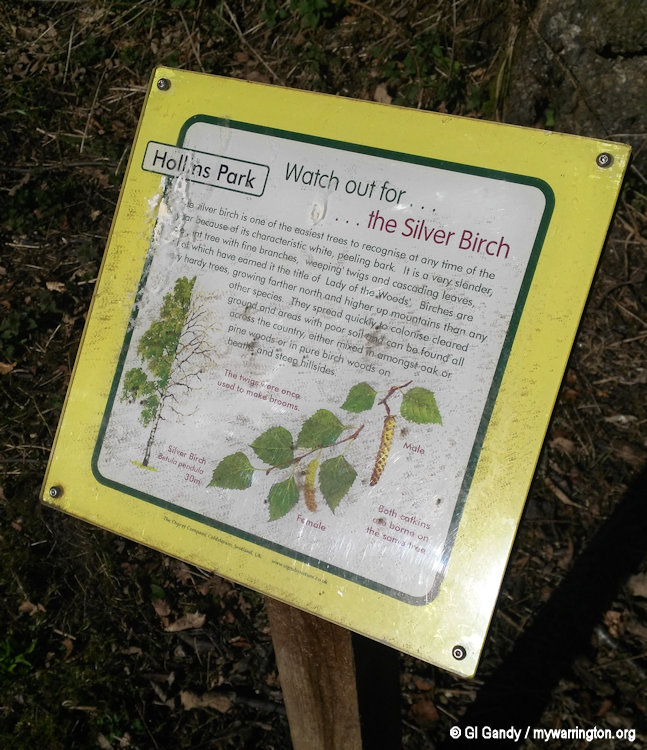
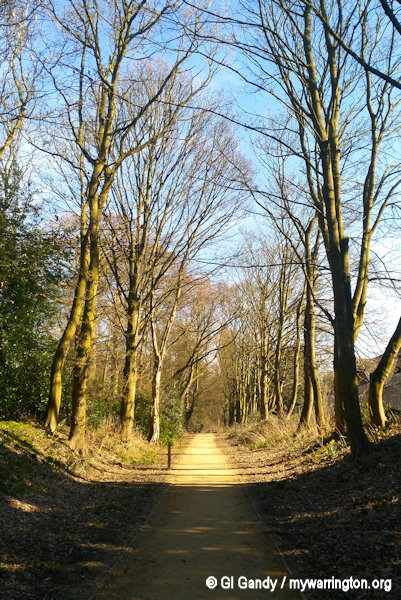
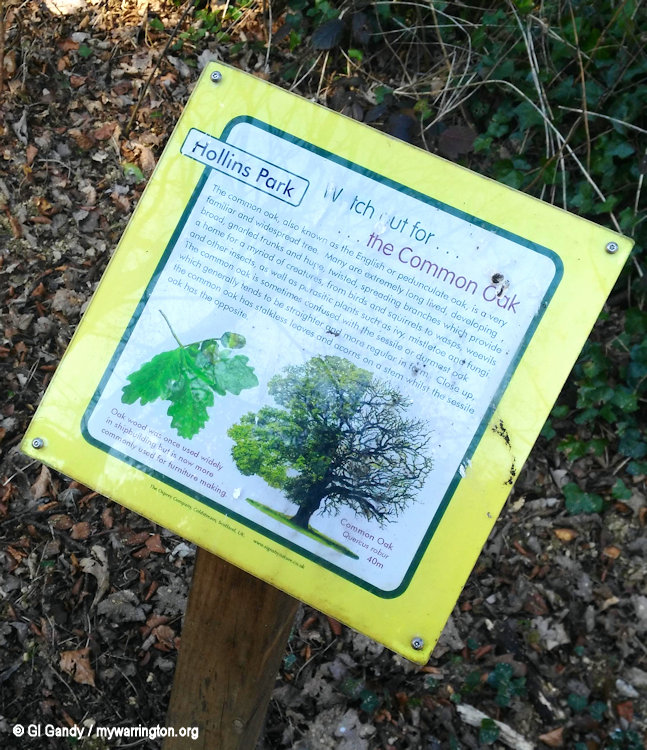
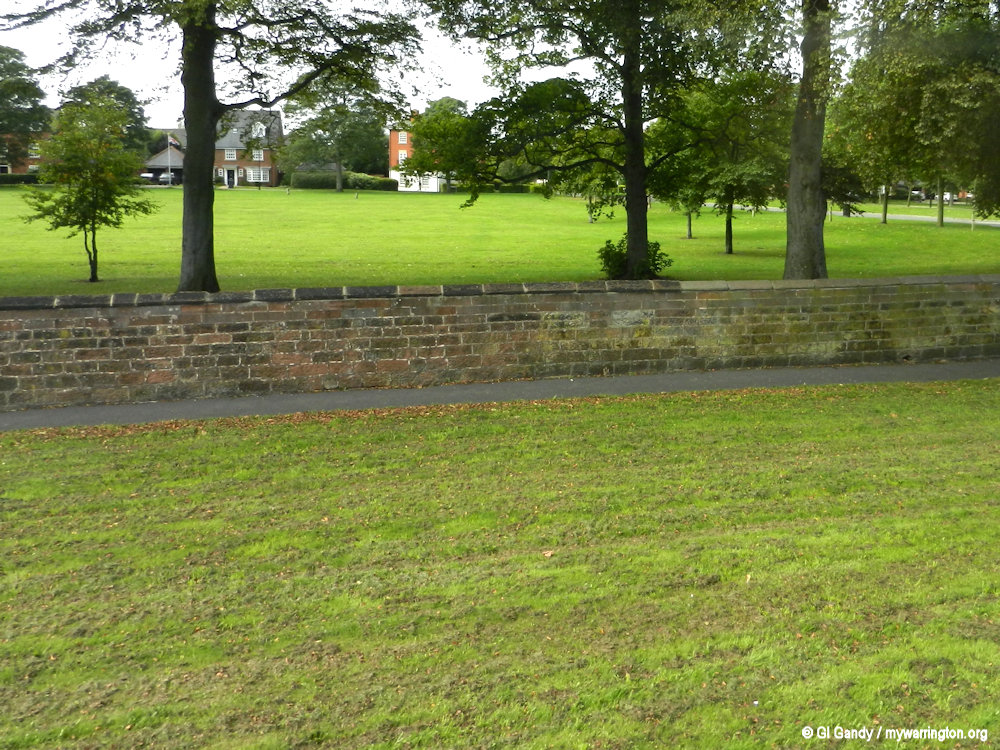
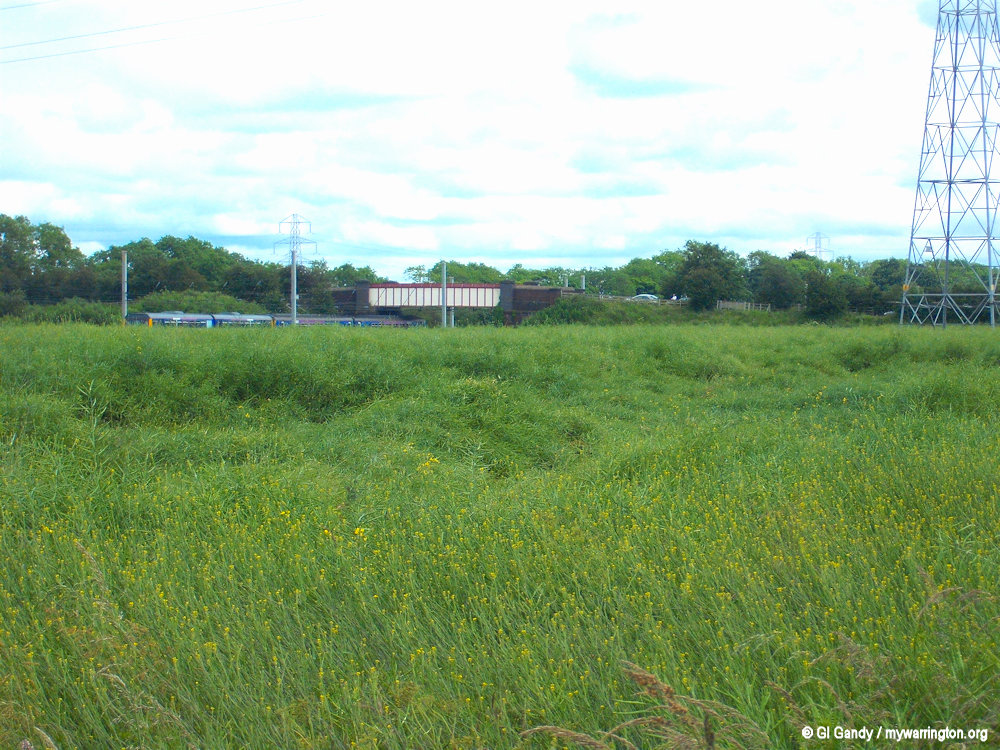
Photos of the the modern housing estate built on the site of the Victorian hospital (first photo), with the remainder showing Hollins Park Hospital entrance (second photo) and the Hollins Park Trail, which has been installed in the grounds of the current mental health facility for the benefit of staff, patients and visitors (photos taken 14 March 2016).
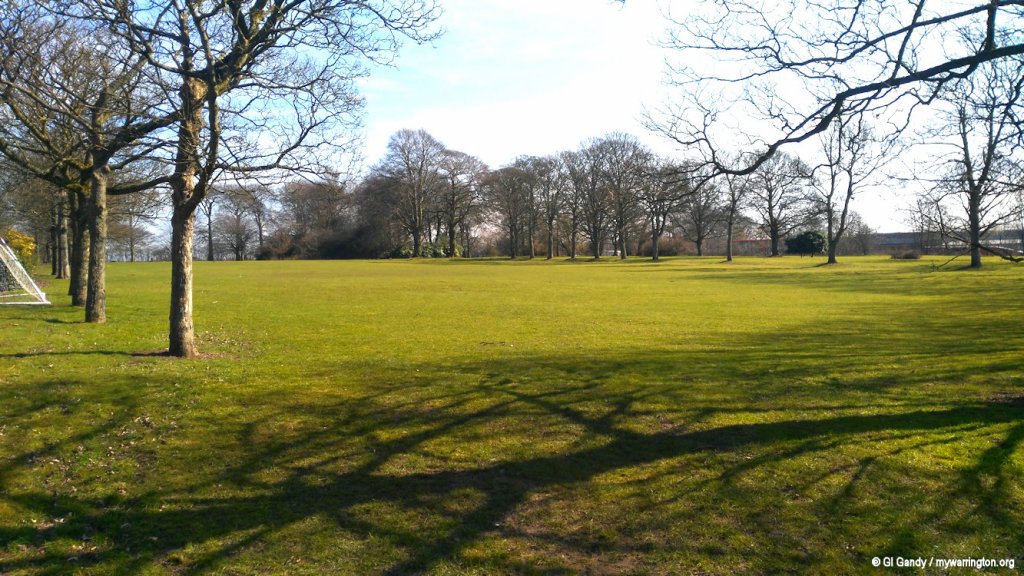
Read memories of nurses who worked at Winwick Hospital in the Warrington Guardian.
Winwick Rail Crash (1934)
The Winwick rail crash took place at Winwick Junction, near Warrington on the London, Midland and Scottish Railway, on 28 September 1934. Two trains collided, resulting in 11 deaths and 19 injuries.
Although the signalman on duty was ultimately responsible for the collision, there were several contributing factors. The layout of the section was complex, with four running lines and a junction between the main Carlisle to London line and the Warrington to Earlestown branch line.
Those two lines carried so much traffic that the signalman had a booking lad with him in the signal box, whose function was to keep the train register and use it to remind the signalman of the position of trains within the section at any time.
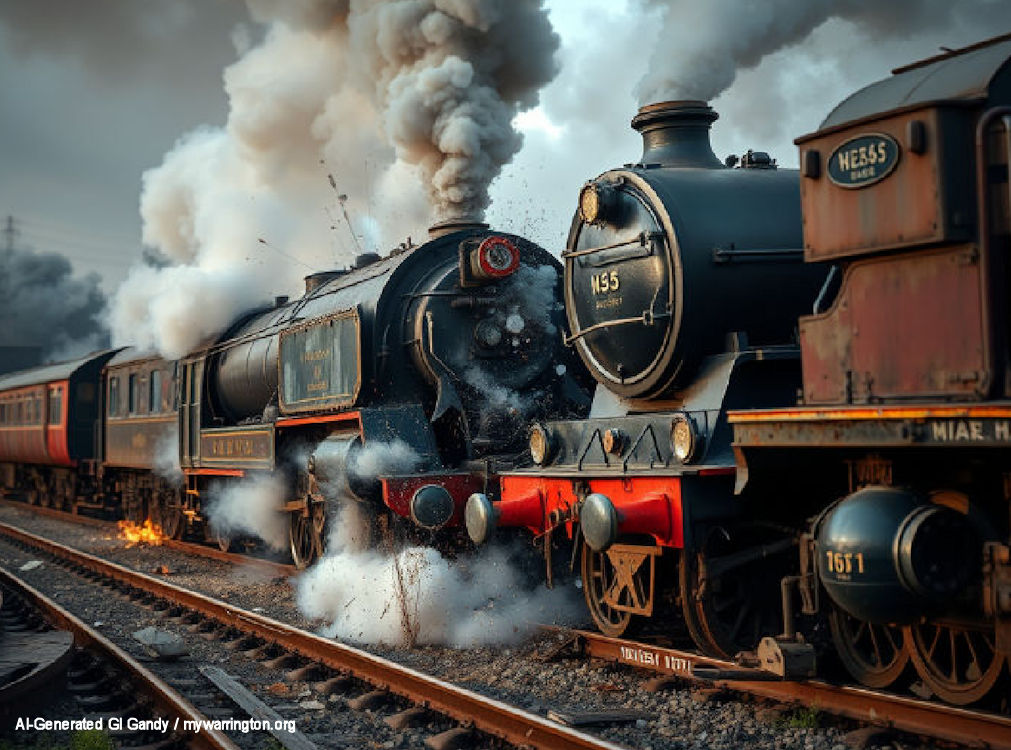
My AI-generated image of a two trains crashing into each other (15 Nov 2015)
Details
Shortly after 9pm a local train from Warrington, destined for Wigan and drawn by a 2-4-2 tank engine No. 6632, entered the section. It was due to be turned off onto the Earlestown branch line, but Signalman Bloor at the Winwick Junction signal box was already busy with no fewer than seven other trains, and probably engaged on the telephone to Warrington, discussing a necessary change to the running order to cater for an express freight train carrying perishable goods (fish).
The local train therefore came to a halt at the Winwick Junction home signals, and Fireman Hayes left the train to walk to the signal box 172 yards (157 m) away to carry out Rule 55, by which he was to remind the signalman of the train’s presence and ensure that it was protected.
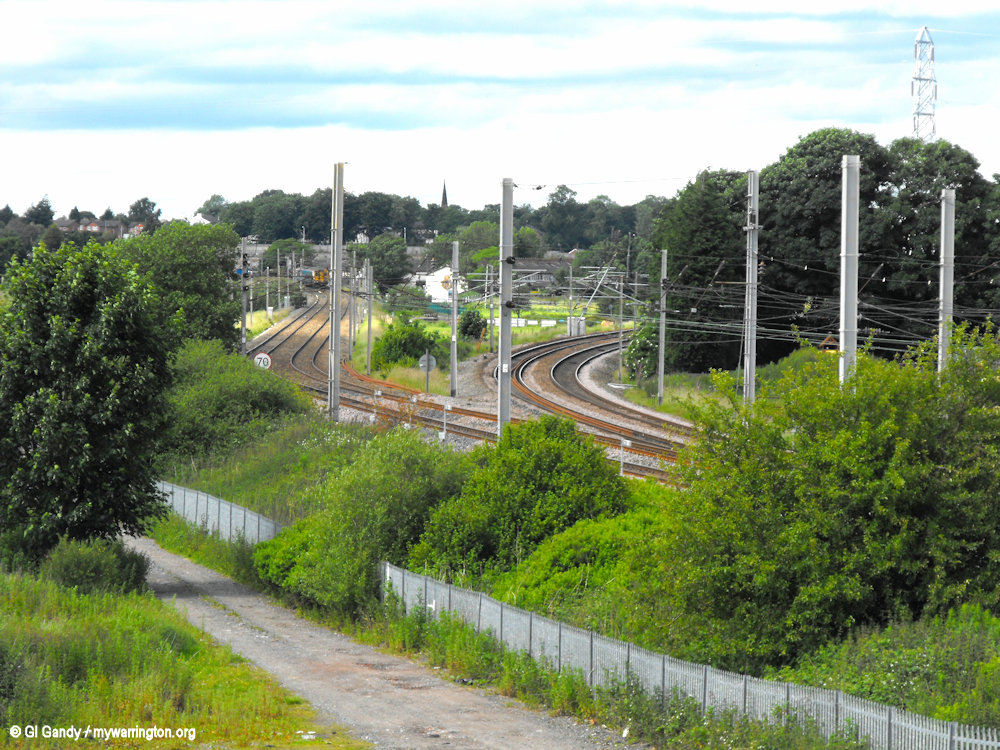
Winwick Junction on 27 June 2012
Before Hayes could reach the signal box, the signalman at Winwick Quay to the south rang Call attention for an express train from Euston to Blackpool.
As the regulations did not permit him to send the Is Line Clear? bell signal until he had received Train Out of Section for the local train, he intended to send the bell signal Shunt engine for following train to pass upon acknowledgment of Call attention, i.e. he expected Bloor to switch the local train temporarily to another running line and halt it while the express passed.
However, Bloor forgot that the local train was standing at his signals, and thought that he had failed to clear his block instruments after a preceding train. He gave the reply, Train out of section and cleared his signals.
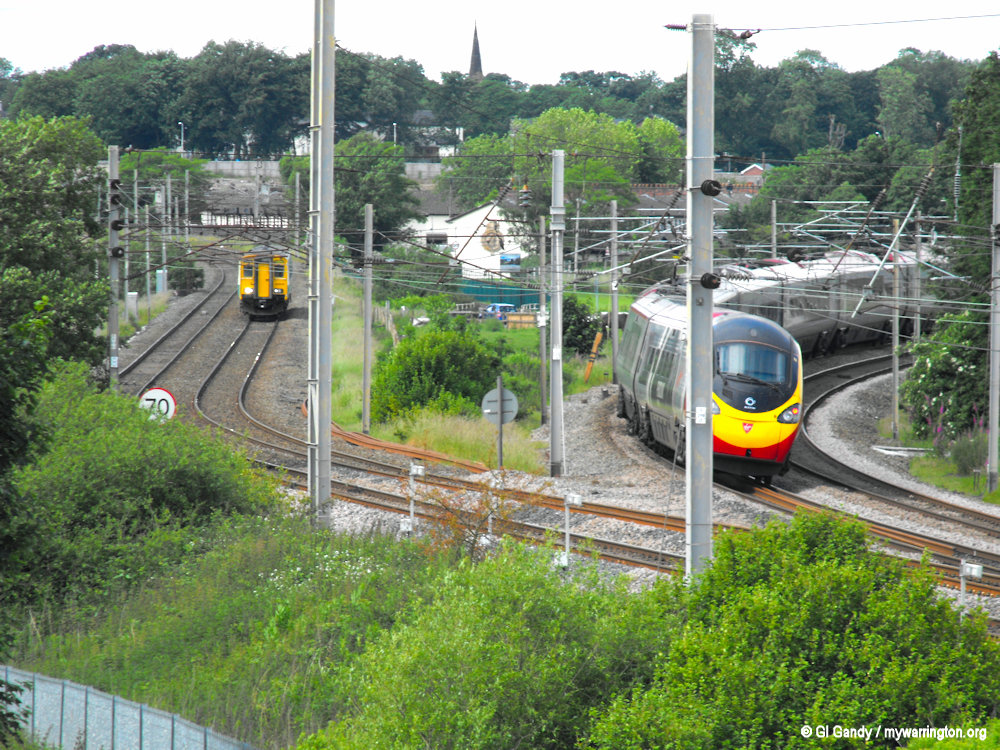
A Chester-bound Diesel Multiple Unit (DMU) waits as a Carlisle-bound Virgin Pendolino travels north through Winwick Junction on 27 June 2012.
The booking lad, E. Derbyshire, who was supposed to alert him to the position of the train, failed to do so. He too had been distracted by a telephone call about a weekly timetable change, and on hearing Bloor exclaim “Good Heavens! I haven’t given the 2-1 [i.e. the train out of section call] here yet”, he assumed that he himself had missed the passage of the local train. Instead of prompting Bloor that the train register entries for the local train were incomplete, which might have alerted Bloor in time to avert the collision, he used guesswork to fill in the register, indicating the local train was out of the section.
When the Winwick Junction home signals cleared, Driver Hope of the local began moving forward slowly to pick up the fireman, but was struck by the express, drawn by LNWR Prince of Wales Class No. 25648, running at high speed.
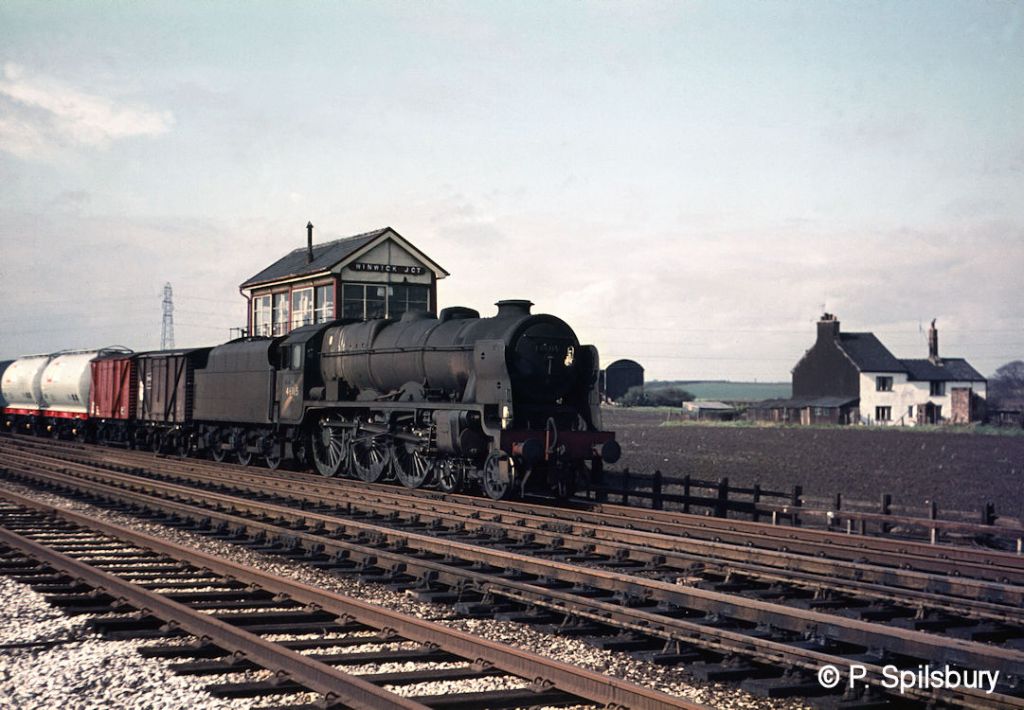
46115 Scots Guardsman at Winwick Signal Box 1965 © P Spilsbury
The rearmost coach of the local train was demolished and the first two of the express train were badly telescoped. The guard and five passengers in the local train, and three passengers in the express train were killed. Two passengers (it is not known from which train) later died in hospital.
Aftermath
Signalman Bloor readily admitted his responsibility, but the booking lad’s assumption about train movement led the Inspecting Officer (Colonel A.C. Trench) to recommend that booking lads should be made more aware that entries other than from personal knowledge should be verified with the signalman.
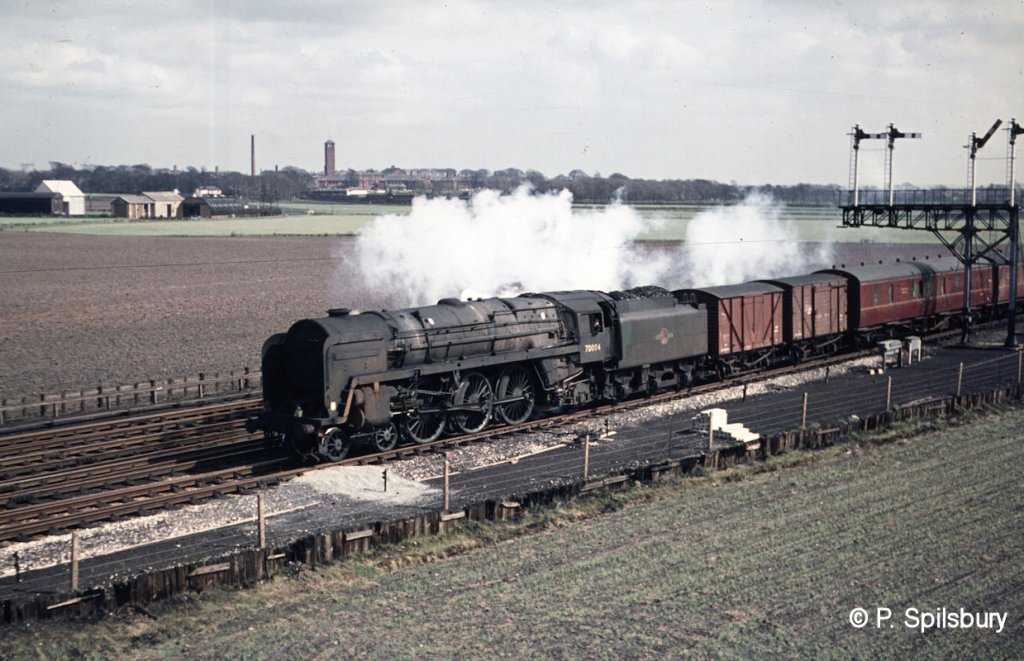
70004 William Shakespeare at Winwick with Winwick Hospital in the background. Year unknown. © P Spilsbury.
The lack of a telephone at the signal post, or a track circuit which would have alerted the signalman that the track was occupied and prevented him accepting the express, was also a factor. The Inspecting Officer’s report recommended that track circuits be installed at the junction.
1967 Accident
Another accident occurred at Winwick Junction in 1967. A passenger DMU collided with a goods train after failing to stop at a semaphore signal which, although “on”, had jammed at approximately 17° to the horizontal. There were no fatalities or serious injuries. The official inquiry concluded that routine maintenance of the signal had been inadequate, and the signalman was at fault for not checking that the signal had properly returned to “Danger” when the lever was replaced. A similar accident, with much more serious consequences, occurred at Invergowrie in 1979.
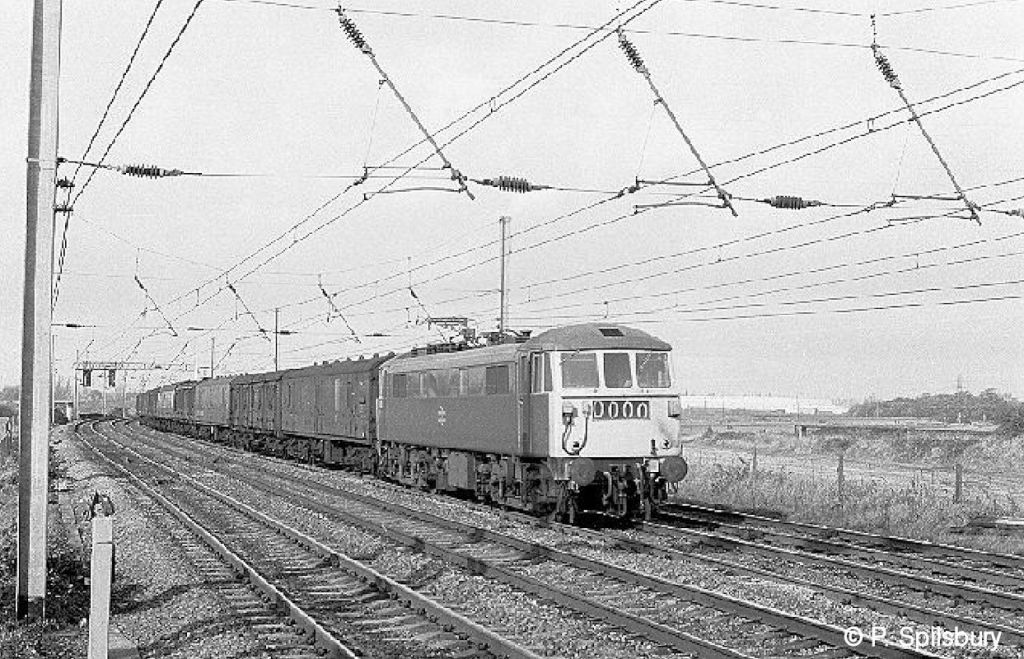
Class 86 electric locomotive with a freight passing Winwick Quay. These locos were built between 1965 and 1966. I witnessed many of these passing through Dallam as a child. © P Spilsbury
Main text from Wikipedia.
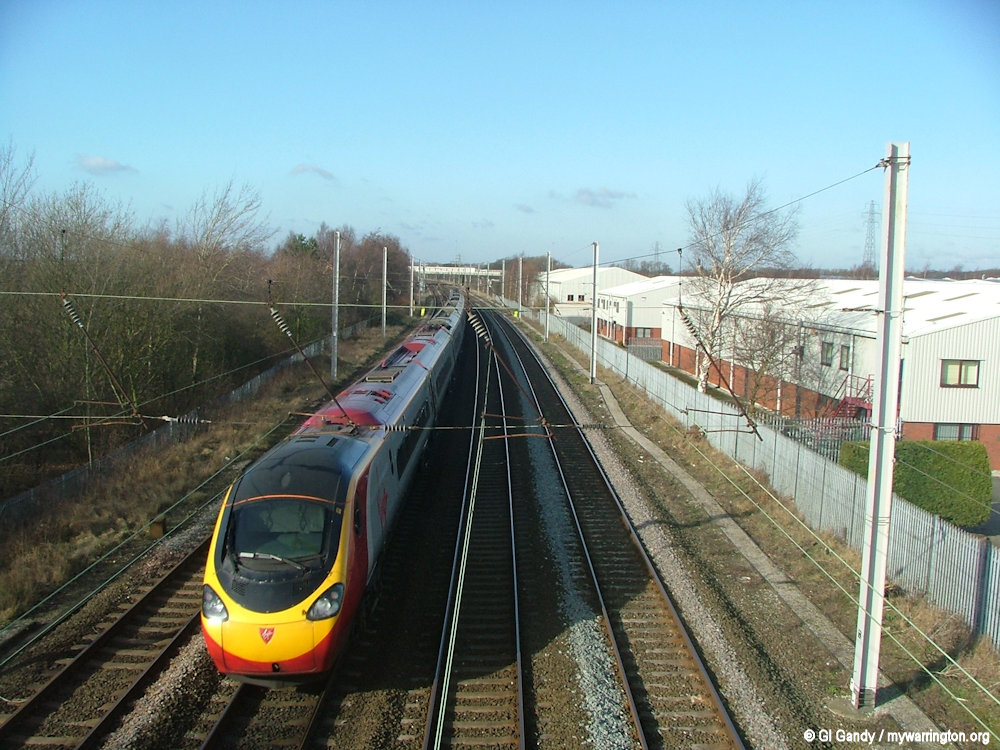
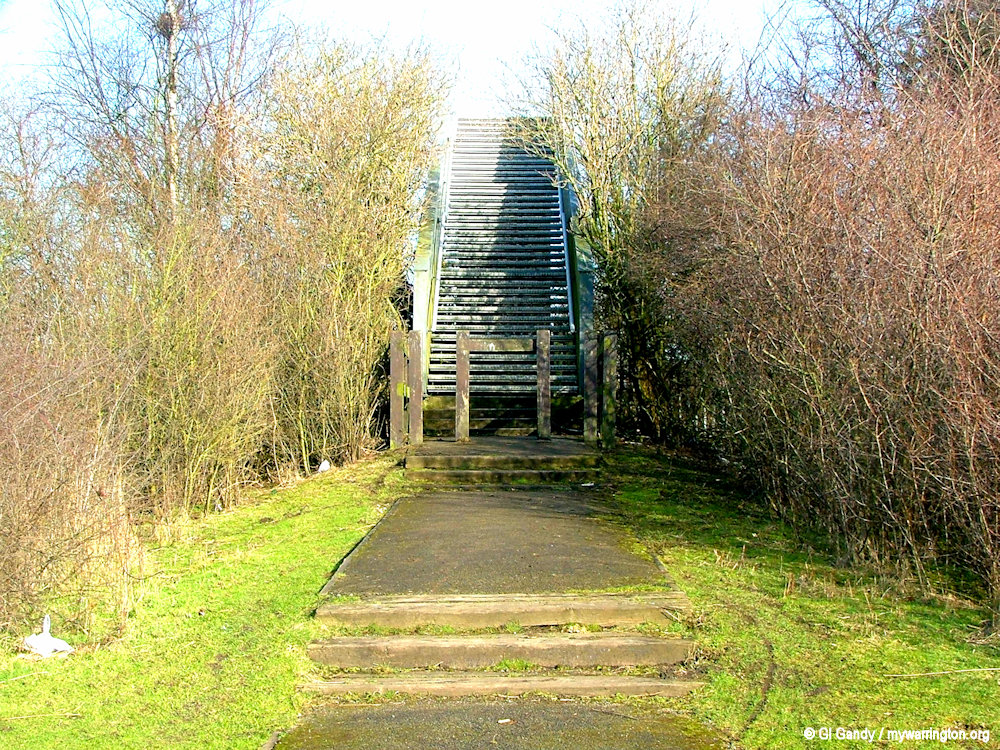
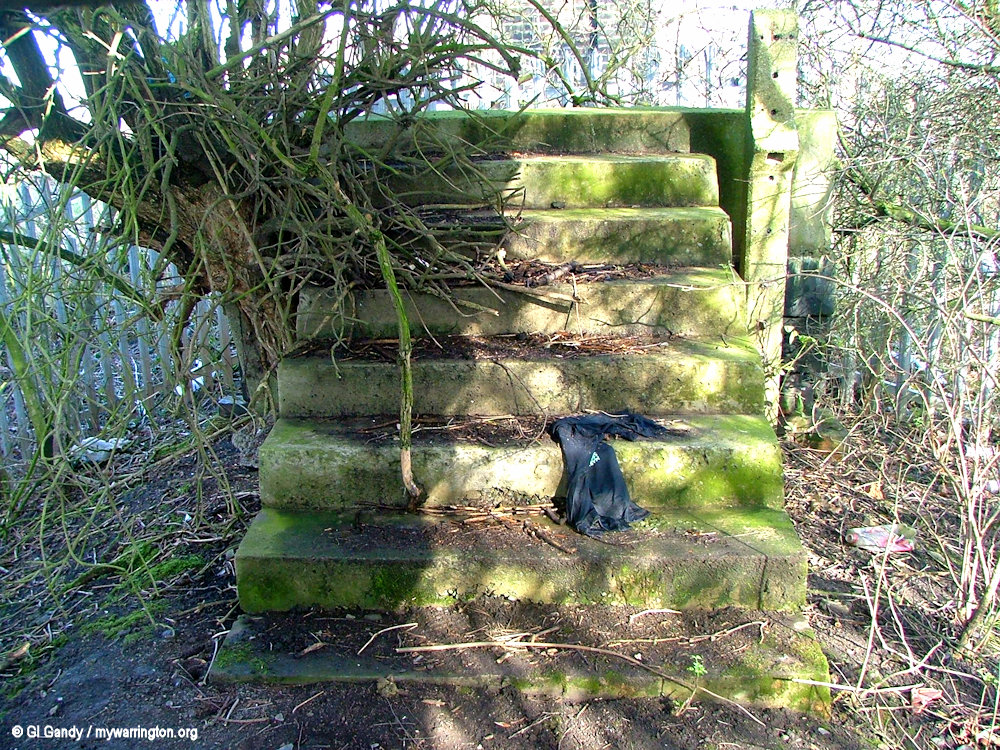
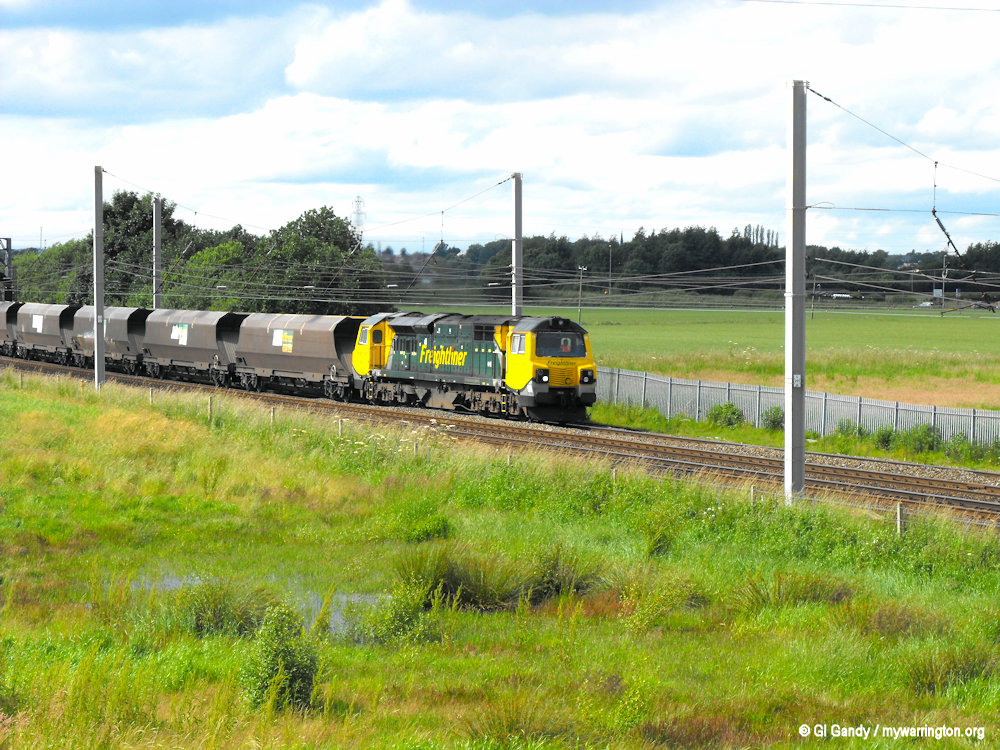
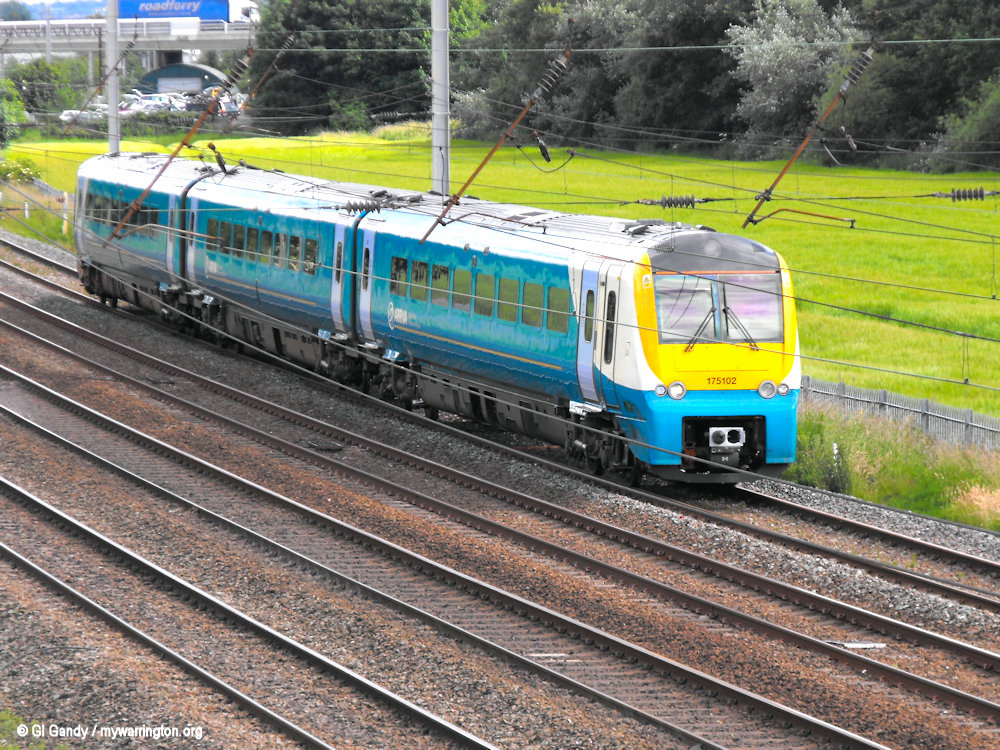
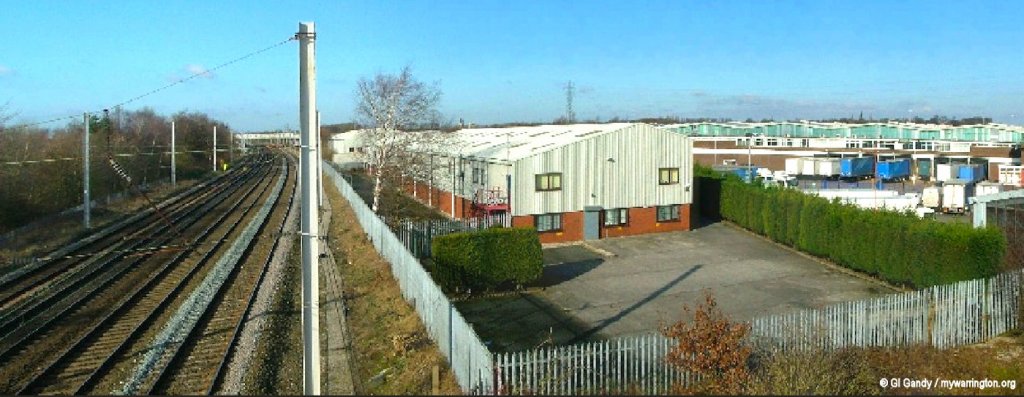
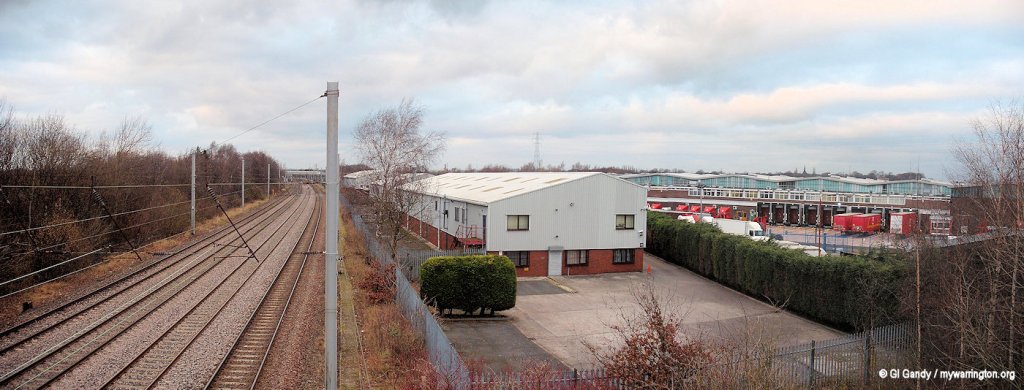
Winwick Quay railway station once stood close to the location of the above photos. See Making Tracks for more.
Winwick Quay
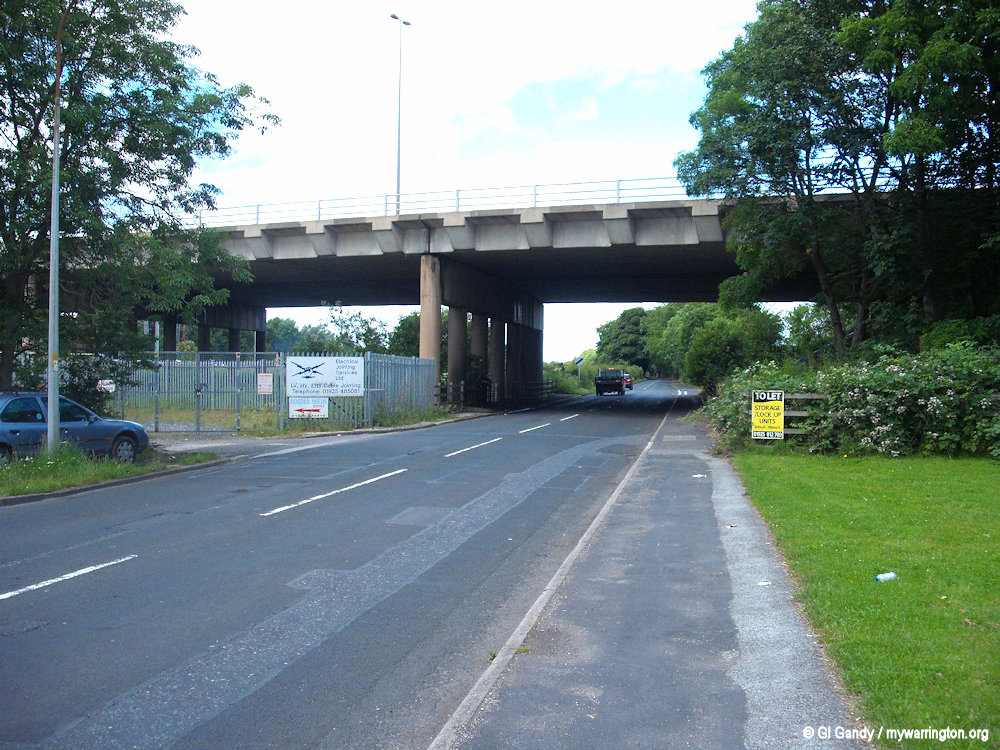
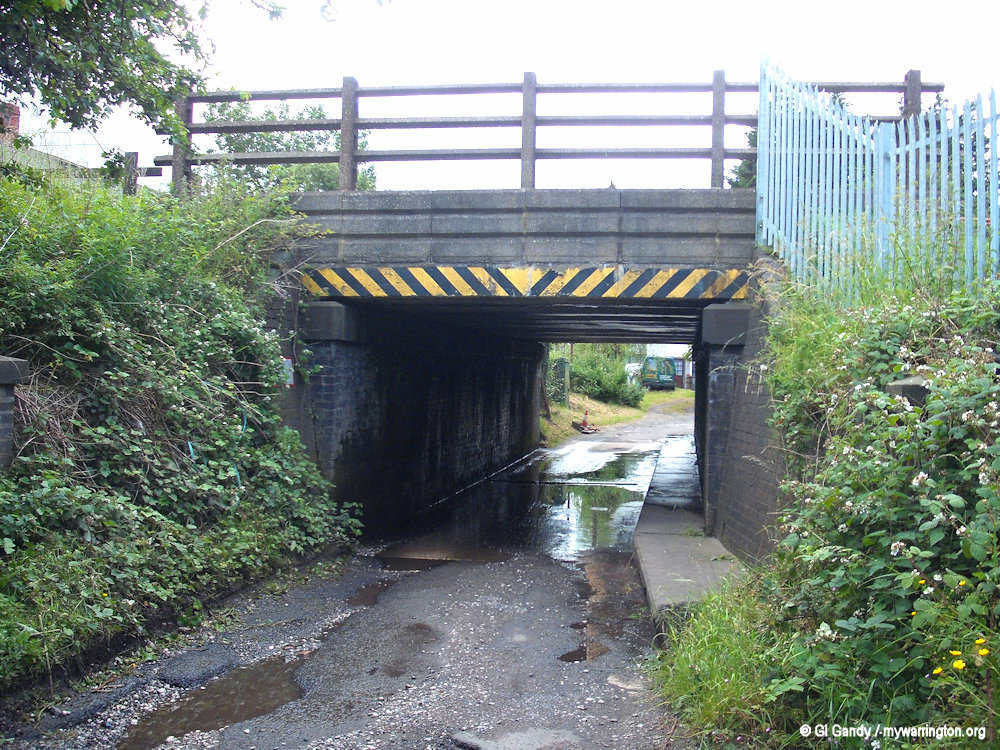
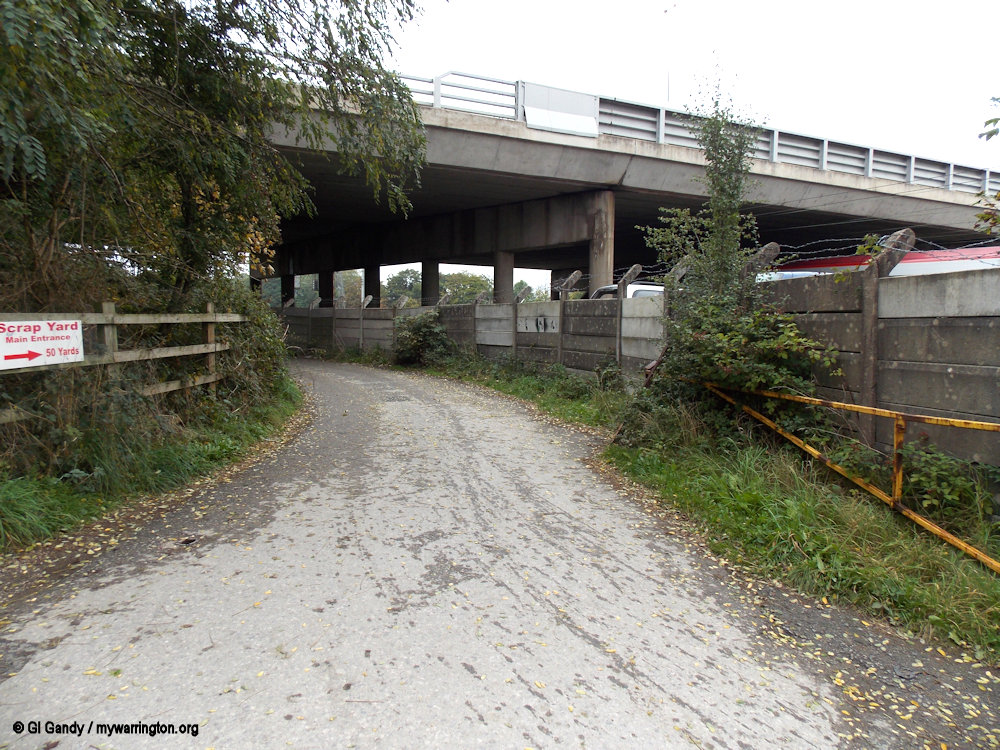
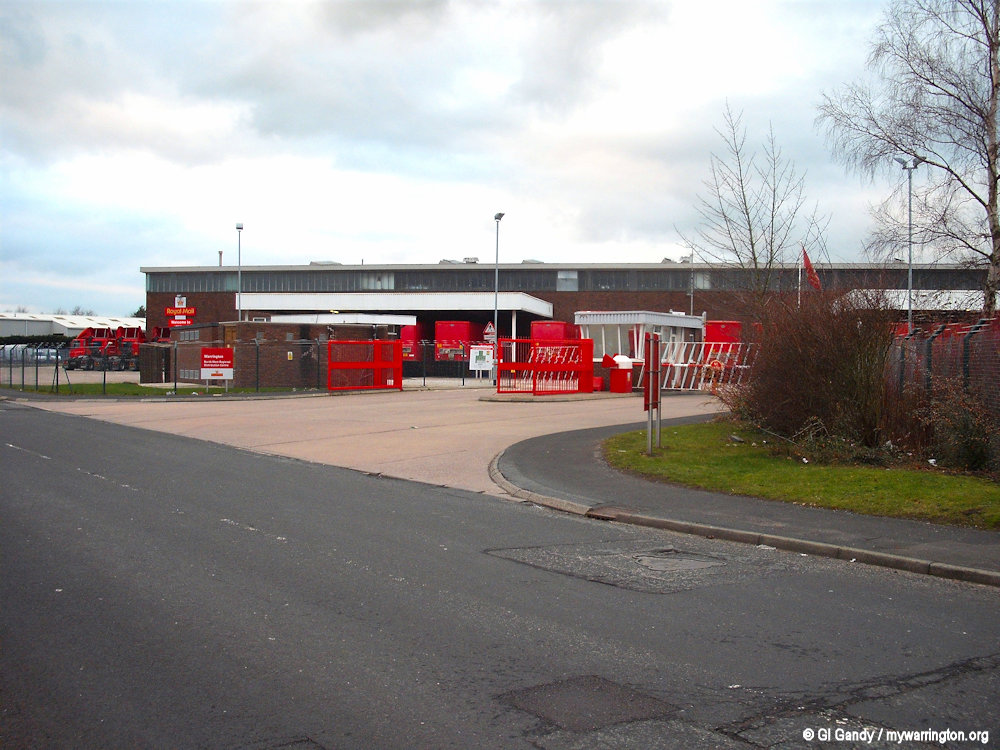
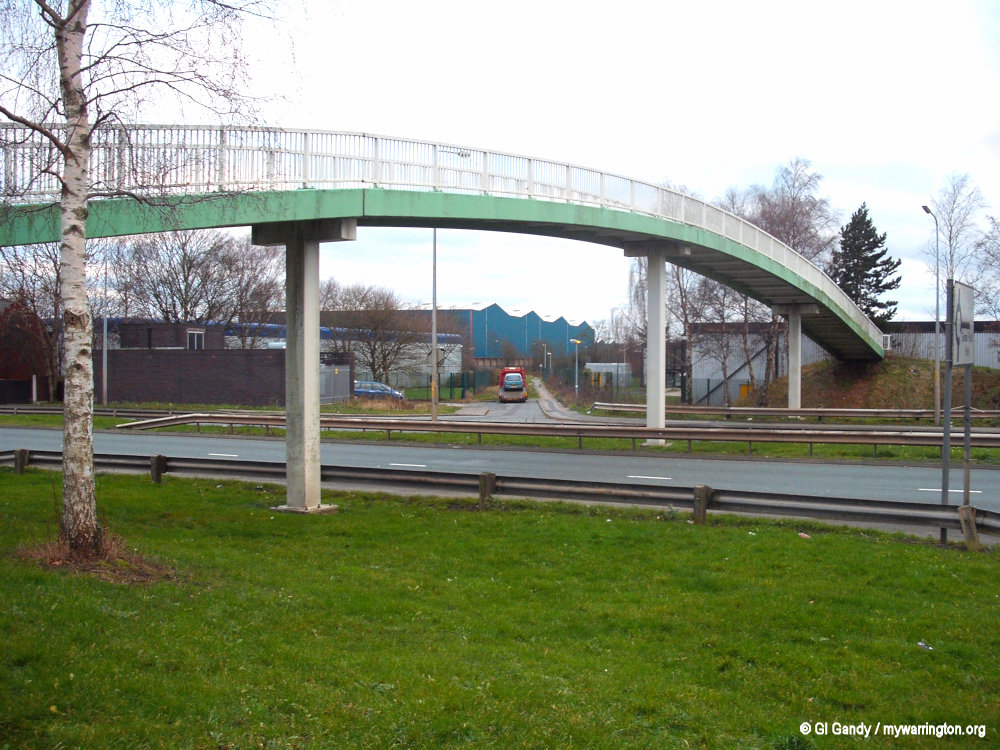
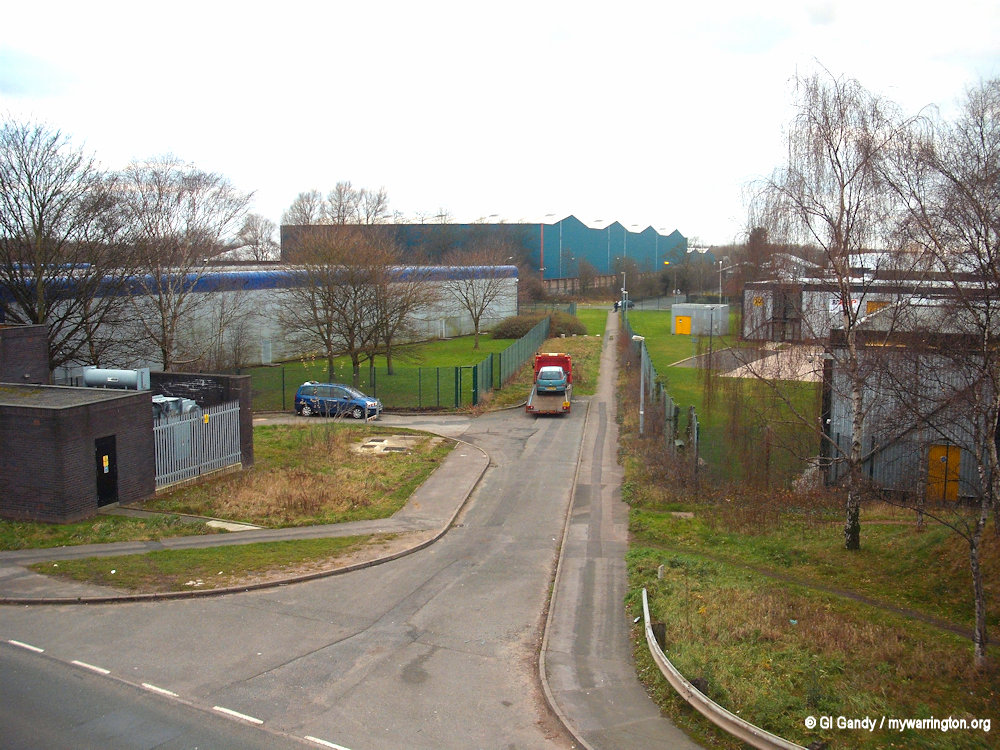
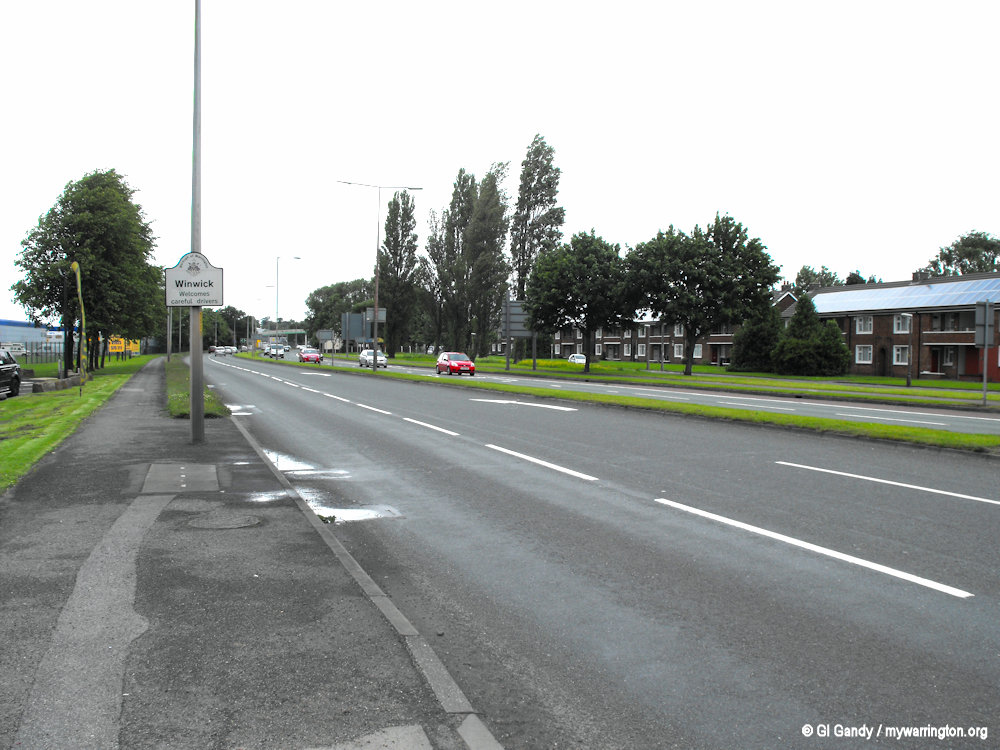
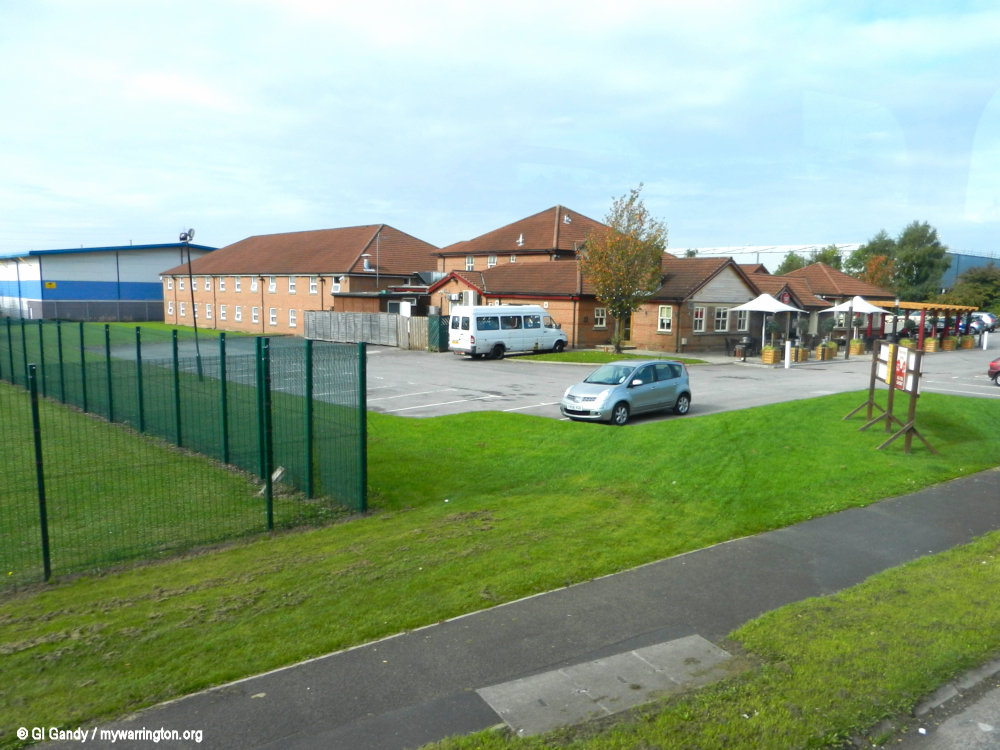
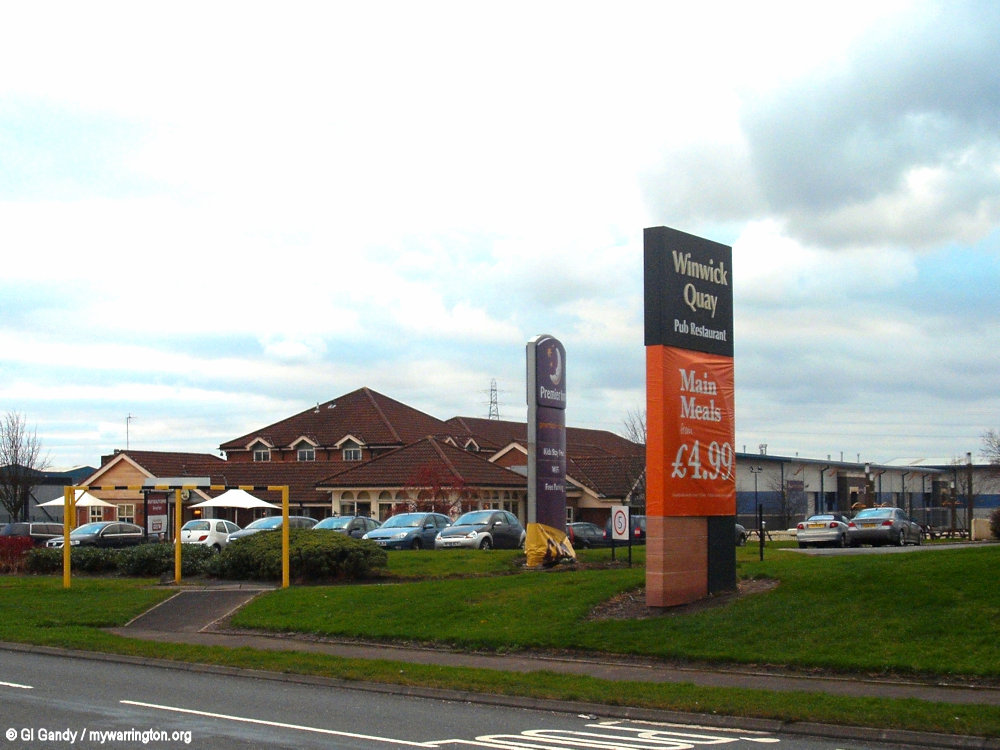
Winwick Quay is nowadays occupied by a business park based around Calver Road and Mill Lane. The Calver Road facilities stand on the site of the former Mill Lane Farm. It is interesting to compare the maps of yesteryear with today’s maps as to what the area looks like. You can do that in the National Library of Scotland side-by-side maps.
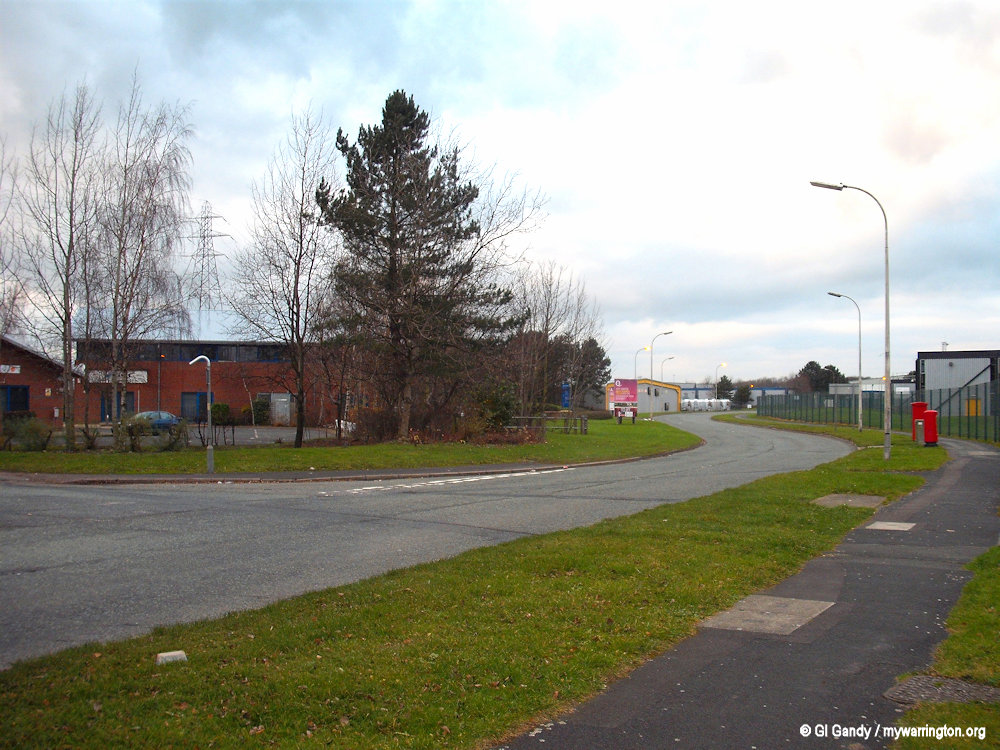
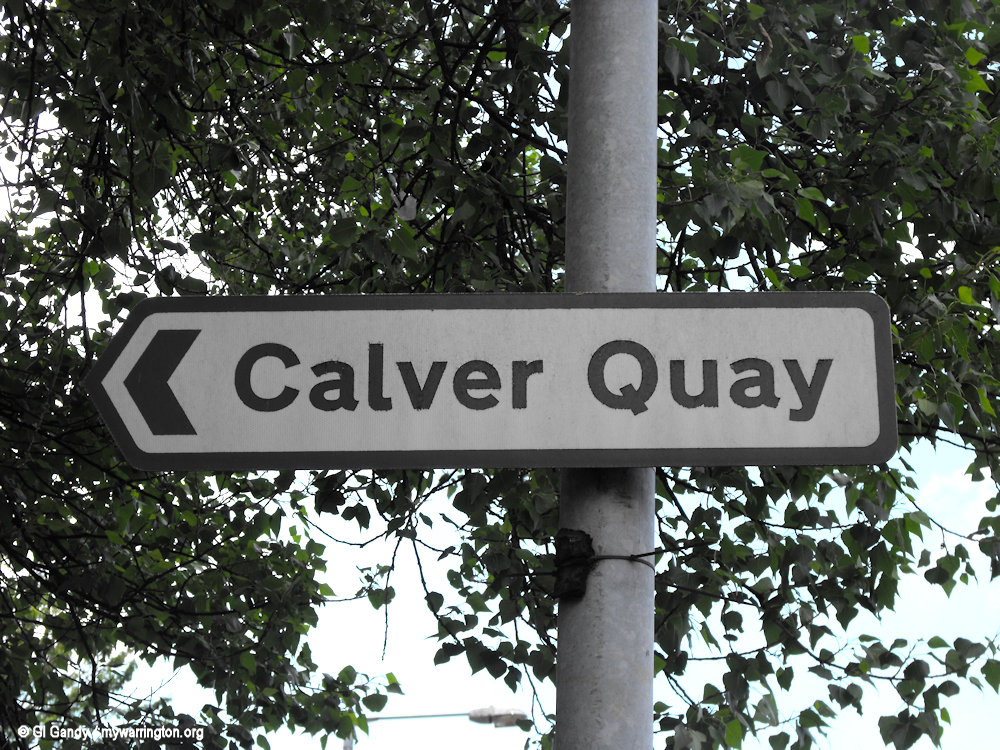
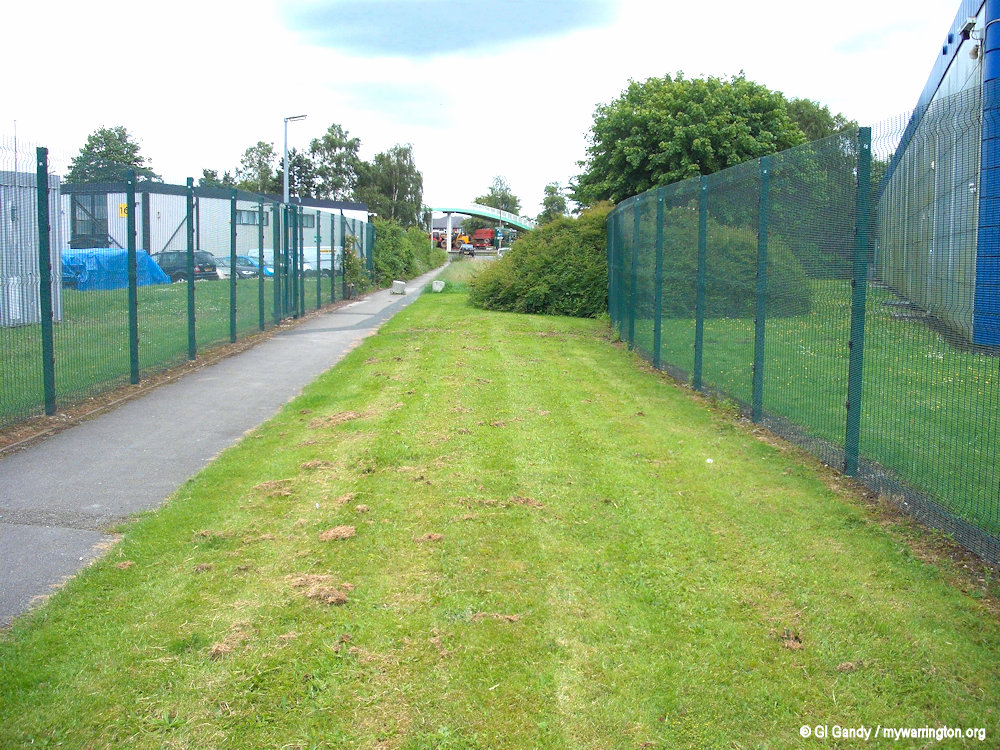
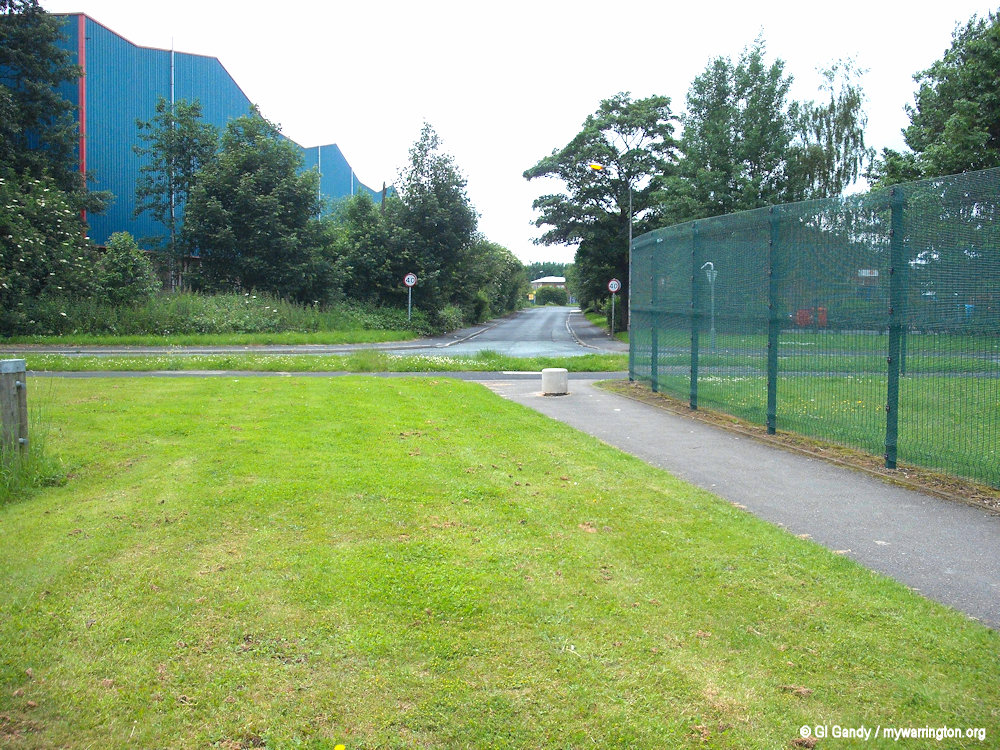
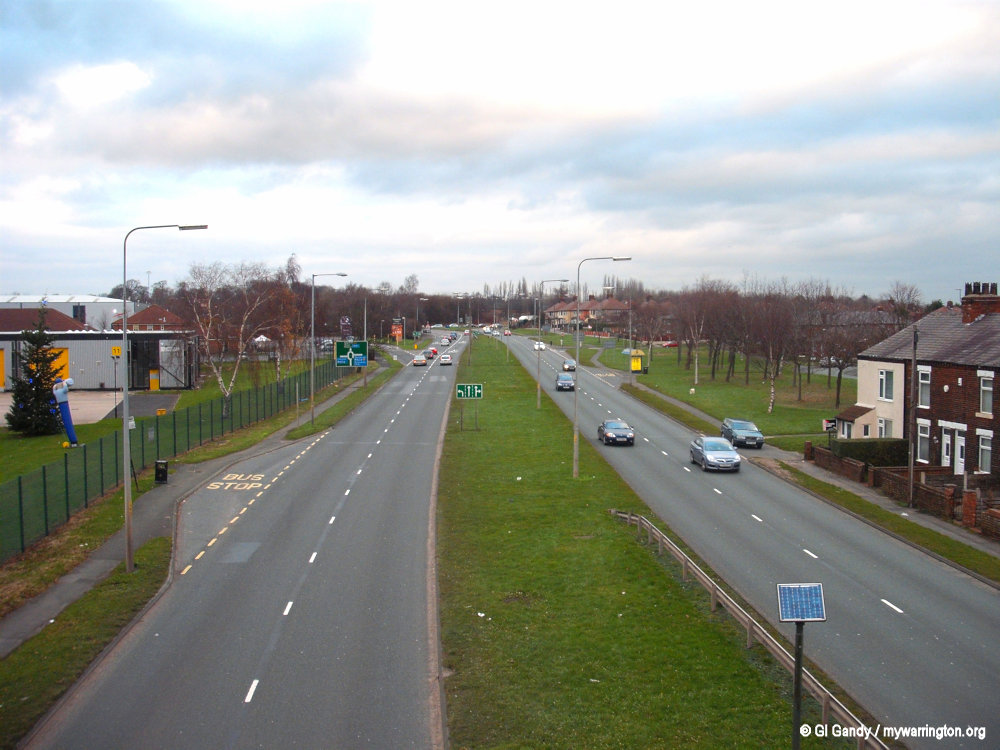
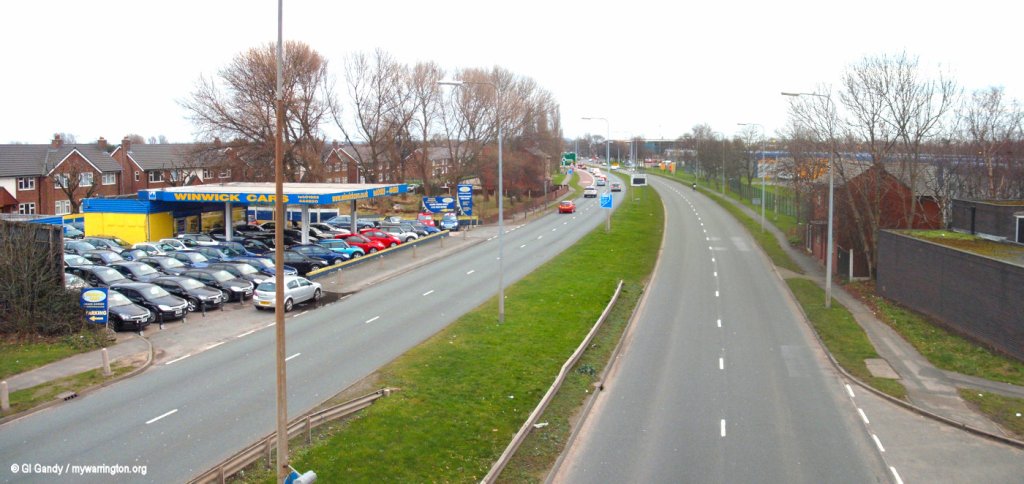
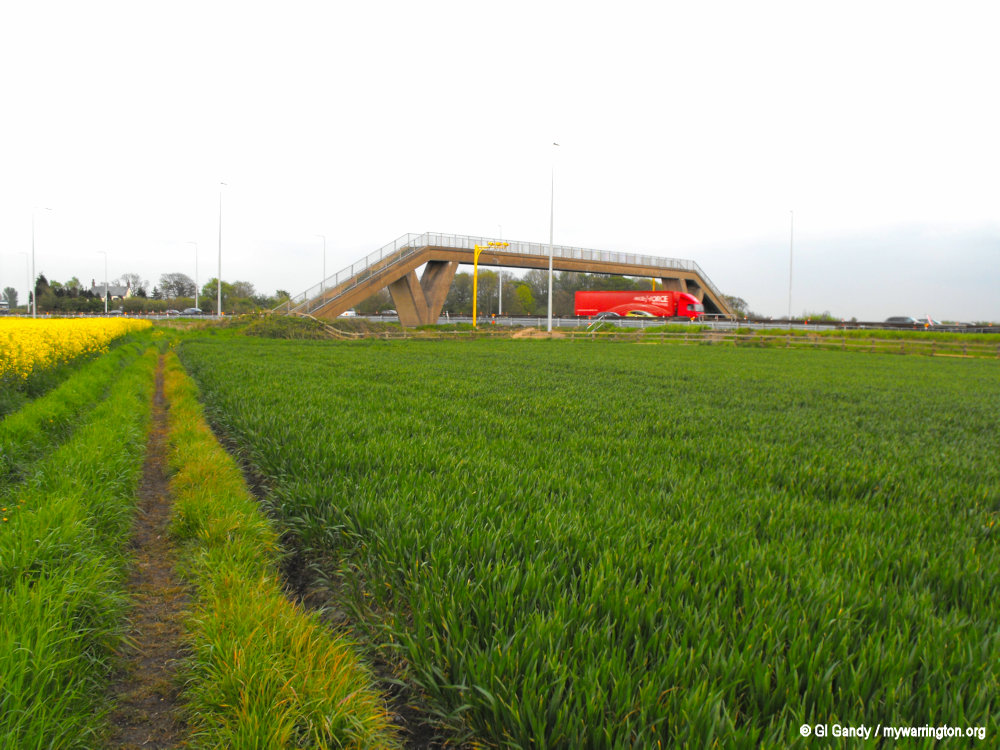
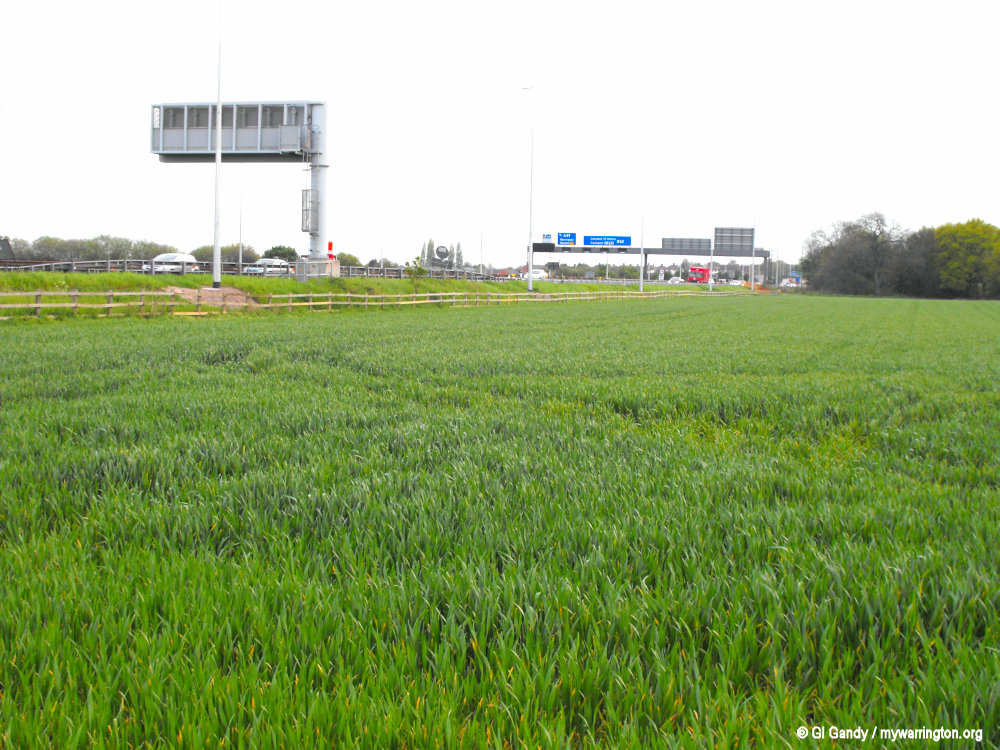
Here are some views in and around Mill Lane and Winwick Quay.
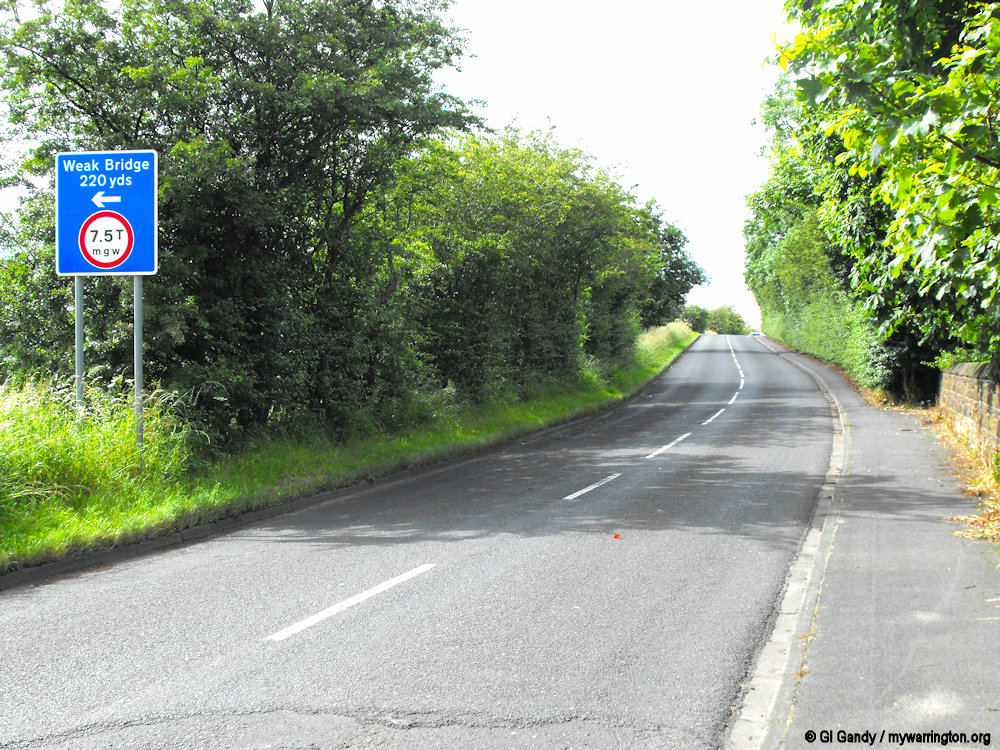
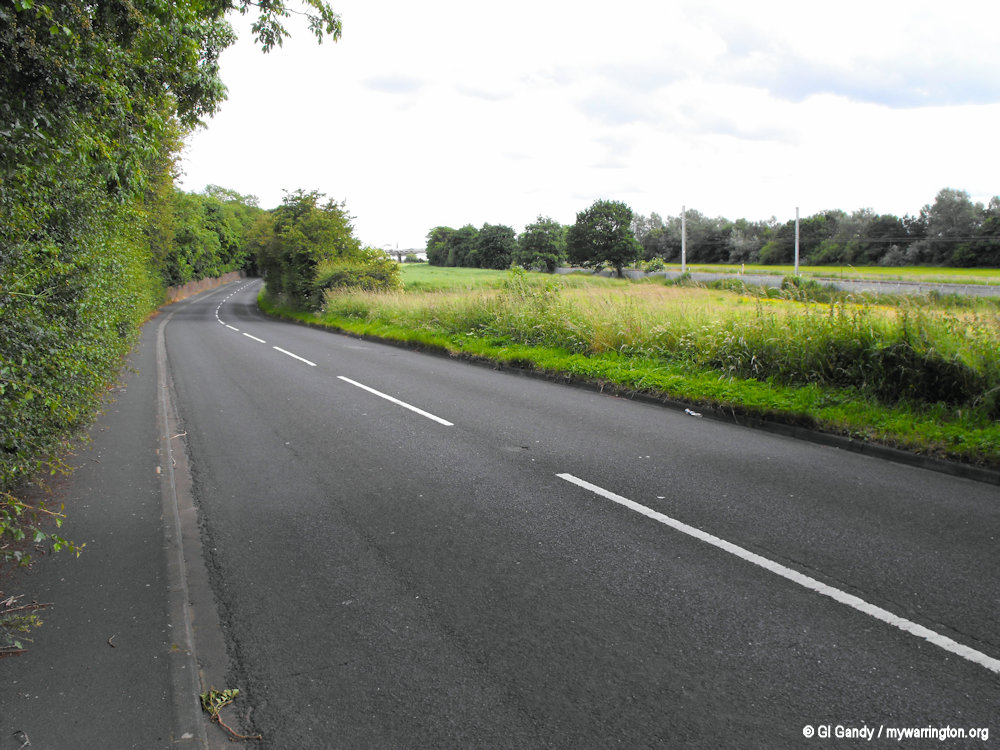
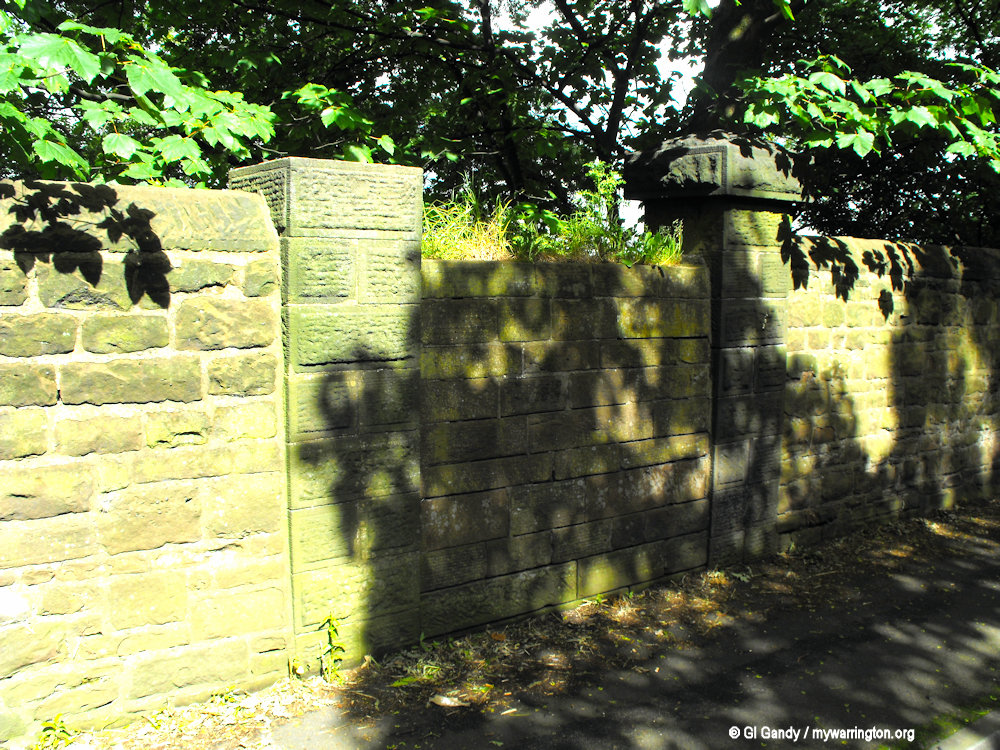
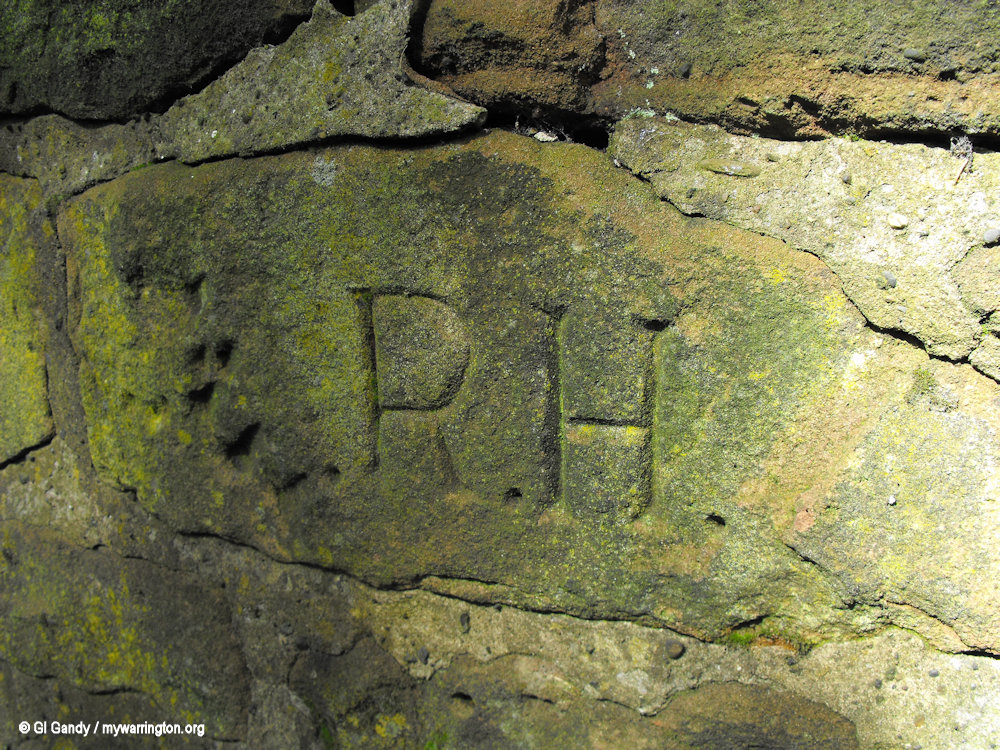
Sankey Canal
The Sankey Canal (also known as the St Helens Canal and Sankey Brook Navigation) open its first section in 1757, four years before the Bridgewater Canal on the opposite side of the town. The Sankey Canal closed to boats in 1963 and has now been filled in around the Winwick Quay area, but a noticeboard gives some of its history. The Sankey Brook itself flows a few hundred metres to the west.
Old Winwick Quay was once a hive of activity with boats, bridges and lock gates all being repaired here. Developed in the 1840s, the maintenance yard was vital to the efficiency of the canal industry, ensuring coal and other dry goods were delivered to market on time. The dry dock is still in place. Today the area forms part of the 15-mile long Sankey Valley Park from St Helens to Widnes, the original route of the canal.
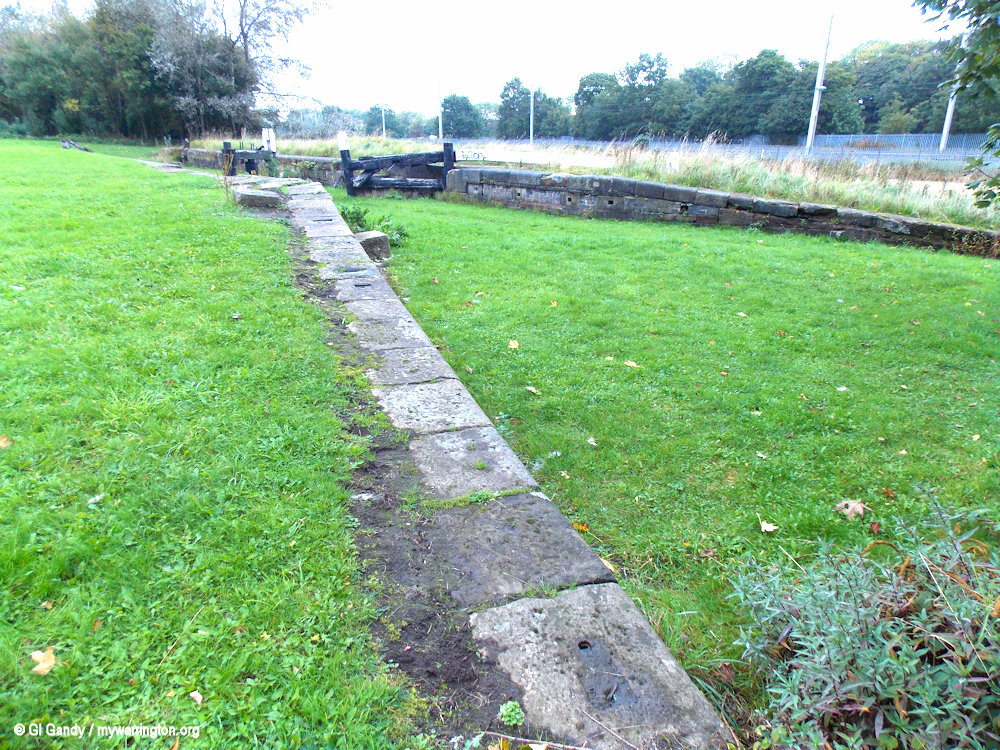
The filled-in section of the Sankey Canal north of the M62 motorway.
See On the Waterfront and Warrington Green for more on the canal.
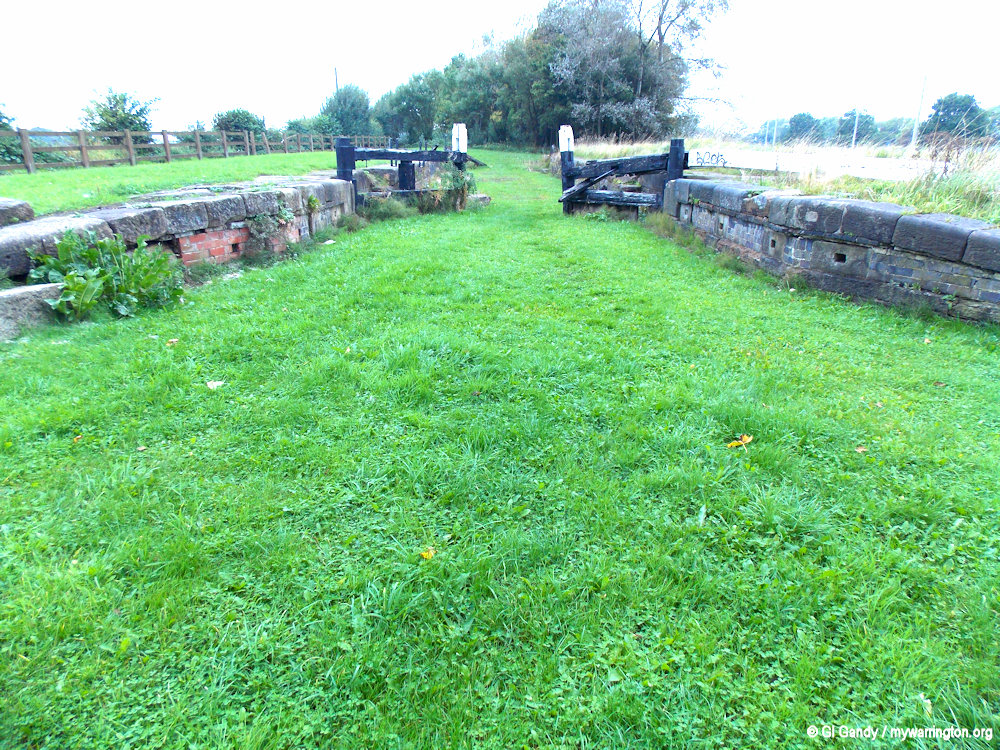
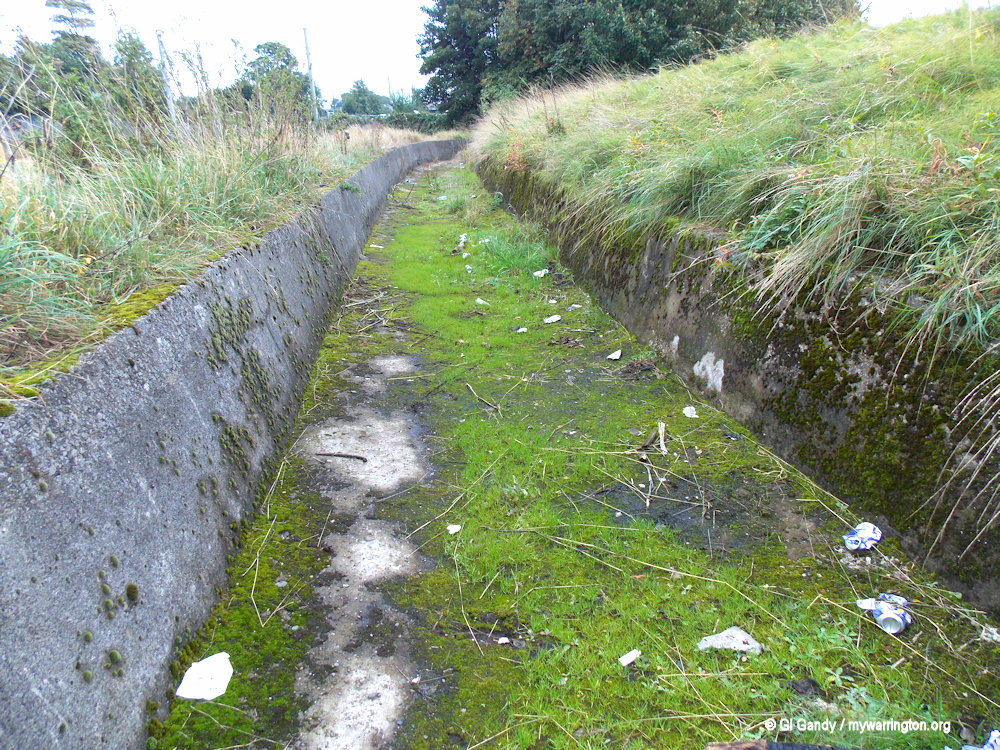
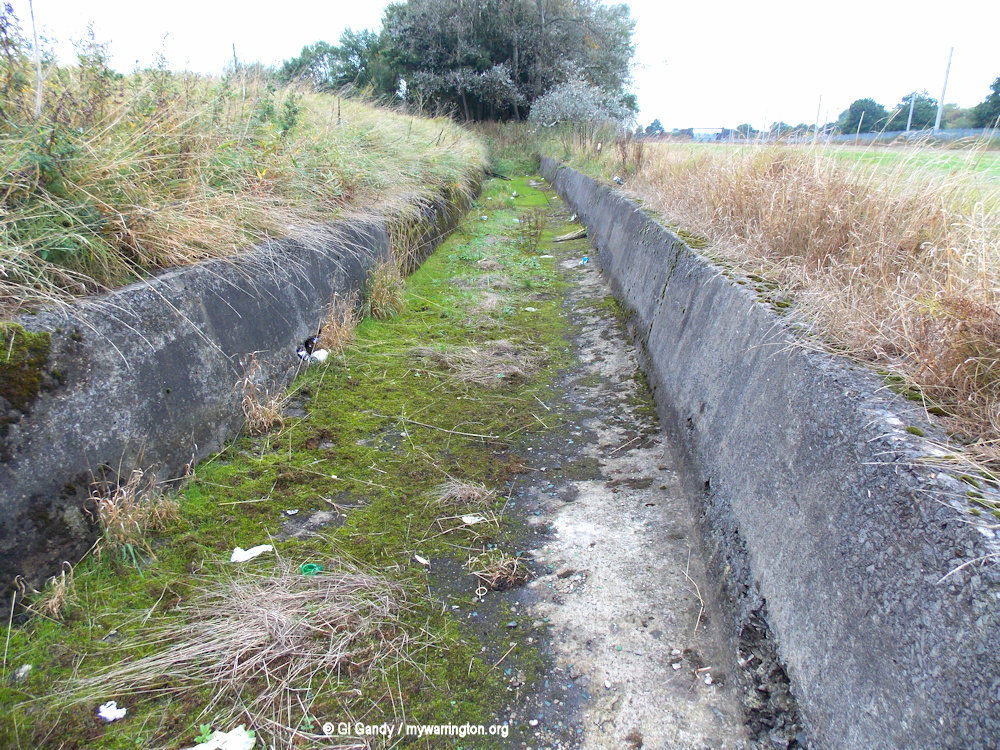
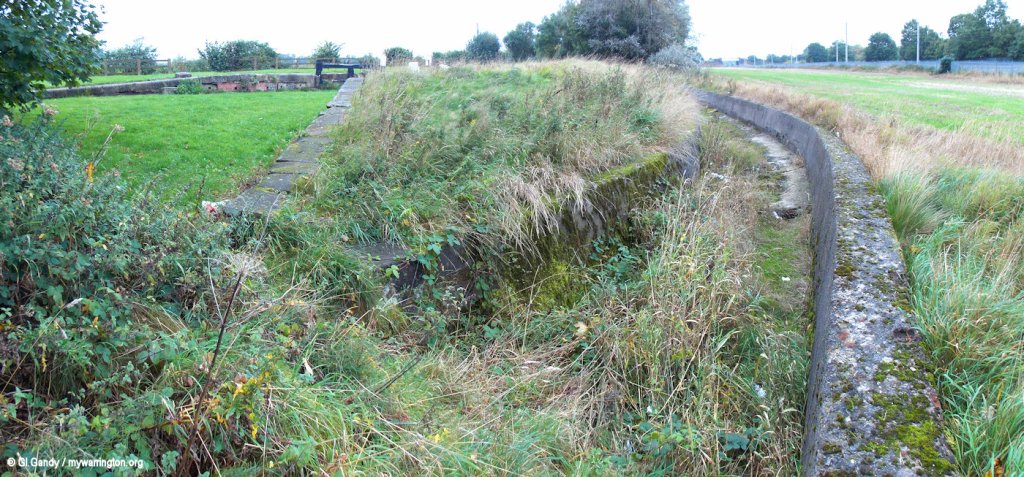
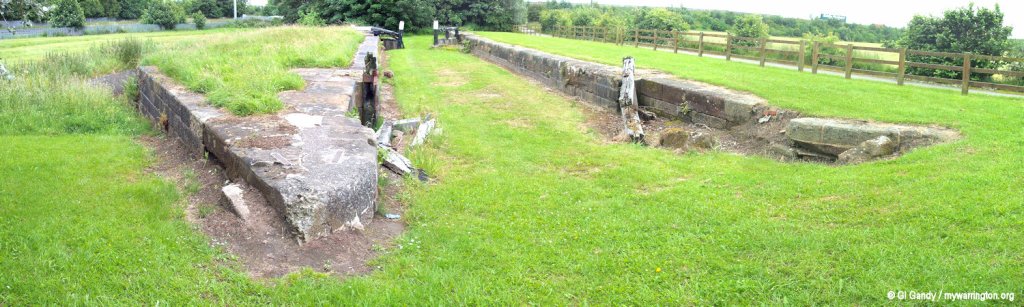
The photos here show the filled-in section of the Sankey Canal north of the M62 motorway. The overflow channels came into their own when the canal was flooded. Photos taken 4 October 2013.
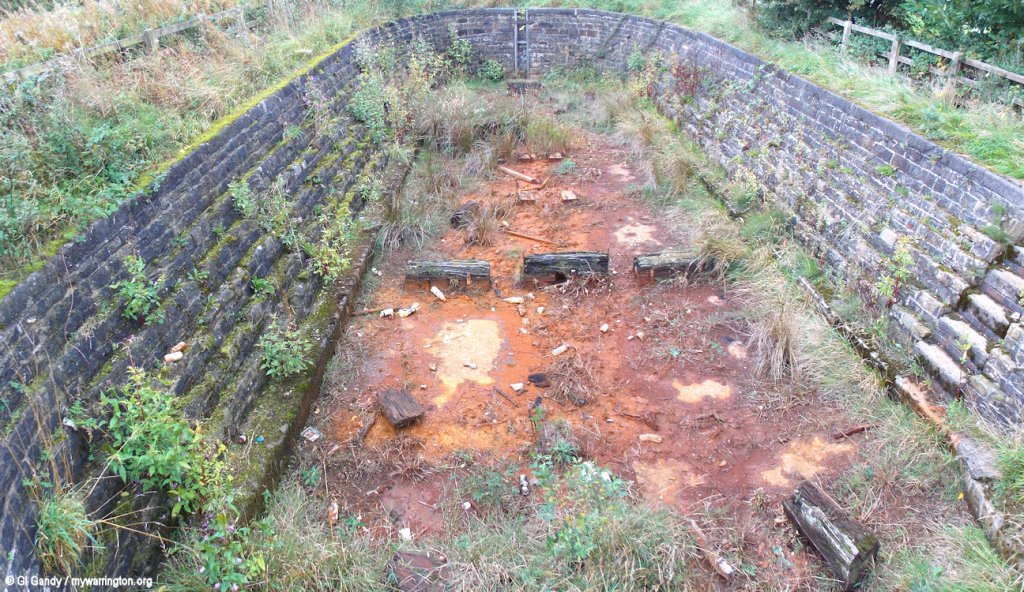
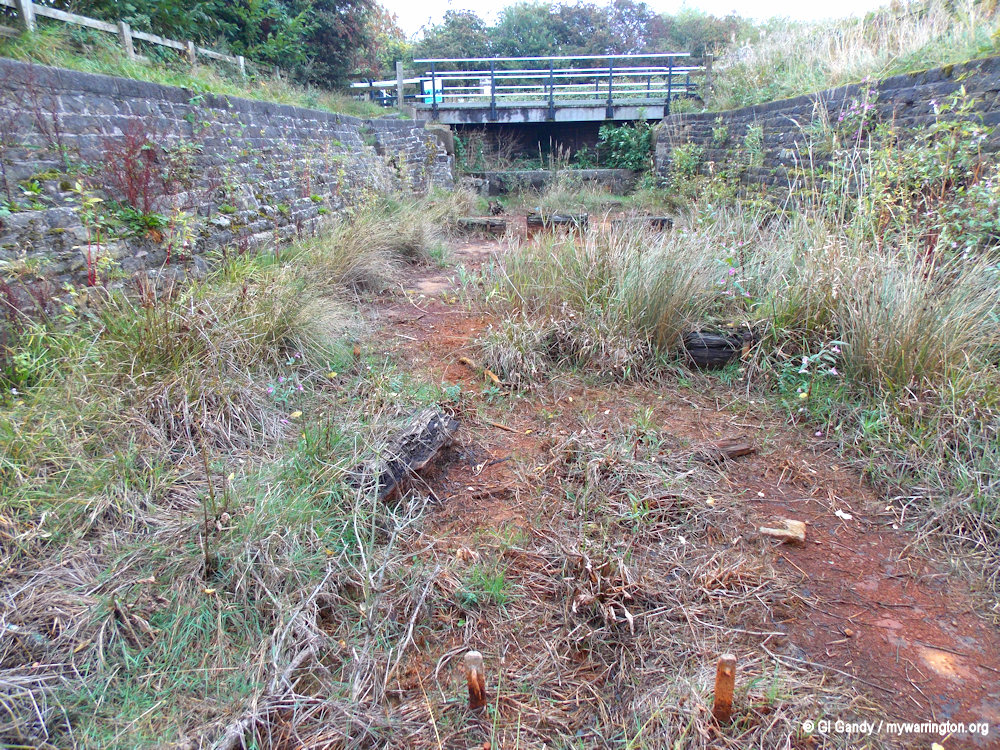
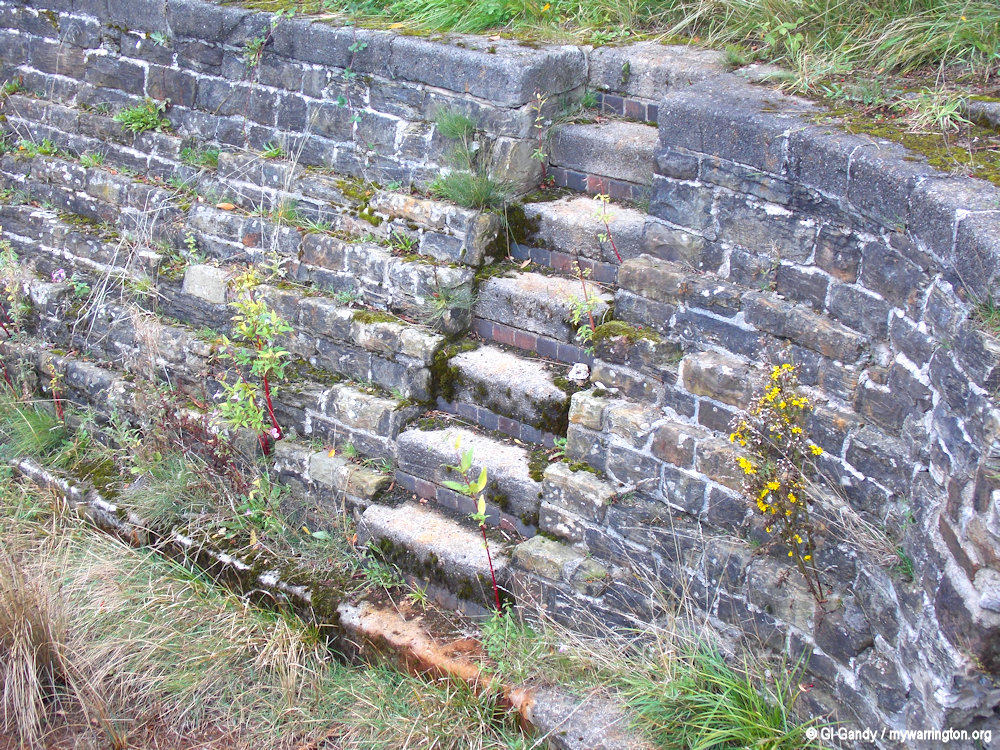
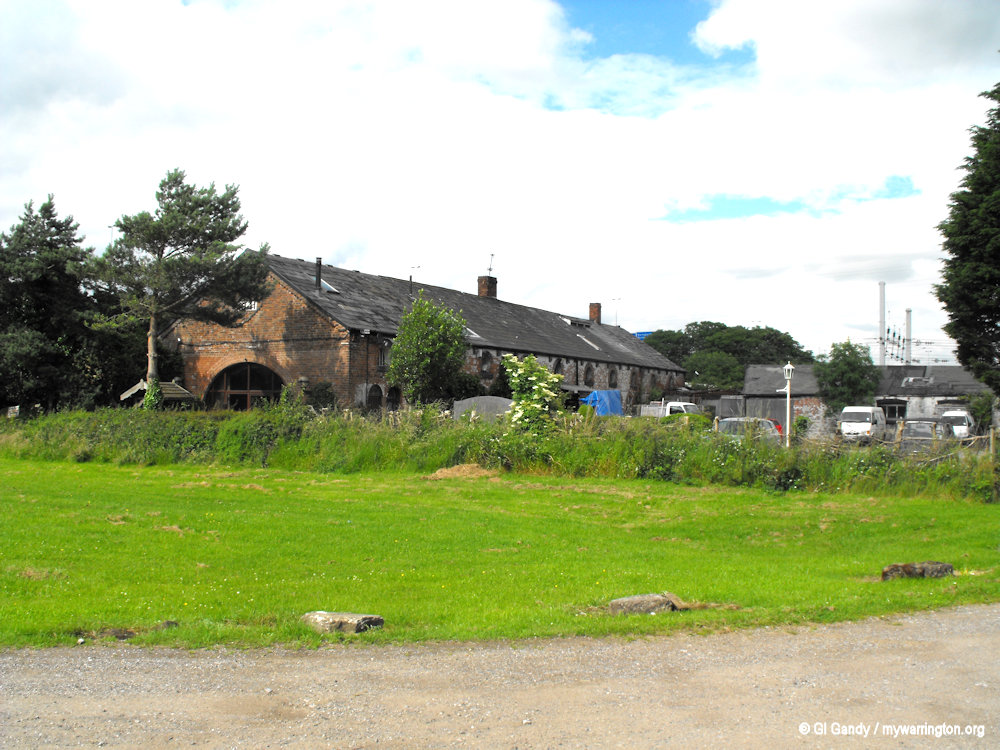
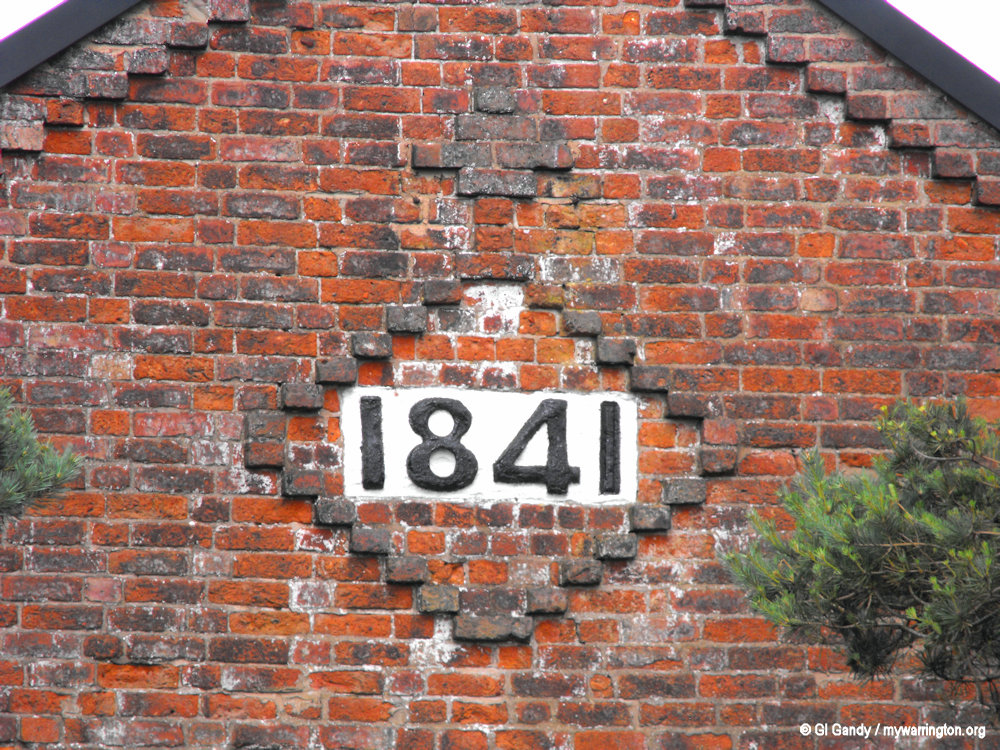
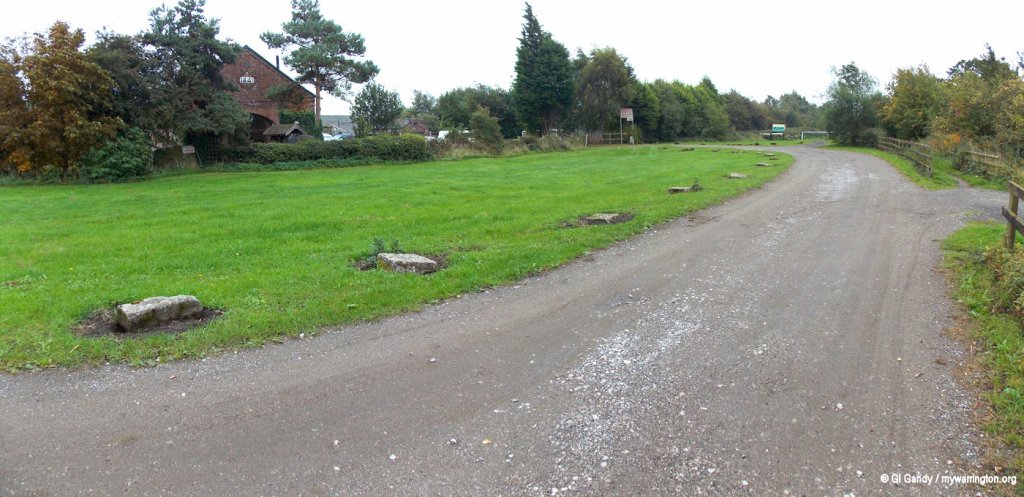
Photos of the dry dock, maintenance yard and building and the filled in section of the Sankey Canal south of the M62 motorway.
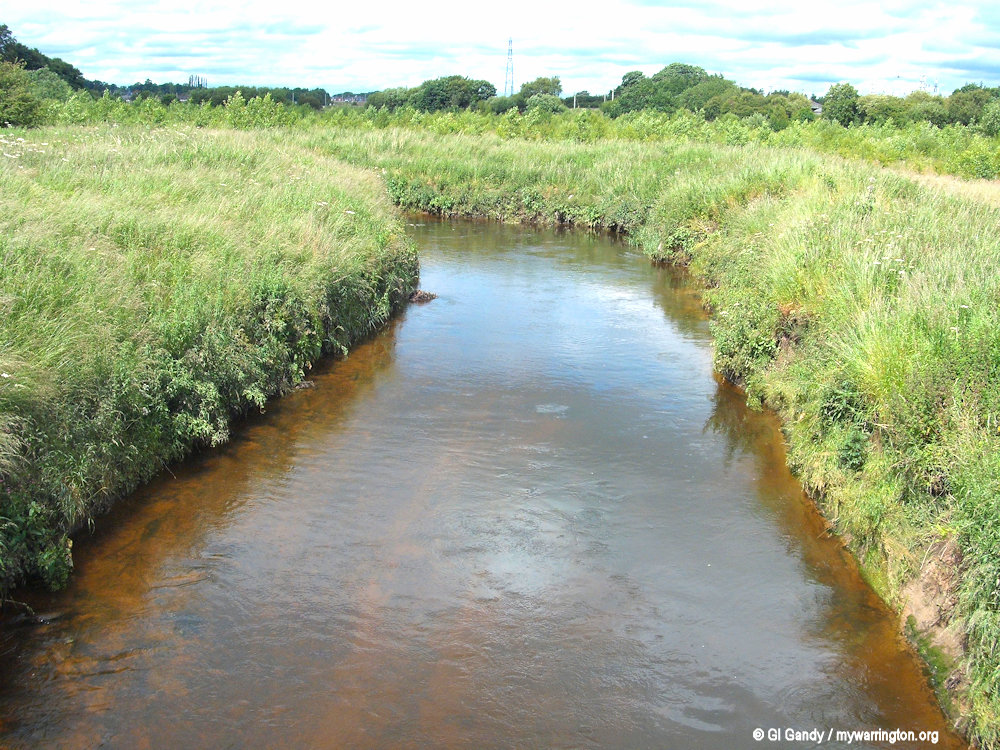
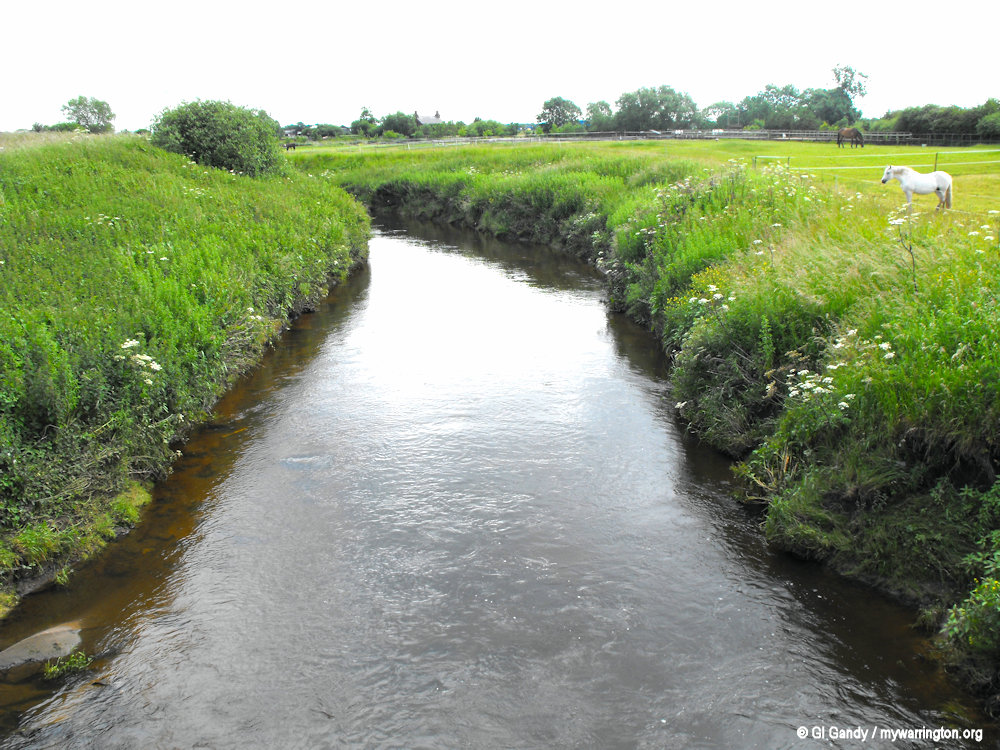
The Sankey Brook. The original plan was to make this waterway wider and deeper, but the separate channel that became the Sankey Canal was dug instead a few hundred metres to the east.
“The Battle of Winwick Quay”
In 1979, the Conservative Party led by Margaret Thatcher would win a majority in Parliament, and subsequently began to enact a series of laws restricting trade union rights in the UK.
In the 1980s, the owner of the Warrington Messenger newspaper group, Eddie Shah, was in dispute with the printworkers union, the National Graphical Association (NGA), now part of the Graphical, Paper and Media Union. The Warrington Messenger Group published several local newspapers. The primary titles at the time included the Warrington Messenger and the Stockport Messenger.
On 4 July 1983, six Stockport Messenger workers walked off the job in protest against Shah’s management. The outcry among the workers that followed afforded Shah the chance to break the closed shop arrangement of the Warrington Messenger Group, where all workers had to be a member of the union, in this case the NGA.
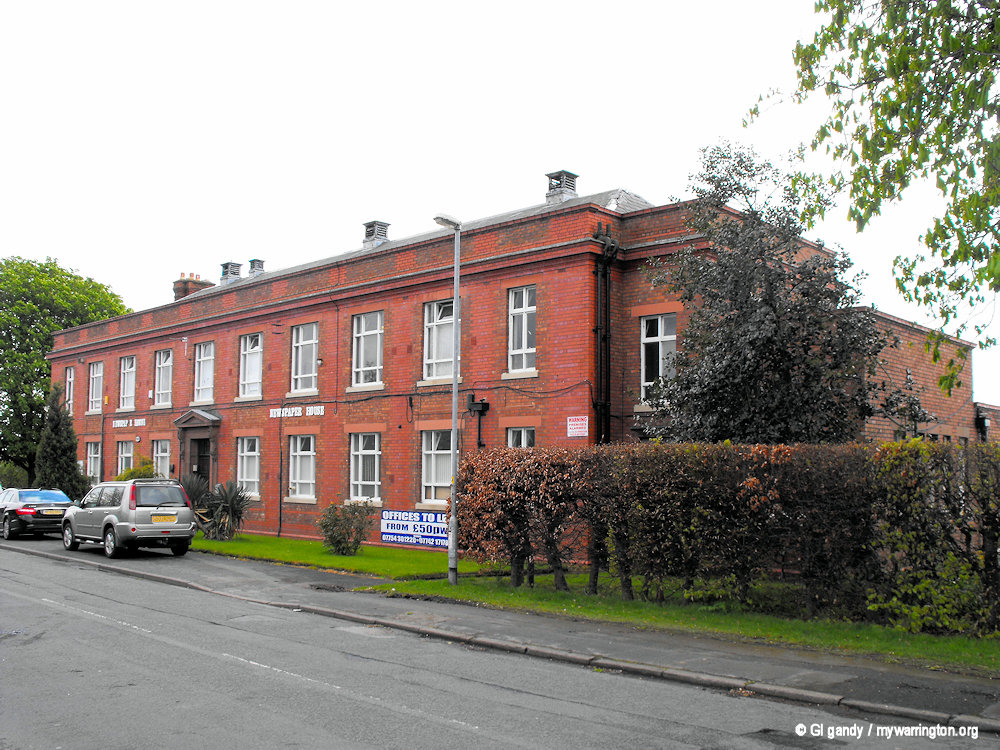
Newspaper House on Tannery Lane, Penketh is where newspaper proprietor Eddy Shah had his base for his Messenger Group newspaper publications in the 1980s.
On 29 November, a picket line with 4,000 workers was set up in front of the Stockport Messenger’s printing plant at Winwick Quay. In response, 2.000 police officers were mobilised to forcibly break up the picket line.
For seven hours, the police charged the picket line and its attempts to regroup, while also seizing the NGA’s loudspeakers, leading the strikers to throw stones and bricks back at the police. This clash would come to be known as the “Battle of Winwick Quay.”
Over 70 strikers were arrested by the police, and at least 34 injured. The police stated that 22 police offers had been injured. The picket line ultimately failed to prevent the 30 November edition of the Stockport Messenger from being printed and distributed. Shah also sued the NGA over the strike. British courts would levy fines worth hundreds of thousands of pounds on the union.
In early December, the NGA announced plans for a national newspaper strike in solidarity with the Warrington Messenger Group strikers. The plans were then lent support by the economic committee of the Trades Union Congress (TUC). However, after TUC general secretary Len Murray criticised the committee’s backing, the NGA temporarily suspended the plans until the TUC general council could hold a vote on them. On 14 December, the general council of the Trades Union Congress voted 29 to 21 against holding the national strike.
British Prime Minister Margaret Thatcher stated in the House of Commons that “employees at the Warrington Messenger Group have exercised their right by ballot to reject a closed shop” and that “this dispute is about the NGA attempting to intimidate them to make them, nevertheless, join a closed shop.” Minister of State for the Arts, Grey Gowrie, condemned the strike as “indiscriminate and damaging” and claimed that the fundamental cause of the strike was “not in fact the future of the six dismissed strikers but the NGA’s rigid insistence on a closed shop.”
According to Paul Mason of the New Statesman, there was “genuine shock among the printers and their working class supporters at the brutality of the police response” and that the Battle of Winwick Quay “has since been recognised by academics as a turning point in UK public order.”
The militarised tactics used by the police in breaking up the strike would go on to be used with success by the British to break up further picket lines in the 1980s, most notably during the 1984–1985 United Kingdom miners’ strike. The 1980s would also see another much larger industrial dispute in the printing industry: the 1986 Wapping dispute, which would fail like the NGA Dispute.
From Wikipedia.
Around the Village
Every year Winwick Carnival takes place on the 3rd Saturday in July on Winwick Park, Myddleton Lane and there is a regular car boot sale, which, believe it or not, is shown on Google Maps as Warrington’s Favourite Car Boot Sale. The village is served by Warrington’s Own Buses (No 19) with Arriva’s 329 service to St Helens via Burtonwood and their 360 service to Wigan passing along Winwick Road and Newton Road.
Winwick Athletic FC
Winwick Athletic FC is a junior football club that has become very well known and highly successful, initially as an FA Charter Standard Development Club from 2006. They won the Lancashire County and North West Regional Awards in 2007, 2009 and 2011, as well as winning the prestigious FA Charter Standard National Club of the Year Award in 2009. In January 2013, Winwick Athletic FC became an FA Charter Standard Community Club, which is the highest level possible for an FA Grassroots Football Club, and in June 2014 they became a Nike Partner Club.
Read more about the club on their website.
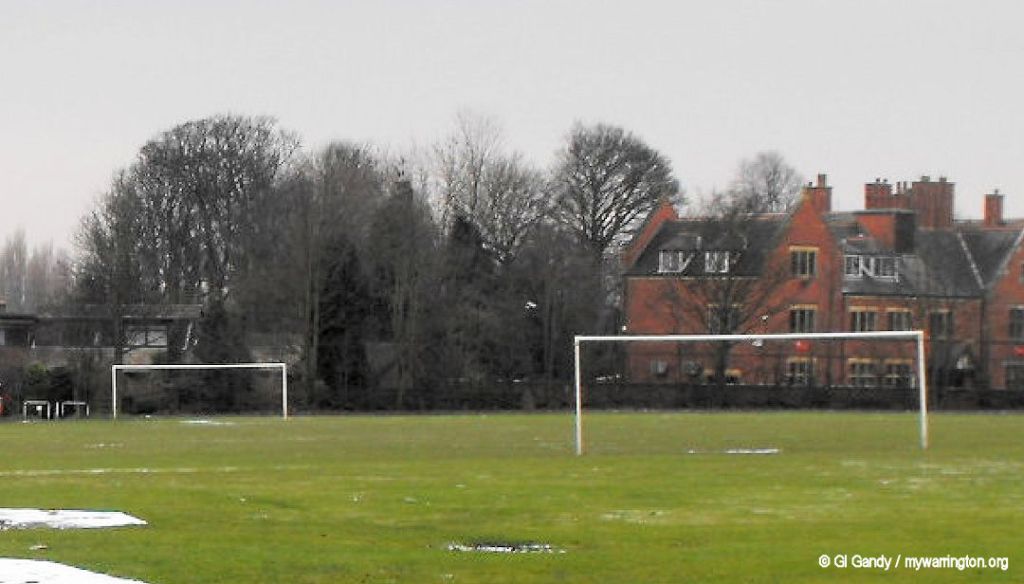
Winwick Park on Myddleton Lane (5 Feb 2009)
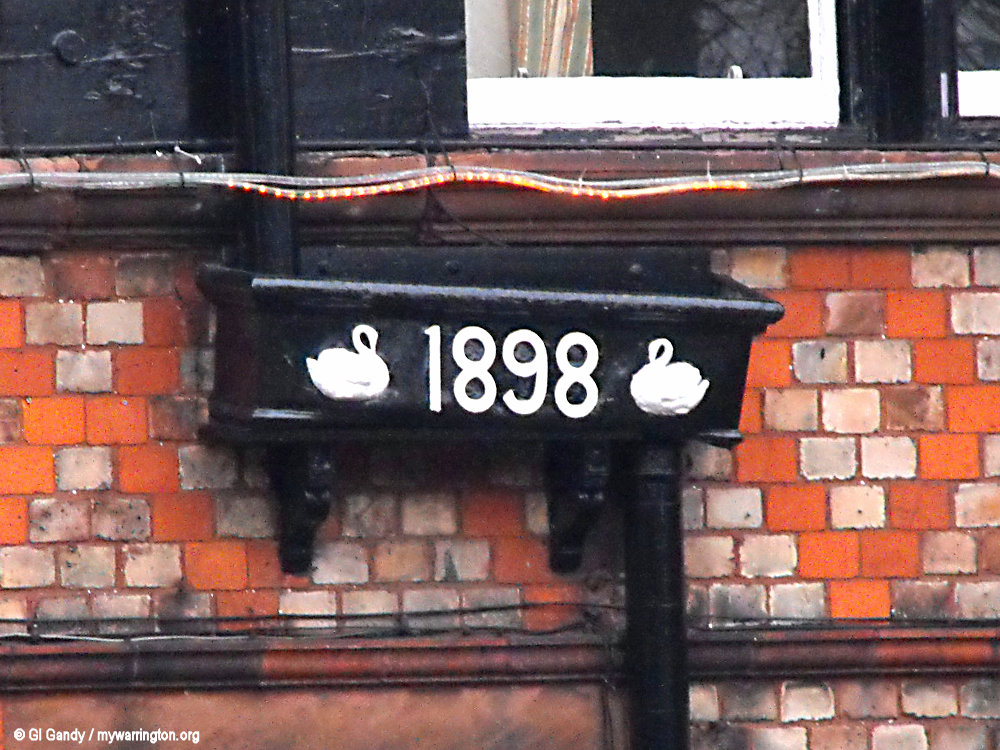
The Swan pub dates back to 1898.
Behind the pub there is a Premier Inn hotel. It opened in the spring of 2008.
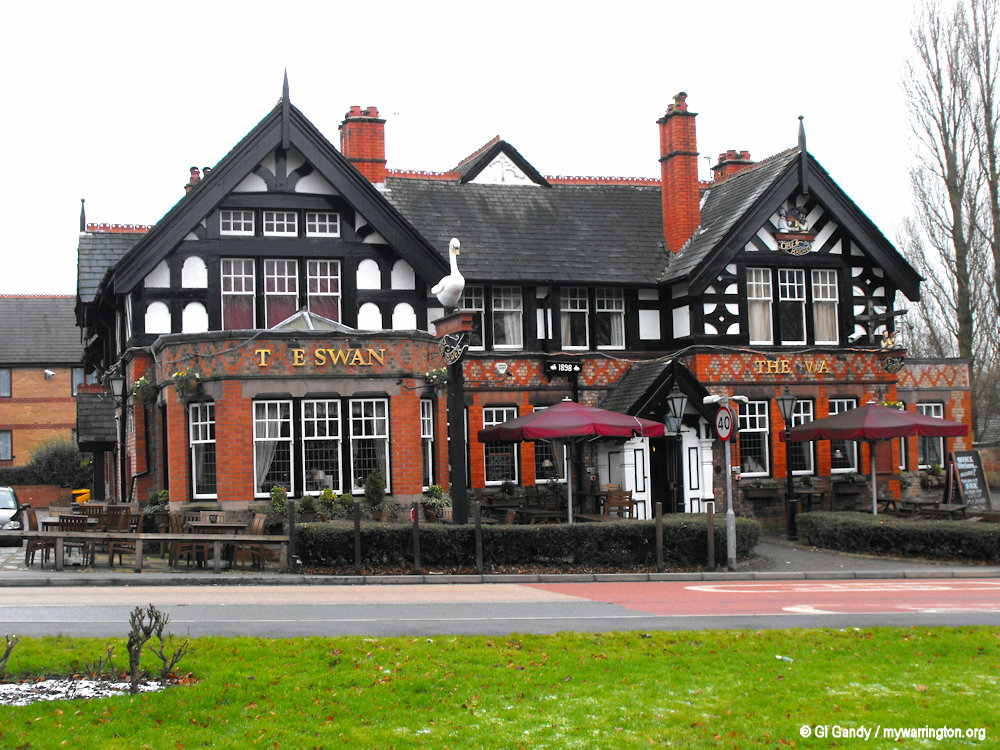
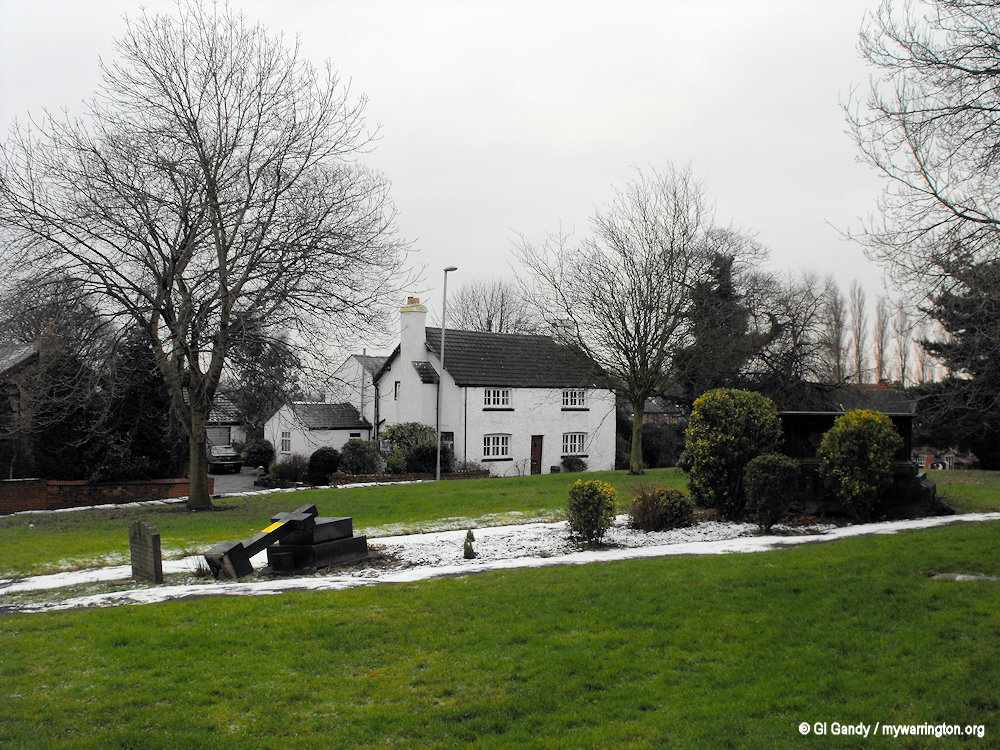
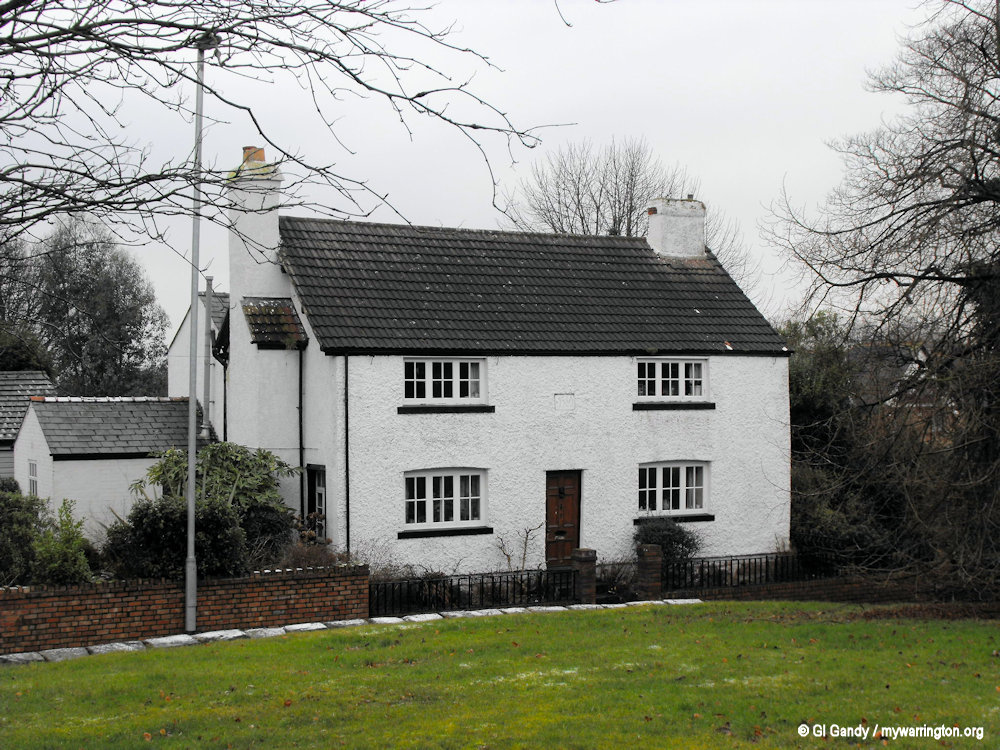
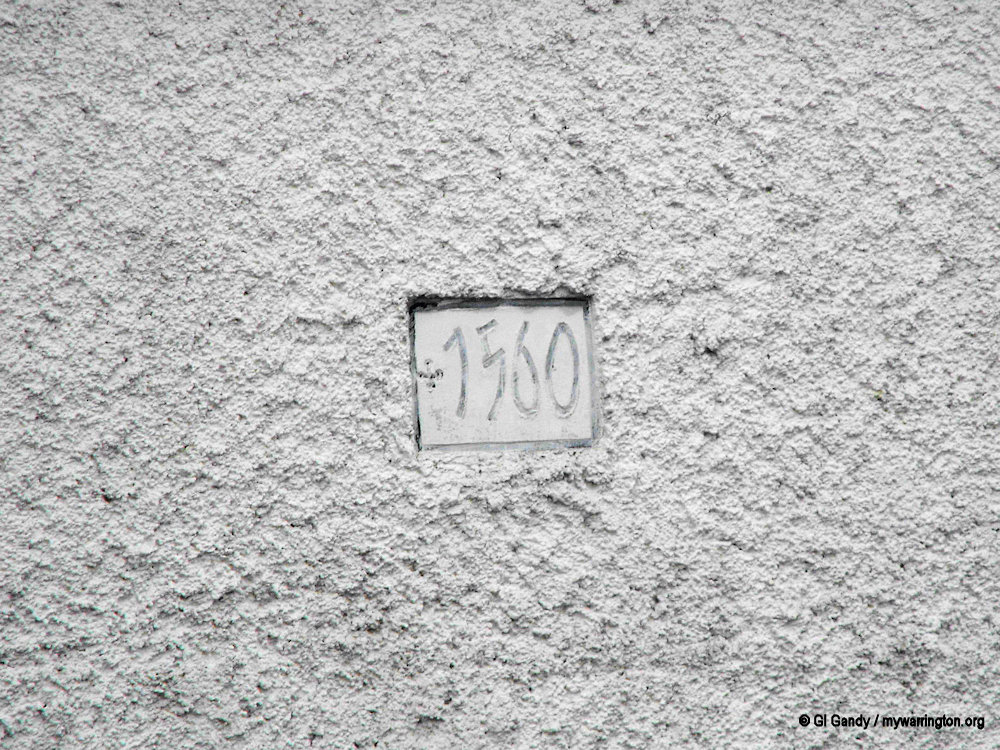
One of the oldest buildings in the village, this house on Golborne Road close to the Swan pub dates back to 1560.
A Final Walkabout
 mywarrington
